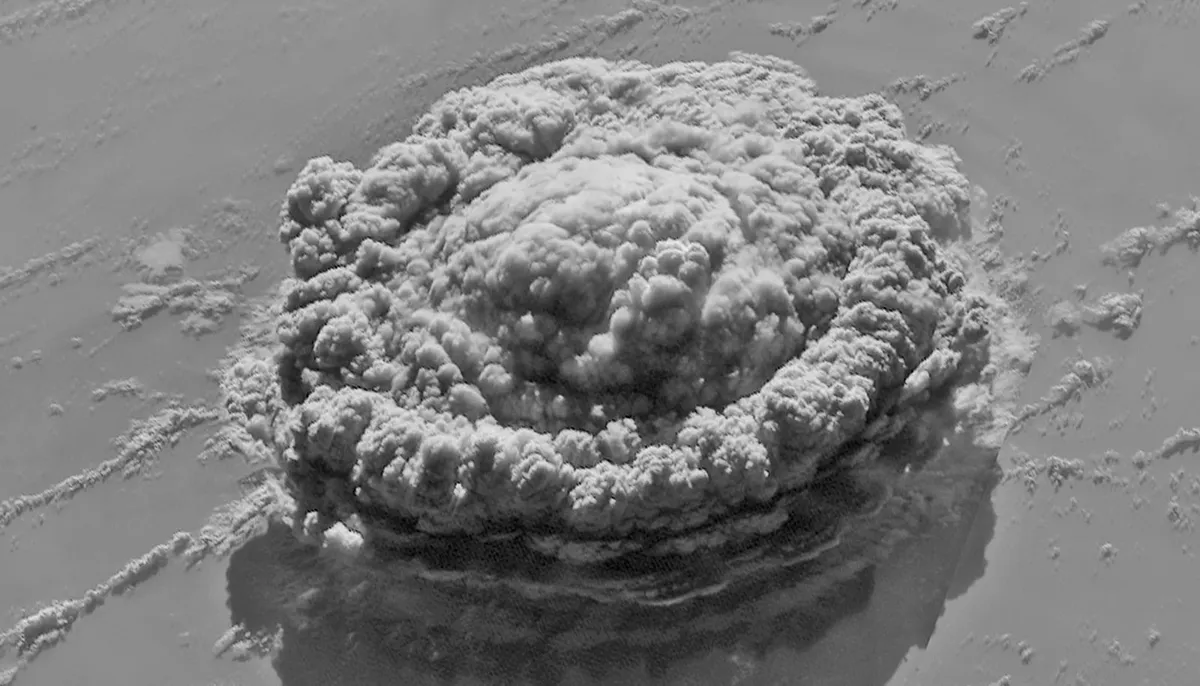
Turns out, even a cataclysmic deep-sea eruption can have a silver lining. Or, at least, a highly reactive chlorine lining. The Hunga Tonga–Hunga Ha’apai volcano, which went off like a cosmic firecracker in January 2022, didn't just unleash one of the most powerful explosions in modern history; it also inadvertently started tidying up the very methane it spewed.
Imagine a volcano with a broom. Because apparently that’s where we are now. This surprising discovery could be a crucial piece of the puzzle in our quest to slow global warming, offering a peek into a natural methane-destroying mechanism previously only seen in a very different part of the world.
The Unexpected Atmospheric After-Party
When the Hunga Tonga–Hunga Ha’apai volcano — a submarine behemoth in the South Pacific — blew its top, it launched a colossal plume of ash, gas, and, crucially, salty seawater high into the stratosphere. Scientists, using advanced satellite measurements, then spotted something completely unexpected in that massive cloud: unusually high levels of formaldehyde.
We're a new kind of news feed.
Regular news is designed to drain you. We're a non-profit built to restore you. Every story we publish is scored for impact, progress, and hope.
Start Your News DetoxNow, formaldehyde isn't exactly famous for its staying power. It usually disappears within hours. But in this volcanic aftermath, it hung around for ten days, tracking all the way to South America. Why does that matter? Because formaldehyde is a fleeting byproduct created when methane breaks down in the atmosphere. Seeing it persist for so long meant one thing: the cloud was constantly, actively destroying methane.
Maarten van Herpen, the lead author of the study, summed up the general vibe: "We were surprised to see a cloud with a record-high concentration of formaldehyde." Understatement of the year, perhaps. While volcanoes are known methane emitters, no one knew their ash could also act as a clean-up crew.
The Sahara's Secret, Now in Space
This isn't the first time researchers have stumbled upon this particular brand of atmospheric alchemy. Back in 2023, they found that dust from the Sahara Desert, mixing with sea salt over the Atlantic, creates tiny particles called iron salt aerosols. When sunlight hits these, it unleashes chlorine atoms that then go to work, breaking down methane.
Professor Matthew Johnson, involved in both discoveries, noted the sheer surprise: "What is new—and completely surprising—is that the same mechanism appears to occur in a volcanic plume high up in the stratosphere." The conditions couldn't be more different, yet the chemistry holds.
The theory is that the 2022 eruption's cocktail of volcanic ash and salty seawater, blasted into the stratosphere, became a perfect factory for highly reactive chlorine once sunlight got involved. That chlorine then went to town on the methane, leaving behind all that tell-tale formaldehyde.
Methane: The Climate's Emergency Brake
Methane is a bit of a climate villain, responsible for a third of global warming and about 80 times more potent than CO2 over a 20-year span. But here's the kicker: it breaks down relatively quickly, usually within a decade. This means cutting methane emissions now could have a noticeable impact on the climate within that same timeframe. It's often called an "emergency brake" on climate change, offering a chance to avoid some immediate climate tipping points.
This volcanic self-cleaning act offers a natural blueprint for engineers. If nature can do it, maybe we can too? The challenge, as always, is proving it works. As senior author Jos de Laat pointed out, "How do you prove that methane has been removed from the atmosphere? How do you know your method works? It’s very difficult."
But the satellite data from the European Space Agency’s Sentinel-5P satellite, specifically its TROPOMI instrument, offers a powerful tool. It means we can actually see methane breakdown happening. Which, if you think about it, is both impressive and slightly terrifying.
The hope is that these findings will inspire new ways to actively reduce methane by speeding up its breakdown. Imagine a future where industrial processes mimic a volcano’s unexpected cleaning spree. Just, you know, with fewer explosions. And definitely no ash clouds raining down on South America. Probably-Not-America. Because that would be less ideal.