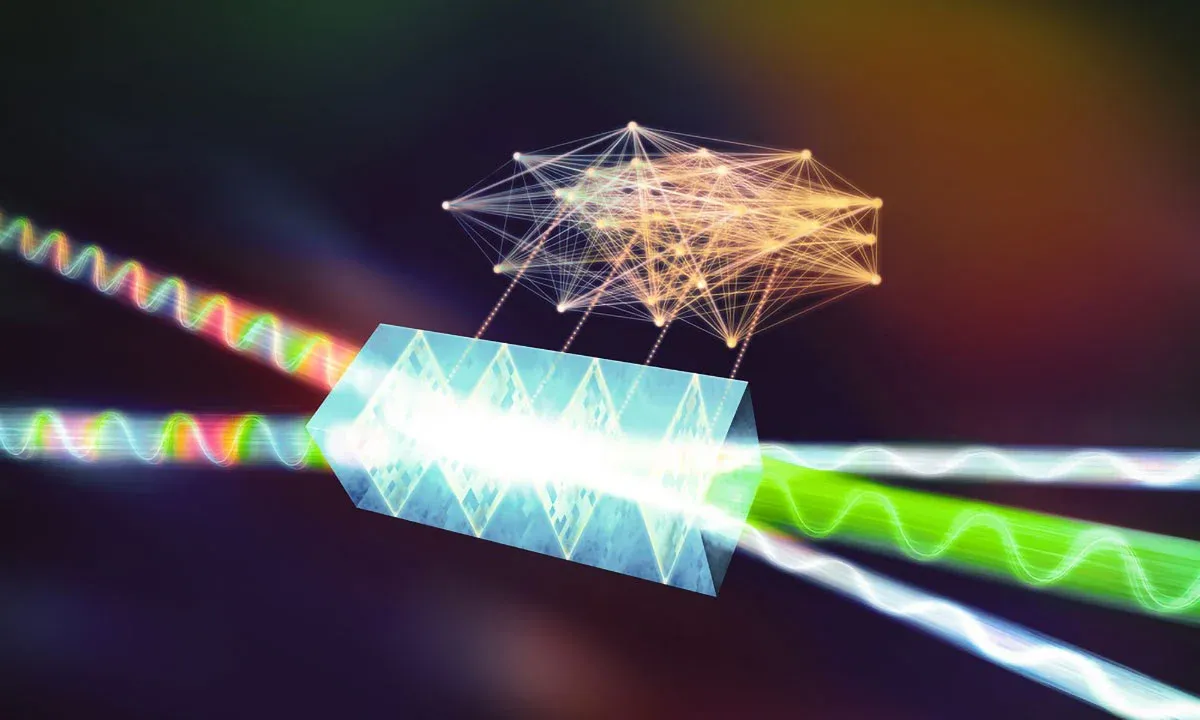
Imagine a super-precise laser system, the kind that helps create powerful X-rays for cutting-edge experiments. Now imagine the painstaking simulations needed to understand exactly how those ultrafast laser pulses behave. For decades, this has been like watching paint dry, but for supercomputers.
Enter the new deep-learning model from Stanford, UCLA, and SLAC National Accelerator Laboratory. It just took those snail-paced simulations and hit the warp-speed button, making them over 250 times faster. Because apparently, even lasers need a productivity hack.
The Laser Dance
At the heart of this speed boost is something called second-order nonlinear optics, or χ² processes. Think of it as light waves doing a complex energy swap inside special crystals, creating new light frequencies and custom pulse shapes. This isn't just a parlor trick; it's crucial for things like particle accelerators.
We're a new kind of news feed.
Regular news is designed to drain you. We're a non-profit built to restore you. Every story we publish is scored for impact, progress, and hope.
Start Your News DetoxTake SLAC's Linac Coherent Light Source (LCLS-II). There, infrared laser pulses are transformed into green light, then into ultraviolet (UV). That UV pulse then kicks electrons off a surface, which are then accelerated and shaped into powerful X-ray pulses. The timing and shape of that initial UV pulse are everything, dictating the quality of the X-rays used in experiments.
Old-school simulations for this χ² frequency conversion involved solving a notoriously complex equation, constantly switching between time and frequency calculations. It was accurate, yes, but also a massive computational hog, eating up 95% of the total simulation time. Someone needed to step in and tell it to pick up the pace.
AI Steps In (and Speeds Up)
The researchers turned to long short-term memory (LSTM) neural networks — a type of AI that’s good at understanding sequences. They adapted these networks, previously used for light moving through fiber optics, for the more intricate world of χ² processes, where multiple light fields are interacting simultaneously. It’s like teaching a chess master to play three-dimensional chess, but faster.
The real genius move? Keeping all the calculations within a compressed frequency representation. By avoiding those constant, compute-heavy conversions between time and frequency, the model dramatically slashed the processing power needed. The average simulation time plummeted to mere milliseconds, powered by GPUs. Let that satisfying number sink in: hundreds of times faster.
This isn't just about speed; it's about accuracy. The new model precisely recreated both the timing and frequency profiles of the laser pulses, even in gnarly situations with strong phase changes. And when it correctly predicted the main output, the other light fields followed suit, matching traditional simulations almost perfectly.
The ultimate vision? Integrating these lightning-fast AI models directly into live laser systems. This could lead to "digital twins" – virtual copies of the physical system that can help with real-time adjustments and diagnostics. Because if there's one thing better than a super-powerful laser, it's a super-powerful laser that can think for itself.