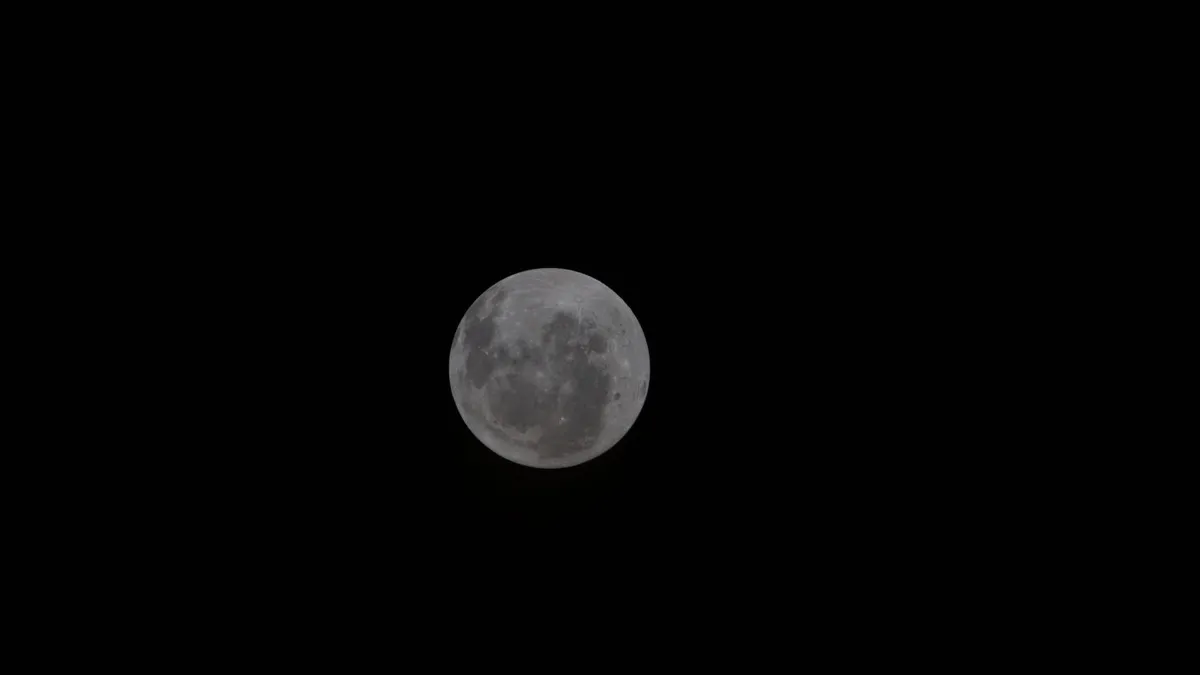
For the first time in over half a century, human eyes are looking at the far side of the Moon. And what they’re seeing is making scientists back on Earth pretty excited.
NASA’s Artemis II mission, carrying four astronauts, recently performed a lunar flyby, circling our celestial neighbor and setting a new distance record for human spaceflight, surpassing Apollo 13's 248,655 miles. During this seven-hour cosmic ballet, the crew got a front-row seat to a solar eclipse from the Moon's far side. Because apparently, that's where we are now.
Why Human Eyes Are Still the Best
You might think, with all our fancy satellites like the Lunar Reconnaissance Orbiter, we’d have every lunar angle covered. But according to Kelsey Young, the Artemis II lunar science lead, there's just no substitute for a trained human brain behind the eyeballs. These real-time observations aren't just for science; they're meant to inspire the next generation of explorers and, as Young puts it, "bring the moon closer to everyone and unite us."
We're a new kind of news feed.
Regular news is designed to drain you. We're a non-profit built to restore you. Every story we publish is scored for impact, progress, and hope.
Start Your News DetoxOn Monday morning, NASA astronauts Reid Wiseman, Victor Glover, Christina Koch, and Canadian Space Agency astronaut Jeremy Hansen woke up a mere 18,830 miles from the Moon. Which, if you think about it, is both impressive and slightly terrifying.
One of the main goals? Spotting subtle color changes on the Moon's surface. A human eye, especially one connected to a brain that knows what it’s looking for, can pick up nuances that even the most sophisticated cameras might miss. Young offered a sandbox analogy: shine a light straight down, you see colors; shine it from the side, you see texture. The spacecraft's movement allows astronauts to view the same locations from wildly different sunlight angles, revealing secrets satellites just can't catch.
The crew will even fly over the old Apollo 12 and 14 landing sites, getting a sneak peek at the lunar south pole – the planned landing spot for humans as early as 2028. Talk about a reconnaissance mission.
Live Commentary from Space
NASA scientists have identified about 35 geological features for the crew to scrutinize. During the flyby, the astronauts were giving real-time descriptions a few times an hour. Yes, you could listen in on a livestream. Imagine the podcast potential.
Commander Wiseman noted he could see far more topography around the Moon's Tycho Crater than any computer model ever showed. Young explained this as a "3D effect," where proximity helps them understand how topography, texture, shape, color, and reflectivity all play together. Wiseman described the view of features like Tycho, Copernicus, and Reiner Gamma as "absolutely unbelievable" and "incredible." Mission Control’s deadpan response? "Copy, moon joy." Some things never change.
While Apollo 13 got much closer, and other Apollo missions actually landed, Orion's closest approach was 4,070 miles from the surface. This distance, Young says, is actually a scientific advantage. It gives the crew a holistic view of the entire Moon with varying light, a scale that the Apollo missions, focused on specific landing sites, didn't quite achieve.
And yes, for the photography purists, the spacecraft is still packed with two Nikon D5s and one Nikon Z9. Thousands of photos are expected to be downloaded after the flyby, ready for public release. Because even with the best human eyes in the business, you still need the receipts.