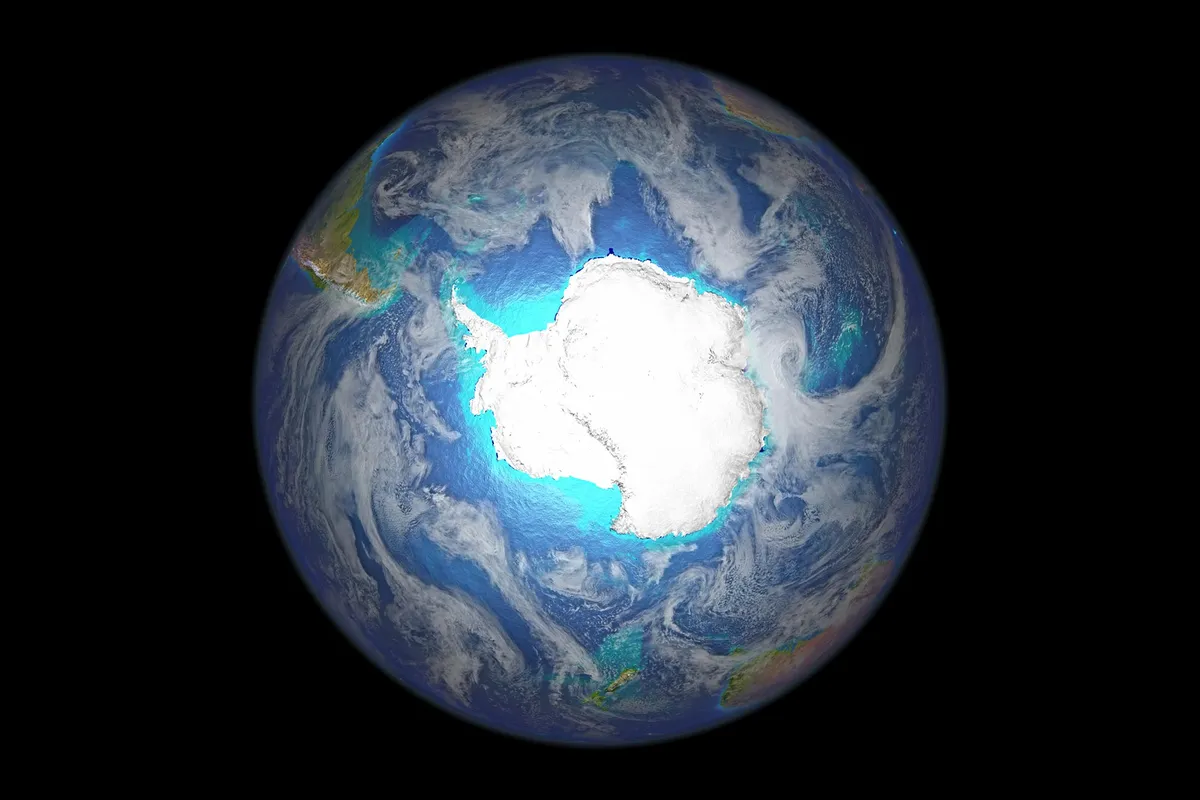
Gravity isn't uniform across Earth. It dips and rises depending on what's buried beneath the surface, and one of the planet's most dramatic low points sits directly under Antarctica.
For years, scientists knew the "gravity hole" was there—satellite measurements made it clear. But what caused it remained a puzzle. New research published in Scientific Reports finally traces the answer: extremely slow movements of rock deep within the planet, playing out over tens of millions of years.
How Deep Rocks Shape the Surface
The gravity variations stem from density differences in rock far below Earth's crust. These differences are subtle in absolute terms, but water responds to them. Ocean water naturally shifts toward regions where gravity is slightly stronger, which means in weaker gravity zones, the sea surface sits measurably lower.
We're a new kind of news feed.
Regular news is designed to drain you. We're a non-profit built to restore you. Every story we publish is scored for impact, progress, and hope.
Start Your News DetoxAround Antarctica, this effect is pronounced enough to show up in satellite data—a visible dip in sea level compared to what you'd expect elsewhere on the planet.
Alessandro Forte, a geophysicist at the University of Florida, and his colleague Petar Glišović at the Paris Institute of Earth Physics tackled the problem by essentially doing a CT scan of Earth's interior. Instead of X-rays, they used earthquake waves. "Earthquake waves provide the 'light' that illuminates the interior of the planet," Forte explained. By mapping how seismic waves travel through different rock structures and applying physics-based calculations, they generated a detailed gravity map that matched satellite measurements with striking accuracy.
Then came the harder part: rewinding 70 million years of rock movement.
Using advanced computer simulations, the team reversed the slow flow of rock deep inside Earth, tracing the gravity hole's development back to the age of dinosaurs. What they found was striking. The gravity hole was initially much less pronounced. But between roughly 50 million and 30 million years ago, it intensified significantly—the same period when Antarctica's climate shifted dramatically and widespread glaciation began spreading across the continent.
That timing is too close to be coincidence, which is why Forte's next step matters. He's investigating whether the strengthening gravity low actually influenced the growth of Antarctica's massive ice sheets. The question sounds abstract, but it gets at something fundamental: how does what's happening deep inside the planet shape the climate and geology we see on the surface.
"If we can better understand how Earth's interior shapes gravity and sea levels, we gain insight into factors that may matter for the growth and stability of large ice sheets," Forte said. His team is now building updated models that connect gravity, sea level, and continental elevation changes to test whether the gravity pattern shift played a direct role in the ice sheets' expansion.
The research reveals that Earth's interior isn't static. Over millions of years, slow rock movements reshape the planet's gravity field—and possibly its climate.