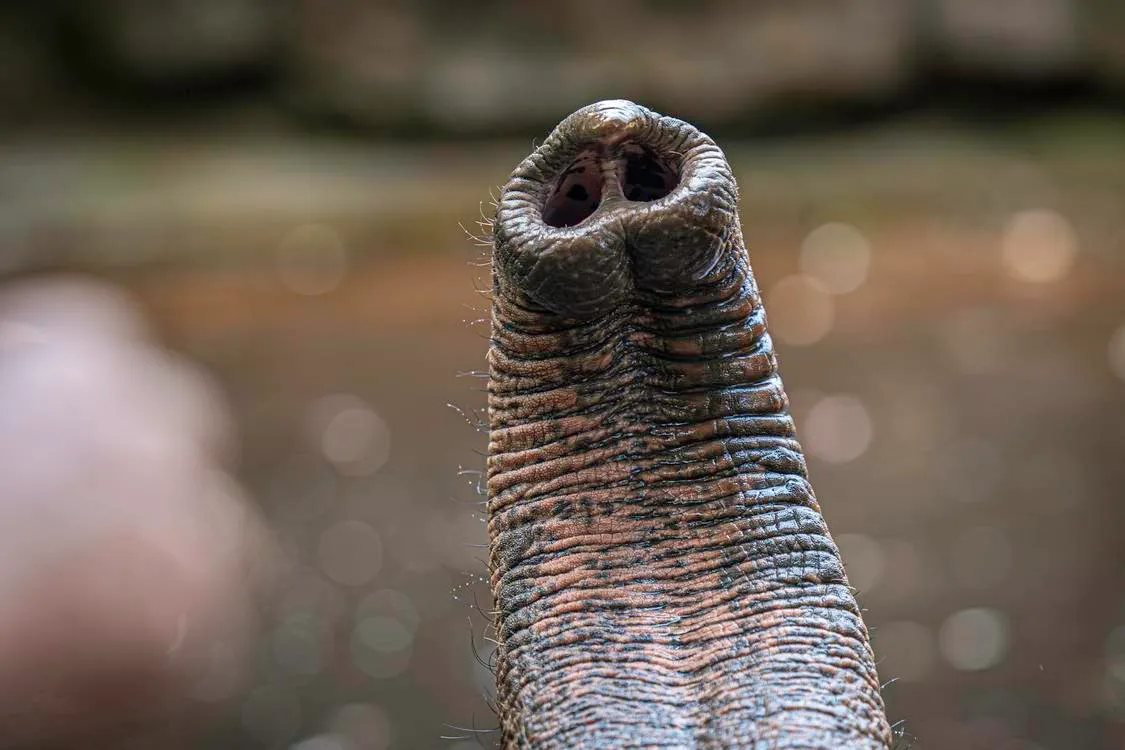
An elephant can pick up a peanut without crushing it. A tortilla chip stays whole. This isn't magic — it's biomechanics, and German researchers have just figured out how.
The 1,000 whiskers covering an elephant's trunk aren't uniform. Each one has a stiff base that gradually softens into a rubber-like tip, a structural gradient that lets the animal pinpoint exactly where something is touching along the whisker's length. Rats and mice have uniformly stiff whiskers. Cats have something similar to elephants. But elephants took it further.
How the whiskers actually work
When researchers used micro-CT scanning to examine elephant trunk whiskers, they found architecture that looks almost engineered. The whiskers are blade-like, flattened, with hollow bases and long internal channels — similar to sheep horns and horse hooves. This porous structure keeps them light enough for an animal eating hundreds of kilos of food daily without wearing them down, while still providing impact resistance.
We're a new kind of news feed.
Regular news is designed to drain you. We're a non-profit built to restore you. Every story we publish is scored for impact, progress, and hope.
Start Your News DetoxThe real innovation is that stiffness gradient. A soft tip flexes easily when it touches something, while the stiff base transmits that flex back to the elephant's nervous system. The difference in how much each part bends tells the brain exactly where contact happened — without needing to see it.
To understand this intuitively, the research team 3D printed a scaled-up whisker prototype with a stiff dark base and soft transparent tip. When Professor Katherine Kuchenbecker held it and touched it to objects, she didn't need to look. "I could just feel it," she said. Computational modeling later confirmed what her hands already knew: the gradient makes spatial awareness automatic, baked into the geometry itself.
This isn't just interesting elephant trivia. Engineers are already watching. The research team is now developing bio-inspired sensors and intelligent systems based on these whisker properties. Dr. Andrew Schulz calls it "embodied intelligence" — when an organism's physical structure does the sensing work before any neural processing happens. An elephant's trunk whisker doesn't need a brain to tell it where contact occurs. The whisker's shape does that job.
Nature spent millions of years solving the problem of precise touch in a working tool. Now humans are paying attention to the solution.