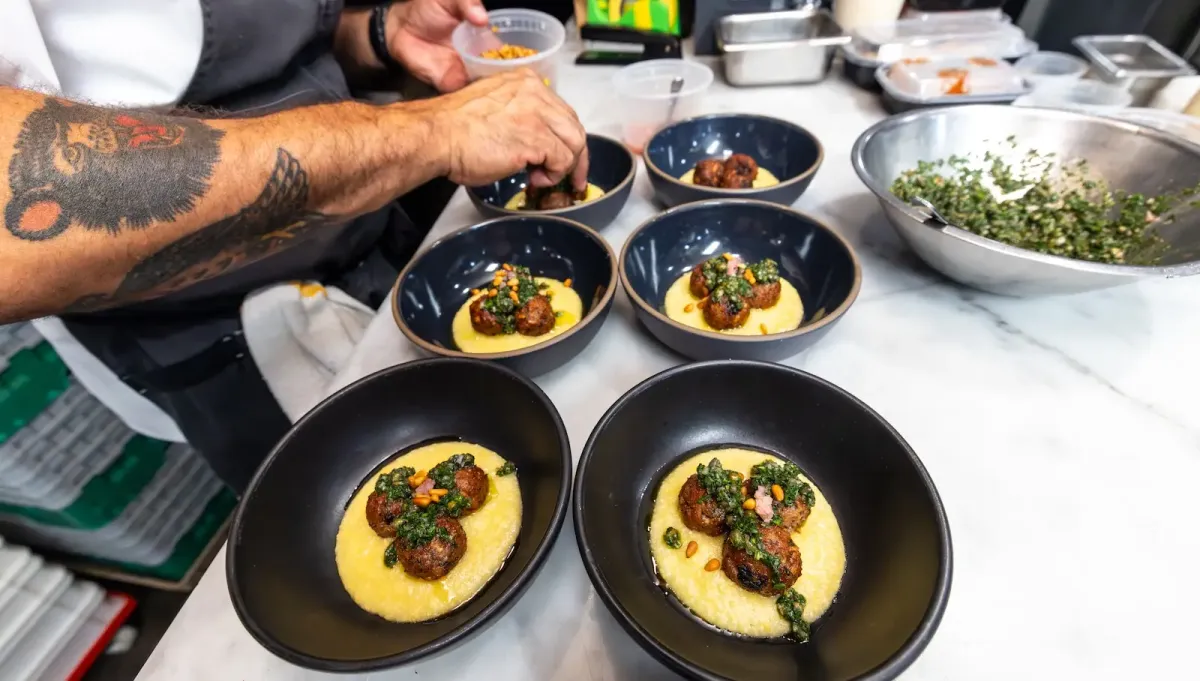
Dawn is a pig living comfortably at a sanctuary in upstate New York. She'll never go to slaughter. Instead, she donated a small sample of fat tissue, which a company called Mission Barns is now growing in bioreactors — essentially fermentation tanks — blending it with plant ingredients to create pork products that taste remarkably like conventional meat.
Dawn's contribution represents something quietly significant: the moment when real animal protein stops requiring actual animals at industrial scale.
The math that broke meat
Conventional livestock farming is phenomenally inefficient. It takes roughly 9 calories of feed to produce 1 calorie of chicken meat. For pork, it's 10 or more. For beef, significantly worse. That cascading waste — what researchers call 800 percent food waste — ripples outward: deforestation to clear grazing land, water depletion, methane emissions, pollution from manure runoff. The UN's 2006 livestock assessment found animal agriculture responsible for more deforestation than any other industry, and the problem has only worsened since.
We're a new kind of news feed.
Regular news is designed to drain you. We're a non-profit built to restore you. Every story we publish is scored for impact, progress, and hope.
Start Your News DetoxToday, roughly 20 percent of global climate emissions come from raising animals for food. And demand keeps climbing. Meat production has jumped 65 percent over the last 25 years, with projections suggesting another 65 percent increase by 2050. More people eating more meat, using more land, generating more emissions — unless something changes.
What's changing is the technology. Mission Barns isn't alone. Impossible Foods and Eat Just are scaling plant-based alternatives that replicate meat's taste and texture without the animal. Meanwhile, cultivated meat companies are literally growing animal tissue in controlled environments, using a fraction of the land, water, and feed required by conventional farming.
Why countries are paying attention
China, Japan, and Korea are watching closely. These nations have genuine food security concerns — they can't feed themselves entirely from domestic agriculture, and that's a national vulnerability. If they can produce meat with a fraction of the inputs, that's not a lifestyle choice. It's strategic advantage.
Even in the United States, where agricultural tradition runs deep, there's bipartisan interest in alternative proteins. The economic competitiveness angle is hard to ignore. Whoever dominates cellular agriculture will shape the global food system for decades.
There's a profit motive too, which matters. These technologies are more efficient, which means lower production costs. That's not idealism — that's capitalism recognizing where the future margin is.
The processing pushback
One real friction point: plant-based meat companies like Beyond Meat and Impossible Foods have struggled financially as consumers increasingly worry about ultra-processed foods. It's a legitimate concern, though the science here matters. Plant-based meats actually compare favorably to the animal products they replace — less fat, less saturated fat, less cholesterol, more fiber, more protein, lower calorie density. They're not Doritos. They're functionally healthier versions of conventional meat.
The cultivated meat path sidesteps this somewhat. Growing actual animal tissue in a bioreactor requires fewer processing steps and additives than trying to replicate meat's texture entirely from plants.
What's next
The traditional meat industry faces a choice that echoes across industries: become the thing or be replaced by it. Companies that figure out how to produce high-quality protein far more efficiently will be enormously profitable. Nobody wants to be Kodak when they could be Canon.
Dawn, meanwhile, gets to keep living at her sanctuary. Her cells are doing the work instead.