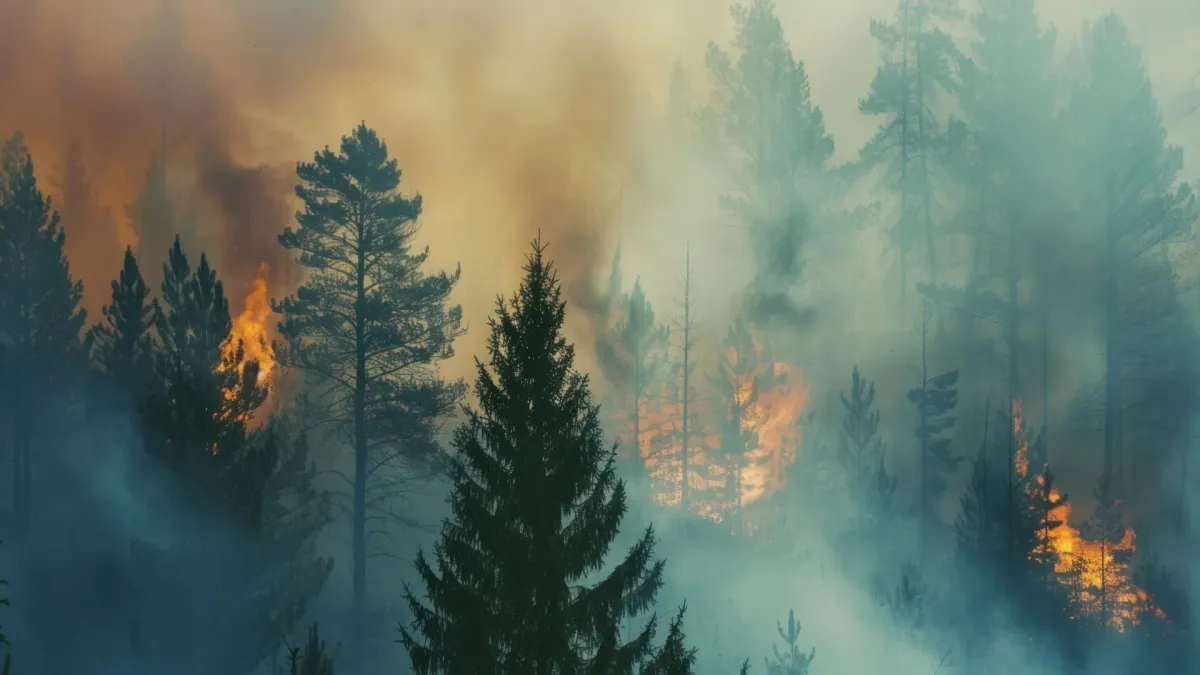
Wildfire smoke is more dangerous than air-quality models have assumed. A new global analysis reveals that when wildfires burn through forests, grasslands, and peatlands, they're releasing about 21% more of certain harmful chemicals than previous estimates accounted for — a gap that's been quietly skewing our understanding of air pollution and health risk across the world.
The overlooked culprits are intermediate- and semi-volatile organic compounds (IVOCs and SVOCs). These chemicals behave differently from the volatile organic compounds (VOCs) that researchers have traditionally measured. While VOCs evaporate readily into the air, IVOCs and SVOCs linger longer in the atmosphere, making them more likely to form fine particles that lodge in your lungs when you breathe. They're harder to detect and measure, so they've largely been missing from wildfire emission inventories — until now.
"Our new estimates increase the organic compound emissions from wildland fires by about 21%," says Lyuyin Huang, lead author of the study. "The inventory provides a foundation for more detailed air-quality modeling, health-risk assessment, and climate-related policy analysis."
We're a new kind of news feed.
Regular news is designed to drain you. We're a non-profit built to restore you. Every story we publish is scored for impact, progress, and hope.
Start Your News DetoxThe research team, led by Shuxiao Wang, examined 26 years of global wildfire data — burned land from 1997 to 2023 — and combined it with laboratory measurements of what different vegetation types release when they burn. When direct field measurements weren't available, they used controlled experiments to estimate the chemical output. The result: an average of 143 million tons of airborne organic compounds released by wildfires each year. That's 21% higher than what earlier models suggested.
Where the risk is concentrated
The real public health story emerges when you look at where these emissions cluster. Equatorial Asia, Northern Hemisphere Africa, and Southeast Asia are hotspots for both wildfire pollution and human-caused air pollution. In these regions, the air quality is shaped by overlapping sources — burning forests and burning fossil fuels, agricultural burning and industrial emissions — all mixing together. This complexity means that reducing air pollution in these places will require strategies that address both wildfires and human activity simultaneously, not one or the other.
Interestingly, human activities still produce more total airborne compounds than wildfires do globally. But when you isolate IVOCs and SVOCs — those particularly harmful semi-volatile compounds — wildfires and human sources are releasing roughly equal amounts. That's a significant finding. It means wildfire smoke isn't just a seasonal inconvenience in fire-prone regions; it's a major contributor to a specific type of air pollution that directly affects breathing and health.
This research shifts the baseline for how we model air quality and assess health impacts in wildfire-affected communities. Better estimates mean better predictions of when and where air will become dangerous, and more accurate guidance for public health warnings. For the millions of people living downwind of wildfire regions — from California to Indonesia to Portugal — that difference could be substantial.