Astronomers using the James Webb Space Telescope have spotted something unexpected: a massive galaxy that has essentially stopped making stars, despite sitting right in the middle of a cosmic gas station.
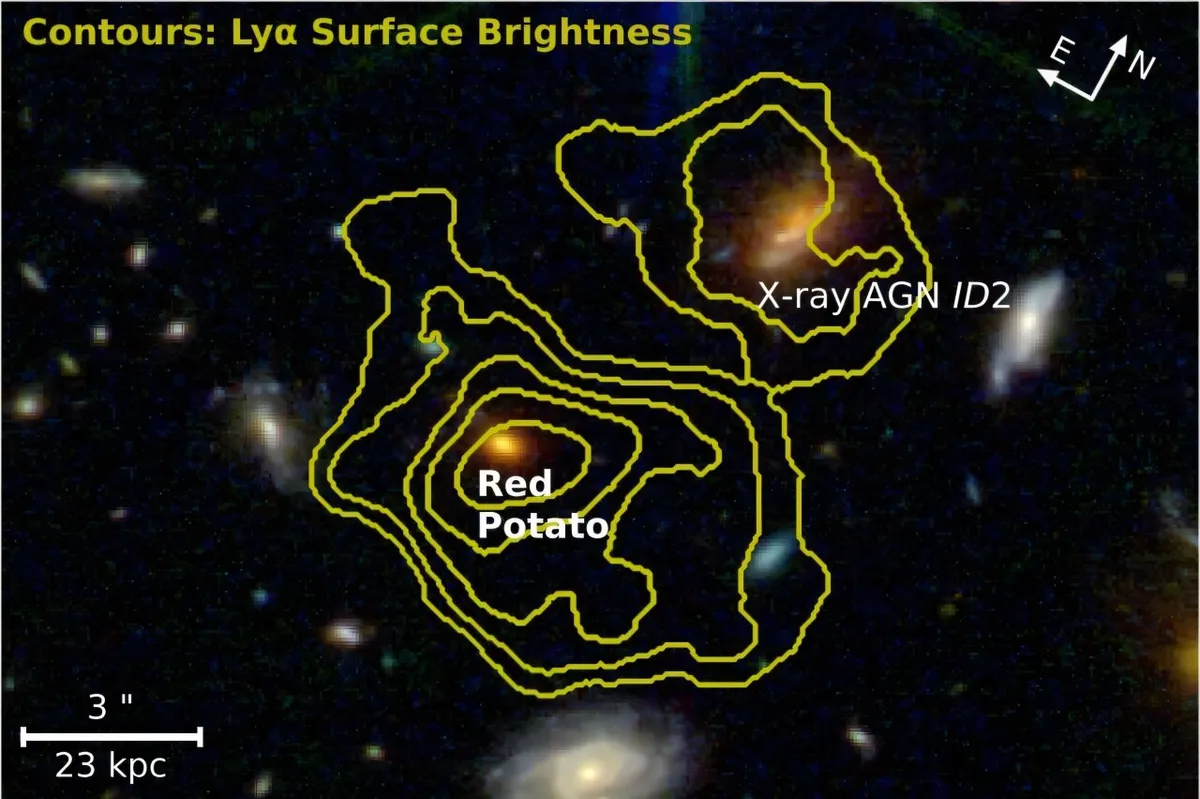
The discovery, made by a team led by Weichen Wang at the University of Milan, caught them off guard. They were investigating a dense node in the cosmic web—a region where galaxies cluster and gas accumulates—when they noticed this peculiar object. Its reddish hue and lumpy shape earned it the nickname "Red Potato."
What makes the Red Potato interesting isn't just its name. This galaxy contains about 110 billion suns' worth of stellar mass, making it genuinely massive. Yet it's producing new stars at a rate far below what astronomers would expect. For context: galaxies its size, in regions this gas-rich, should be churning out stars at a much faster pace. The Red Potato is creating only about four new stars per year—a trickle compared to the torrent its surroundings suggest should be possible.
We're a new kind of news feed.
Regular news is designed to drain you. We're a non-profit built to restore you. Every story we publish is scored for impact, progress, and hope.
Start Your News DetoxThe Cosmic Puzzle
Here's where it gets interesting. The Red Potato sits at the heart of what should be an ideal star-making environment: a region packed with cool, molecular gas. By all conventional logic, this galaxy should be a stellar factory. Instead, something is actively suppressing star formation.
That something appears to be a jet of high-energy particles blasting out from a neighboring active galaxy. The X-ray data reveals this extended jet is creating turbulence in the gas surrounding the Red Potato, essentially stirring up the cosmic medium and making it harder for gas to settle down and collapse into new stars. It's like trying to light a candle in a hurricane—the conditions look right on paper, but the environment itself is working against you.
The Red Potato's internal motion also tells this story. Its stars are moving at unusually high velocities relative to one another (268 kilometers per second), a sign that the galaxy's gas is being jostled and disrupted. Combined with the absence of molecular gas and gas outflows, the picture emerges of a galaxy in stasis: too turbulent to form stars efficiently, too depleted of fuel to sustain rapid growth.
This discovery matters because it challenges our understanding of how massive galaxies evolve. We've long assumed that galaxies in rich environments would grow rapidly. The Red Potato suggests that feedback mechanisms—in this case, jets from neighboring galaxies—can act as cosmic brakes, halting growth even in the most promising circumstances. It's a reminder that the universe's rules are more nuanced than our models sometimes capture, and that sometimes the most revealing discoveries come not from finding what we expect, but from finding what contradicts it.