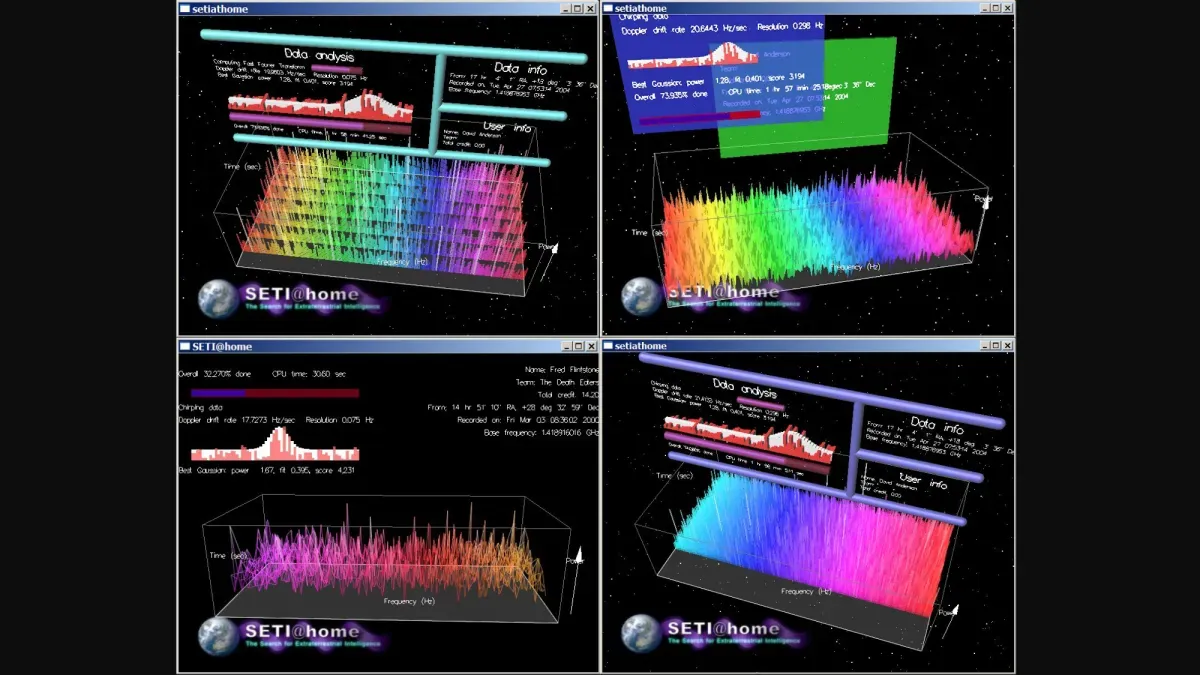
After 11 years of volunteer computing power, UC Berkeley researchers have identified 100 mysterious radio signals worth a closer look for signs of extraterrestrial life. The project didn't find ET—but it proved something just as significant: millions of people with home computers can tackle problems that supercomputers alone cannot.
SETI@home launched in 1999 as an audacious experiment. The team needed to analyze data from Puerto Rico's Arecibo Observatory, a 984-foot radio telescope scanning the sky for narrow-band signals that might indicate alien broadcasts. The computing burden was staggering. Accounting for the Doppler drift caused by Earth's movement around the sun meant checking tens of thousands of possible frequency variations for each signal. "That multiplies the amount of computing power we need by 10,000," explained David Anderson, one of the project's lead computer scientists.
The solution was radical for 1999: ask the public. Volunteers downloaded a small program that would passively analyze radio data on their home PCs while they worked or slept. The researchers expected 50,000 participants. Within days, they had 200,000 from over 100 countries. Within a year, the client was running on 2 million machines.
We're a new kind of news feed.
Regular news is designed to drain you. We're a non-profit built to restore you. Every story we publish is scored for impact, progress, and hope.
Start Your News DetoxFrom Billions to Hundreds
By the time SETI@home officially wrapped in 2020, the distributed network had processed roughly 12 billion signals of interest. That's where the real sifting began. A supercomputer at Germany's Max Planck Institute for Gravitational Physics narrowed the field to a couple million candidates, then ranked them by likelihood of alien origin after filtering out interference from satellites, TV broadcasts, and—yes—kitchen microwaves.
From that mountain of data emerged 100 finalists. Since July 2025, researchers have been collecting fresh observations of those sky regions using China's Five-hundred-meter Aperture Spherical Telescope (FAST). The findings, published in The Astronomical Journal, reveal both the project's power and its limits.
Anderson was candid about the results. "Some of our conclusions are that the project didn't completely work the way we thought it was going to," he said. "We have a long list of things that we would have done differently." But there's a silver lining: if an alien signal existed above a certain power threshold in those observed regions, SETI@home would have found it. The project established a new baseline for what we can and cannot rule out.
Eric Korpela, another lead researcher, acknowledged the disappointment of finding no smoking gun. "There's a little disappointment that we didn't see anything," he said. But he also noted something crucial: the telescope's limited field of view and observing time meant the search was far from exhaustive. "In order to probe farther distances, you need bigger telescopes and longer observing times."
What Comes Next
SETI@home's real legacy isn't a confirmed alien signal—it's proof that crowdsourced science works. The project harnessed computing power that no single institution could have afforded, and it did so by tapping into something that hasn't faded: human curiosity about whether we're alone. "I think it still captures people's imagination to look for extraterrestrial intelligence," Korpela said.
That imagination, combined with today's faster internet and more powerful personal devices, could fuel the next generation of sky surveys. The search hasn't ended—it's just entered a new phase, with better tools and harder questions.