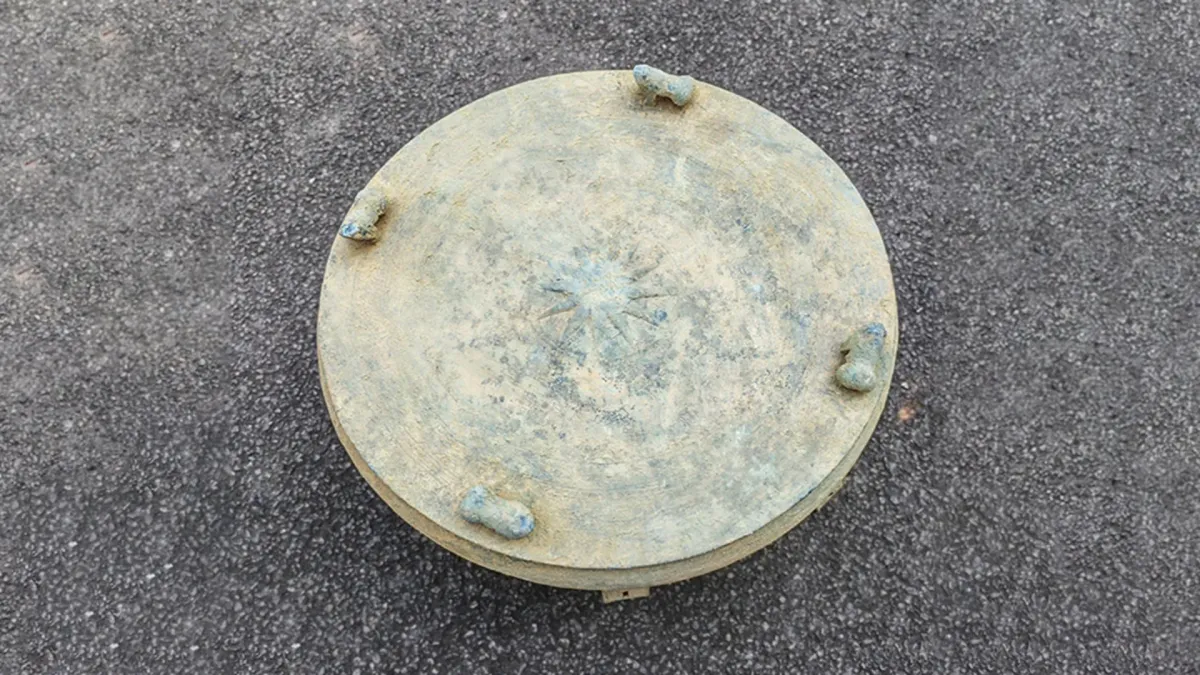
A farmer in China recently found a 2,000-year-old bronze drum. This discovery sheds light on the religious practices and bronze casting methods of the Eastern Han Dynasty.
The farmer, Wang Deqiang, was working in Wenxing village in Southwest China’s Yunnan Province. He accidentally dug up an object he knew was important. Local experts from the Yunnan Institute of Cultural Relics and Archaeology quickly came to investigate.
A Drum Reveals Ancient Practices
Archaeologists found the drum buried upside down in a burial pit. It was decorated with toads, a common symbol in southwestern China. This suggests the drum was important not just to its owner, but to the wider culture, possibly used in burial ceremonies.
We're a new kind of news feed.
Regular news is designed to drain you. We're a non-profit built to restore you. Every story we publish is scored for impact, progress, and hope.
Start Your News DetoxToads symbolized fertility and good fortune. The drum might have been meant to bring abundance and blessings into the afterlife. It may also have been used to please the gods, hoping they would help the deceased.
The bronze drum, though weathered to yellow and green, was well-preserved. It measured 23 inches in diameter, 2.13 feet wide, and about a foot high. A 12-pointed sun design was at its center, a common pattern on ancient bronze drums in southern China. Concentric bands of linear patterns wrapped around the rim.
The most striking feature was the four sculpted toads placed around the drumhead. Because toads were so important in many southwestern Chinese cultures, archaeologists believe the drum carried deep messages and meanings beyond just music.
Its upside-down placement was not random. It was likely meant to pour blessings into the grave for the afterlife. The Cultural Relics Management Department believes it was also for protection from spiritual forces.
Music for the Afterlife
Zhang Qiyu, director of the Weixin County Cultural Relics Management Department, explained that the drum's main purpose was not just to make music. It was used in ceremonies and possibly to guide the dead to the next life.
Zhang said it was a "sacred vessel" used to communicate between Heaven and Earth. It also showed social power and ritual authority. This suggests the drum was a sign of high status in southwestern China. Being buried with such a drum might have given someone an advantage in the afterlife.
This understanding grew when researchers found another Eastern Han drum in a nearby grave in 1980. That earlier site had been lost and forgotten. So, this new drum is the second found in a burial setting, confirming its important role in ancient southwestern Chinese cultures.