Researchers at Berkeley Lab just completed something that sounds like science fiction: they used 7,000 graphics processors running for a full day to simulate what happens inside a quantum microchip smaller than your pinky nail.
The catch is that this simulation actually matters. Building quantum computers is expensive and error-prone—you design a chip, fabricate it, test it, find problems, and start over. What Zhi Jackie Yao and Andy Nonaka figured out is how to test the design before you build anything physical. They can now see, in precise electromagnetic detail, whether a quantum chip will actually work.
"The computational model predicts how design decisions affect electromagnetic wave propagation in the chip," Nonaka explained. "To make sure proper signal coupling occurs and avoid unwanted crosstalk." In other words: does the quantum signal get where it needs to go, or does it get lost in noise?
We're a new kind of news feed.
Regular news is designed to drain you. We're a non-profit built to restore you. Every story we publish is scored for impact, progress, and hope.
Start Your News DetoxThe Scale of the Challenge
The chip they simulated was just 10 millimeters square and 0.3 millimeters thick—with features etched at one micron wide. To capture what was actually happening inside, they carved it into 11 billion grid cells and ran over a million time steps. This required nearly the entire Perlmutter supercomputer, one of the world's fastest, for 24 hours straight.
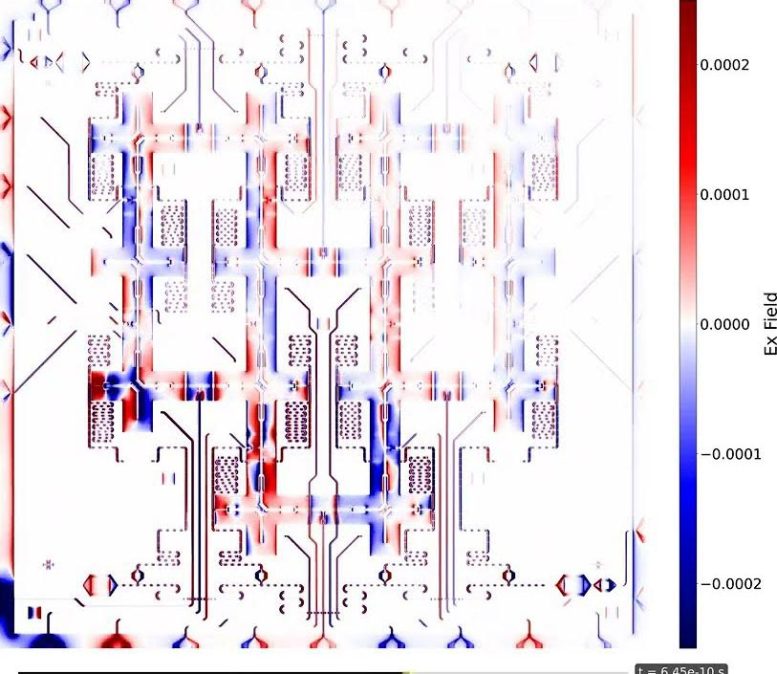
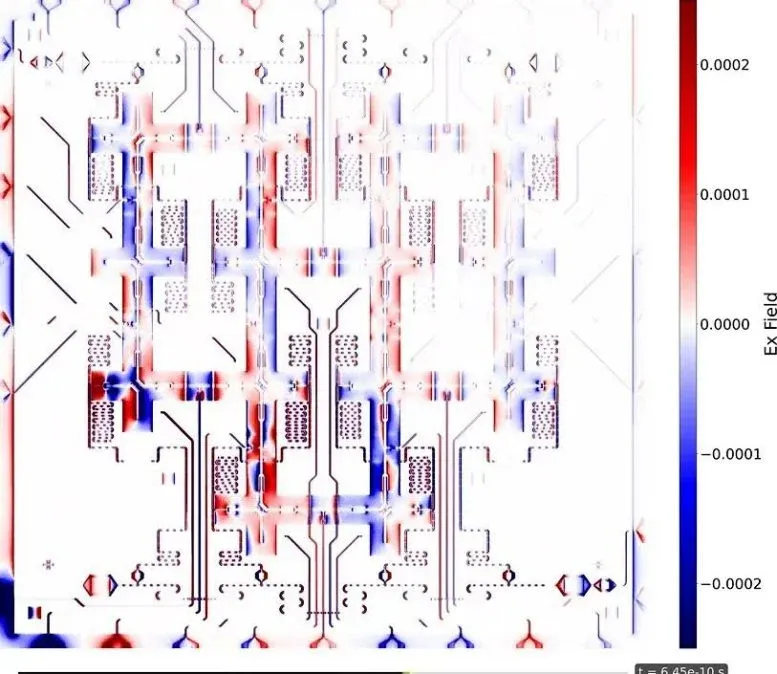
Most quantum simulations treat chips as black boxes—they model the behavior without worrying about the physical details. Yao and Nonaka went the opposite direction. They cared about every material choice: which metal wires (niobium or otherwise), the exact layout, the size and shape of resonators, how everything connects. They even simulated how qubits communicate with each other in real time, mimicking what actually happens in a lab.
"We do full-wave physical-level simulation," Yao said. "We care about those physical details, and we include them in our model." This combination—microscopic detail plus real-time behavior—is what made the simulation unique. They used Maxwell's equations in the time domain, which let them capture nonlinear effects that simpler models miss.
Katie Klymko, a quantum computing engineer at NERSC, called it "one of the most ambitious quantum projects on Perlmutter to date." Not because it was the biggest, but because it pushed the boundaries of what's physically possible to model.
What Comes Next
The real test arrives when the chip gets built and tested in the physical world. Yao and Nonaka will compare their simulation to what actually happens, then refine their model. They're also planning more detailed simulations to understand how the qubit resonates with the rest of the circuit—checking their work against other frequency-domain models to build confidence in the results.
The broader point: quantum hardware is getting closer to practical. Every time researchers can catch design flaws before fabrication, every time they can test three different configurations in a single day instead of months, they're accelerating the timeline toward quantum computers that actually work at scale.