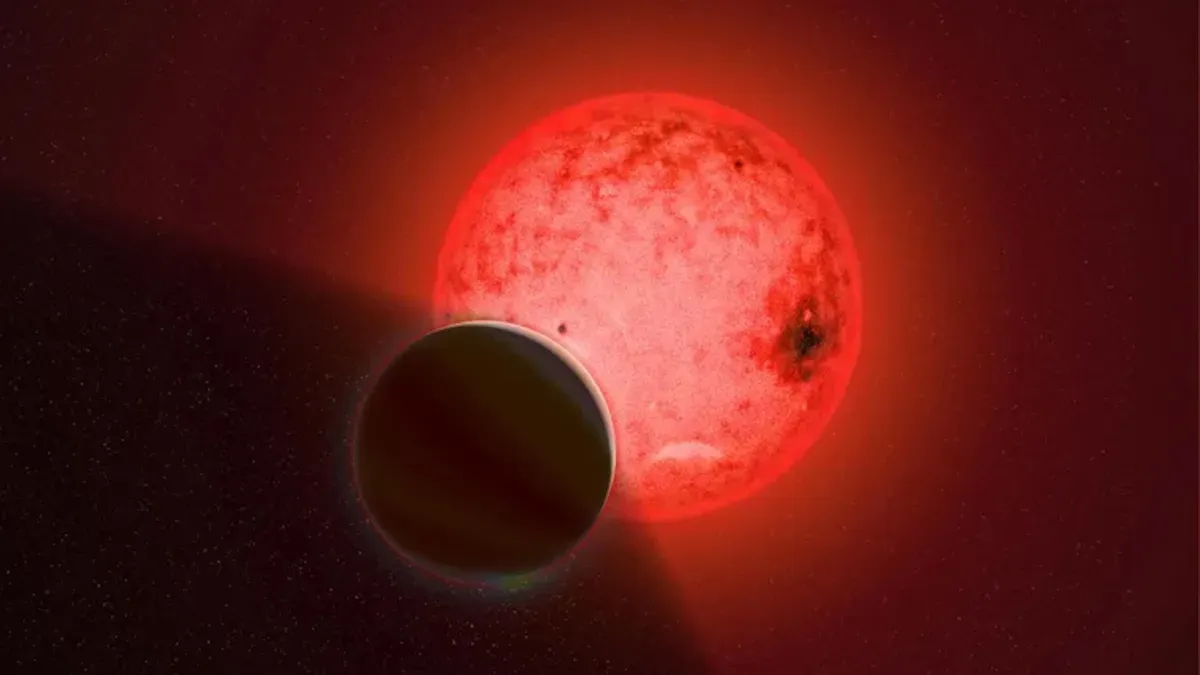
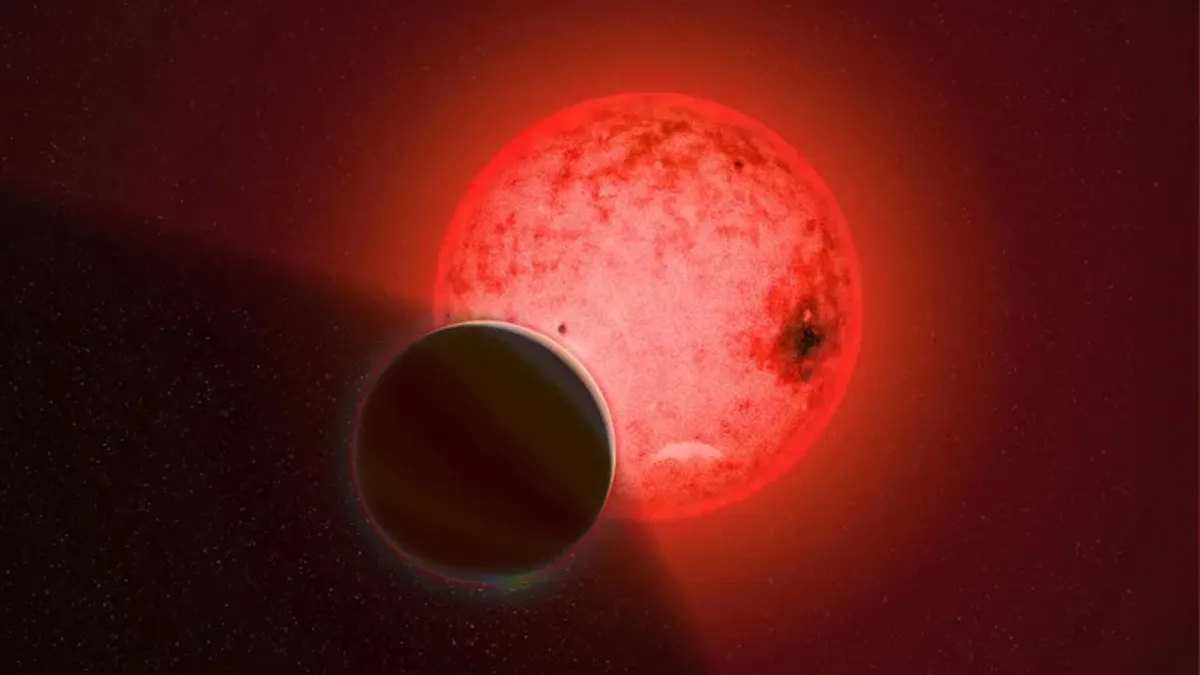
Imagine a planet so out of whack with cosmic expectations that astronomers have officially dubbed it "forbidden." That's TOI-5205 b for you, a gas giant roughly the size of Jupiter, currently orbiting a red dwarf star about 282 light-years away. The problem? Everything we thought we knew about how planets form suggests this one shouldn't exist.
An international team of stargazers recently published their findings in The Astronomical Journal, basically saying, "Yeah, this thing is a head-scratcher." Its atmosphere is surprisingly light on heavy elements, while its core is, well, doing its own thing. Because apparently that's where we are now: planets just deciding to defy physics.
The Cosmic Anomaly
NASA's Transiting Exoplanet Survey Satellite (TESS) first spotted TOI-5205 b in 2023. Since then, scientists have been putting it under the cosmic microscope, using spectrography to figure out what it's made of. When the planet passes in front of its star, it blocks about six percent of the starlight. By analyzing the light that does get through, broken down into its constituent colors, researchers can essentially taste the planet's atmosphere.
We're a new kind of news feed.
Regular news is designed to drain you. We're a non-profit built to restore you. Every story we publish is scored for impact, progress, and hope.
Start Your News DetoxAfter observing three of these celestial transits, they found TOI-5205 b's atmosphere is a delightful mix of methane and hydrogen sulfide. Which is interesting enough, but the real party trick is what's inside. Computer models, based on the planet's mass and size, suggest its interior is about 100 times richer in metal than its atmosphere. But here's the kicker: its overall metal content is still significantly lower than that of its host star.
Shubham Kanodia, an astronomer at Carnegie Science and co-author of the study, noted that their models expected a much higher metal content in the core. This implies that during its formation, heavy elements decided to stage an internal coup, moving inward and then just… staying there. No mixing with the atmosphere. Rude, if you ask us.

This "forbidden planet" has a metallic core, a carbon-rich but oxygen-poor atmosphere, and it's orbiting a star about four times larger than Jupiter, but with only 40 percent of our Sun's mass. Planets typically coalesce from a swirling disk of dust and gas around a young star. But TOI-5205 b's sheer size, combined with its cozy orbit around a relatively cool star, is making scientists rethink everything they thought they knew about how these cosmic giants are born, live, and eventually, don't die.
As Anjali Piette, another study co-author from the University of Birmingham, put it, these findings are shaking up our understanding of how giant planets form early in a star's life. It's truly unique among all giant planets studied so far, mostly because it's just refusing to play by the rules. Which, if you think about it, is both impressive and slightly terrifying.