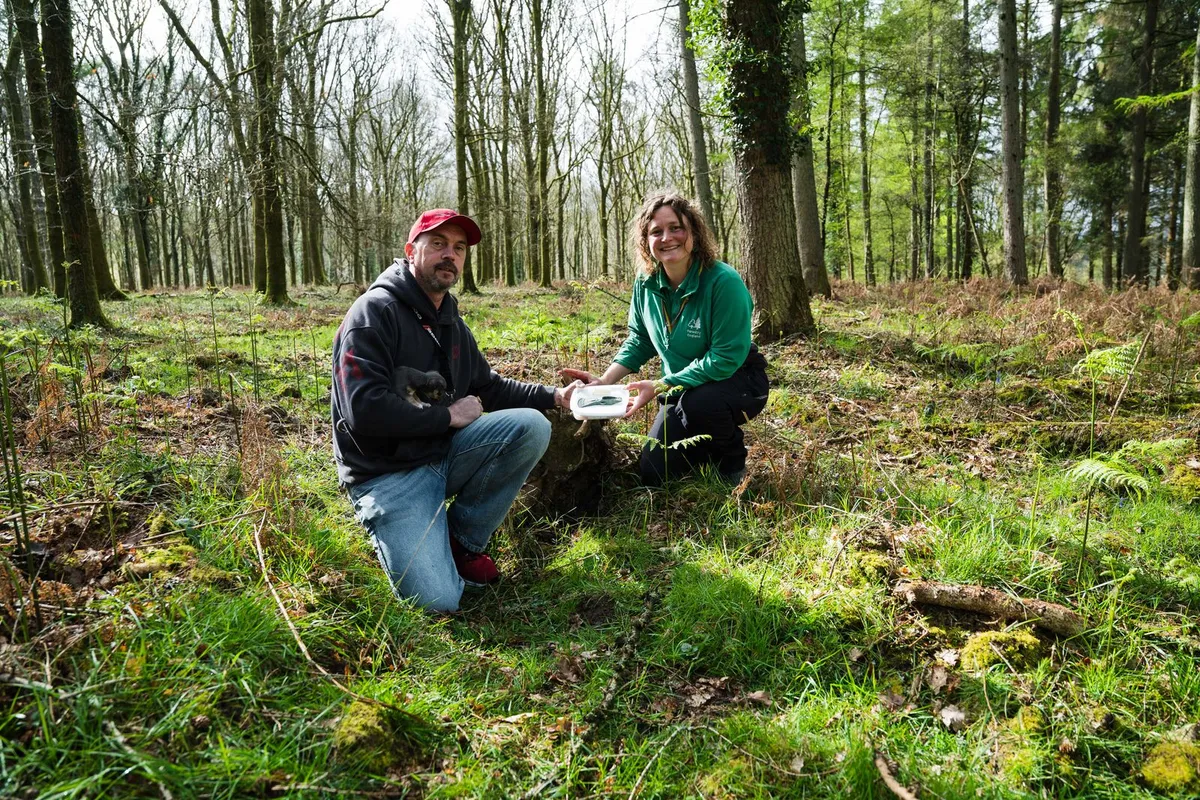
John Smith was walking his dog in England's Forest of Dean when they stumbled upon a 3,400-year-old ax head. His dog ran off, and as Smith looked down in the tree roots, he saw a green, sparkling object. It was an ancient ax head, wedged in a hole.
Smith reported his find to Forestry England. They then contacted Cotswold Archaeology for help. The ax head is now at the Dean Heritage Center for study and preservation.
A Glimpse into the Bronze Age
Experts believe the ax dates back to between 1400 B.C.E. and 1275 B.C.E. This is because it's made of bronze, a mix of copper and tin. It's also a "palstave" ax, a type specific to that period.
We're a new kind of news feed.
Regular news is designed to drain you. We're a non-profit built to restore you. Every story we publish is scored for impact, progress, and hope.
Start Your News DetoxLeoni Dawson, a community ranger with Forestry England, noted that such finds help us understand life in the Bronze Age. These tools survived thousands of years, hidden underground. They connect us to people who lived in these lands long ago.
The Bronze Age in Britain lasted from 2300 B.C.E. to 800 B.C.E. Bronze was first used for tools around 2200 B.C.E. Palstave axes were common then. They had a loop on the head to secure the metal to a wooden handle with a cord.
These axes were made by pouring molten metal into two-part molds. This was a more advanced method than earlier stone molds. Bronze Age people used axes for many tasks, like butchering animals and woodworking. They also used them to show their status. Some axes have even been found in burials as valuable grave goods.
The Forest's Ancient History
The Forest of Dean, where the ax was found, has been home to people since the Stone Age. It's one of England’s ancient woodlands, meaning it has been a forest continuously since 1600 C.E.

During the Bronze Age, people in the forest cleared trees for farming, homes, and ritual monuments. In 2019, archaeologists found a ring cairn in the forest. This round bank, about 80 feet across with small standing stones, dates to between 2500 B.C.E. and 1500 B.C.E.
Archaeologist Jon Hoyle explained that the purpose of these cairns isn't fully known. Some are linked to burials, and often show signs of fire, suggesting rituals.
Matt Seaver, from the National Museum of Ireland, noted that an object's location is as important as the object itself. He said that where objects were placed in the landscape gave them meaning. This new ax head discovery helps us understand the ancient people of the Forest of Dean.
Deep Dive & References
Experimenting with Bronze Age Technology: Casting Palstave Axeheads (E4) - YouTube