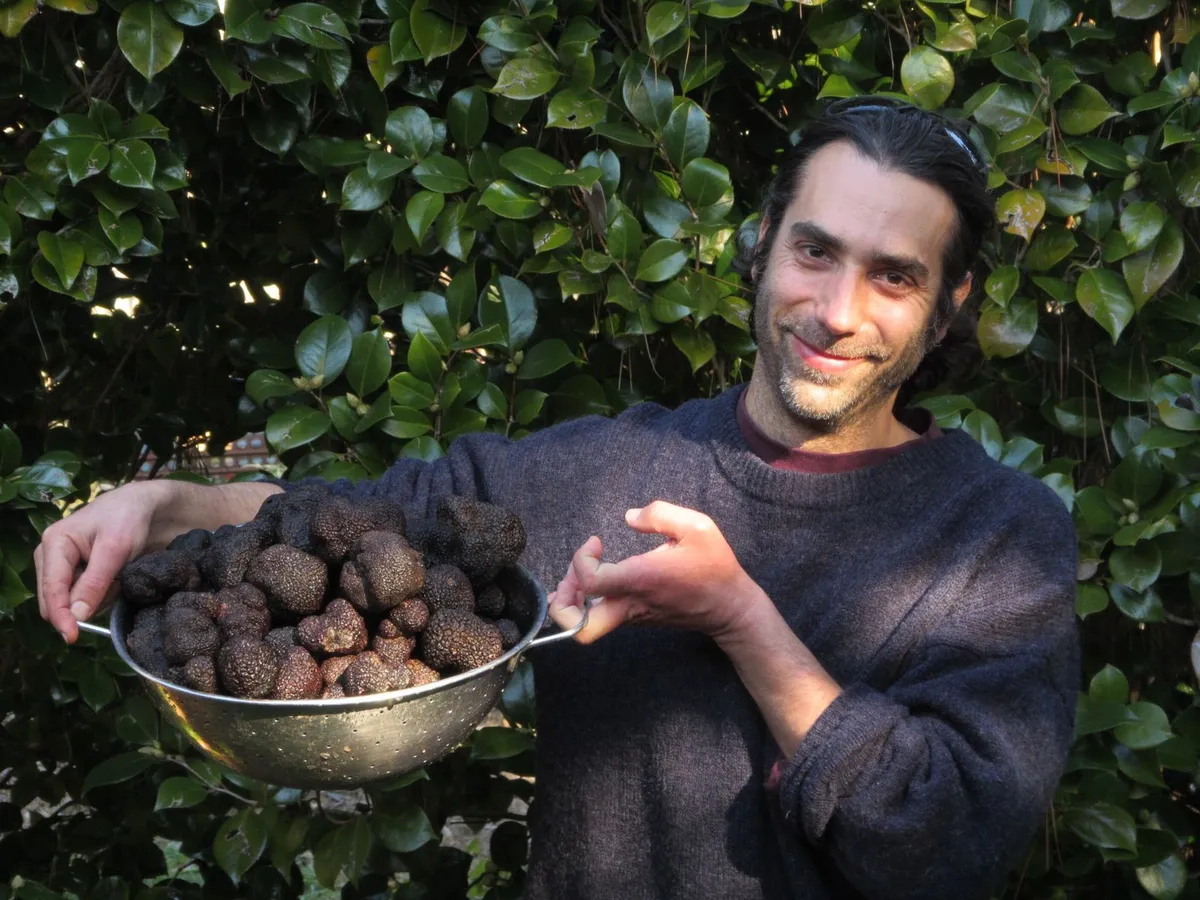
Black truffles are a prized food, known for their rich, earthy smell. These rare fungi, Tuber melanosporum, naturally grow near tree roots in the limestone-rich soils of Southern Europe. Surprisingly, Australia has become one of the world's top truffle producers.
Truffles were first brought to Australia 25 years ago. This happened when trees with T. melanosporum spores were planted there. Since then, Australia's truffle industry has grown quickly. It is now the fourth-largest producer of these valuable fungi. Some Australian truffle farms even produce more than those in Europe. A new study helps explain why black truffles have done so well there.
Less Competition Helps Truffles Thrive
Gregory Bonito, a mycologist at Michigan State University, co-authored the study. He told the Guardian that understanding truffles is hard because they grow underground. He explained that with an apple tree, you can see the flowers and then the fruit. But it's much harder to track what happens below ground.
We're a new kind of news feed.
Regular news is designed to drain you. We're a non-profit built to restore you. Every story we publish is scored for impact, progress, and hope.
Start Your News DetoxTo learn more, Bonito and his team studied the tiny life forms in soils from 24 truffle farms. These farms were in Australia, France, Spain, and Italy. Over two years, they collected 522 soil samples from under and near truffle-infected trees. They then used genetic analysis on these samples. Their findings were published in Applied and Environmental Microbiology on April 3.
The researchers discovered that Australian soils had fewer types of fungi. DNA tests showed European soils had 6,575 distinct types of fungi. Australian samples, however, had only 4,415. Australian farms also had 75% fewer species of mycorrhizal fungi. T. melanosporum was much more common in the Australian soils compared to European samples.
This means black truffles in Australia face less competition from other fungi. They have an easier time forming their important relationship with trees.
Other Factors and Future Research
Bonito noted that other things might also help black truffles succeed in Australia. He mentioned climate, water, pruning methods, or specific farm management. He added that this research suggests larger ecological factors are also at play.
Australian truffle growers are already looking at the study's results. Stuart Dunbar, a farmer who grew the largest cultivated truffle, told the Guardian that many things lead to a good crop. These include temperature, soil, water, careful timing, and hard work. He explained that a truffle's main goal is to be eaten, usually by a pig, when its spores are ripe. This helps spread it through the forest.
The researchers now plan to study microbial diversity in truffle farms in North America and other Southern Hemisphere countries. They want to see if similar patterns exist elsewhere. Bonito pointed out that the U.S. was the first country outside Europe to successfully grow black truffles in the 1980s. However, its yields are not as high as Australia's. This new study could help explain why.
Deep Dive & References
Australia's truffle industry may owe its success to less competition from other fungi - Phys.org, 2026 Ecological Factors Associated with Tuber melanosporum Productivity in Australian and European Truffle Orchards - Applied and Environmental Microbiology, 2026 Australia is the world’s fourth largest black truffle producer – now scientists may have unearthed why - The Guardian, 2026