Imagine a particle accelerator so powerful it makes the Large Hadron Collider look like a toy car battery. Now imagine that accelerator is just… out there in space, doing its thing, and it's doing it in a way scientists didn't think was possible. That's essentially what the Large High Altitude Air Shower Observatory (LHAASO) just found.
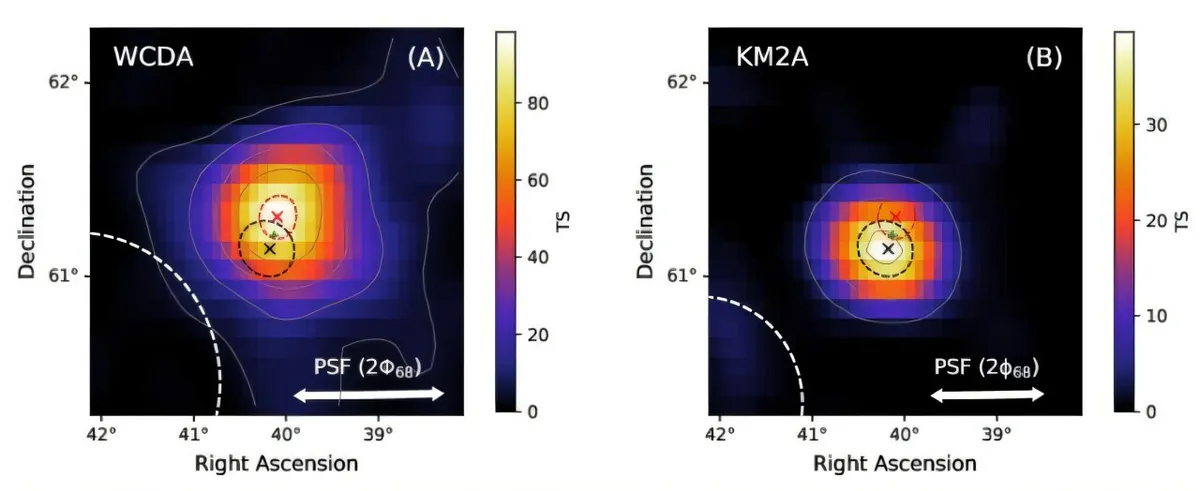
They've detected ultra-high-energy (UHE) gamma rays blasting out from a system called LS I +61° 303. And by "ultra-high-energy," we're talking over 100 trillion electron-volts (TeV). For context, your average visible light photon is a few electron-volts. This is like comparing a sneeze to a supernova.
This discovery is a cosmic head-scratcher because it directly challenges our current understanding of how particles get supercharged in the universe's most extreme environments.
We're a new kind of news feed.
Regular news is designed to drain you. We're a non-profit built to restore you. Every story we publish is scored for impact, progress, and hope.
Start Your News DetoxThe Universe's Most Extreme Labs
For ages, astrophysicists have been trying to figure out where high-energy cosmic rays — those charged particles zipping through space — actually come from. They need to find "PeVatrons," which are cosmic accelerators capable of boosting particles to peta-electron-volt (PeV) levels. That's 1,000 trillion electron-volts. Let that satisfyingly massive number sink in.
"Gamma-ray binaries" have always been prime suspects. These systems are basically cosmic odd couples: a massive star dancing with a compact star (either a neutron star or a black hole). They're natural laboratories for extreme physics, but until now, we'd only seen a few of them emitting very-high-energy (VHE) gamma rays (above 0.1 TeV). LS I +61° 303 was one of those, but nobody thought it could hit the UHE big leagues.
LHAASO Breaks the Rules
Enter LHAASO. With its super sensitive instruments, it measured the energy spectrum of LS I +61° 303 up to 200 TeV. This confirmed it as a bona fide UHE gamma-ray binary. Which, again, shouldn't really be happening.
The team also noticed something peculiar: the gamma-ray brightness of the system changes with its 26.5-day orbital period. This "orbital modulation" isn't just a pretty light show; it's a direct clue that complex physics is at play inside the system.
Here's the twist: in these binary systems, strong magnetic fields usually act like cosmic speed bumps, causing high-energy electrons to lose energy before they can hit UHE levels. So, detecting photons above 100 TeV suggests a different mechanism. The leading theory now is that during certain orbital phases, high-energy protons (hadrons) are accelerated. These protons then smash into the dense stellar wind surrounding them, creating the UHE gamma rays we're seeing.
This finding doesn't just rewrite a few textbooks; it strongly suggests that gamma-ray binaries like LS I +61° 303 are indeed those elusive PeVatrons. It's a massive step forward for understanding particle acceleration in the most extreme corners of space, and it opens up exciting new avenues for "multi-messenger astronomy" — using both light and other signals to peek into the universe's deepest secrets. Because apparently that's where we are now: finding forbidden particle accelerators in the sky.