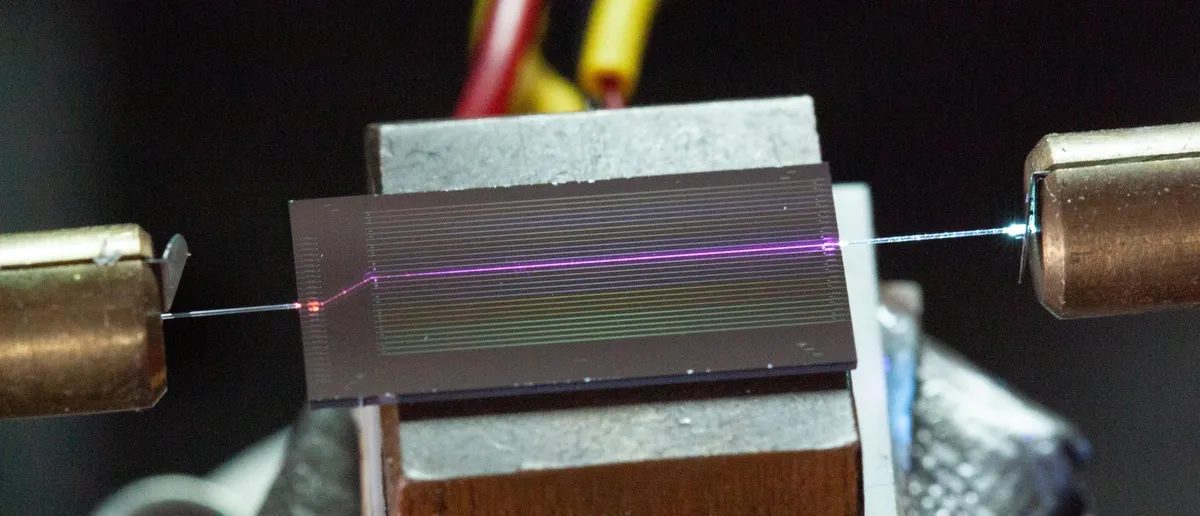
Imagine a world where your computer chip doesn't just process data, but also zaps germs, scans biological samples, and maybe even powers a tiny quantum computer. Harvard scientists just took a giant leap toward that future, by figuring out how to generate serious UV light on a device no bigger than a speck of dust.
Turns out, this tiny photonic device can take everyday red light and transform it into powerful UV, which is basically the superhero of light. It's the stuff that sterilizes surgical tools, helps build other computer chips, and could one day run hyper-accurate atomic clocks. And now, it's chip-sized.
The UV Light Problem
For years, getting UV light to play nice on a microchip has been like trying to herd cats through a garden hose. UV light just doesn't like traveling through the tiny channels of a chip, losing its zing almost immediately. This has kept chip-based UV a sci-fi dream.
We're a new kind of news feed.
Regular news is designed to drain you. We're a non-profit built to restore you. Every story we publish is scored for impact, progress, and hope.
Start Your News DetoxEnter Professor Marko Lončar's team from Harvard. They built a new device on a thin film of lithium niobate – a material that sounds like it belongs in a sci-fi novel but is actually perfect for this kind of magic. This device, just a few microns across, pumps out 100 times more UV light than previous attempts.
Instead of trying to force UV light through tiny channels, they decided to make it there. They shine red light into the lithium niobate crystal, which then does a neat trick called "frequency upconversion." Essentially, it takes two red light particles, combines their energy, and spits out one super-charged UV photon. Presto.
Lončar, whose group is famous for using lithium niobate with infrared light, realized this clear crystal could do more. Co-first author Kees Franken admits that thin-film lithium niobate isn't typically seen as a UV material, but, well, here we are. He also hinted that there are still some unexplained effects happening, which is always a fun detail when we're talking about scientific breakthroughs.
The Sidewall Poling Solution
To get light to travel efficiently and convert properly, the crystal structure inside the device needs to be flipped at regular intervals – a process called "poling." Doing this precisely on something the size of a fingernail has been a monumental headache.
Older methods were clunky. Poling the whole film meant one mistake ruined everything. Poling after making the waveguides was inefficient because the electrodes couldn't get close enough to do their job.
So, the team invented "sidewall poling."
Instead of putting electrodes only on top, they placed tiny metal "fingers" directly along the sides of the waveguide. Apply a small voltage during manufacturing, and boom: crystal parts flip with incredible precision. Soumya Ghosh, another co-first author, noted this required manufacturing accuracy down to a mind-boggling 50 nanometers.
This ensures the entire crystal is flipped, letting light interact with the optimal structure for maximum conversion. They even tweaked the spacing of these flipped regions to account for any tiny variations in thickness or shape. Because apparently, that's where we are now with micro-engineering.
The result? A whopping 4.2 milliwatts of UV light on a chip. That's 120 times more powerful than previous devices in this range. Earlier attempts only managed microwatts – enough to prove the concept, but not enough to, you know, actually do anything useful.
This reliable, chip-sized UV source is a game-changer for new tech like trapped-ion quantum computers, which need precise UV light for their atomic gymnastics. Franken points out that for quantum computers to shrink from room-sized behemoths to practical devices, everything has to scale down to the chip level.
Beyond quantum dreams, this same UV wavelength could be used in tiny sensors to sniff out greenhouse gases and other pollutants in the air. Because if you're going to make a powerful new light source, you might as well use it to save the planet.
Franken and Ghosh credit their success to the team's ability to handle every single step themselves, from napkin sketch to final test. It's a reminder that sometimes, the biggest breakthroughs come from getting your hands dirty – or in this case, extremely precise.