
Scientists are proposing a new way to find alien life. Instead of looking for single clues on one planet, they suggest searching for patterns across many planets. This could help when traditional signs of life are hard to confirm.
This new idea comes from researchers Harrison B. Smith of the Earth-Life Science Institute (ELSI) and Lana Sinapayen of the National Institute for Basic Biology. They believe this broader approach could open new doors in the search for life beyond Earth.
Moving Beyond Traditional Biosignatures
One big problem in finding alien life is that many "biosignatures," like certain gases in a planet's air, can also be made by non-living processes. This can lead to false alarms. Even signs of advanced technology (technosignatures) rely on guesses about how alien intelligence might act.
We're a new kind of news feed.
Regular news is designed to drain you. We're a non-profit built to restore you. Every story we publish is scored for impact, progress, and hope.
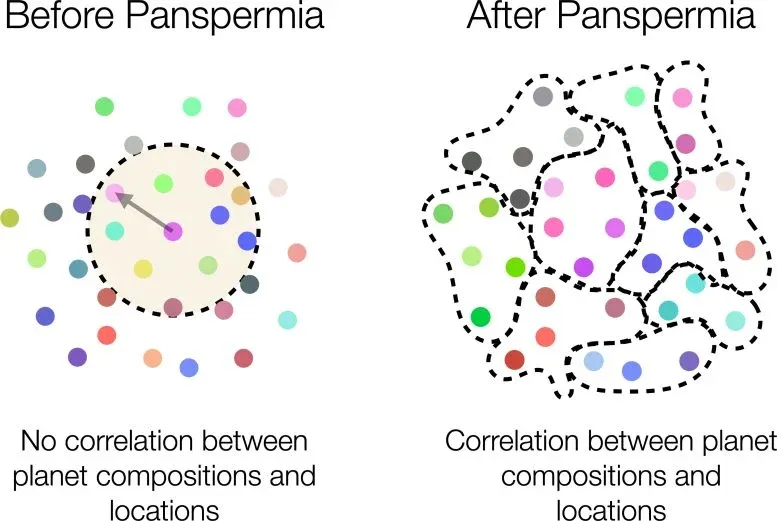
Start Your News DetoxThe new study suggests looking at how groups of planets compare. The idea is that life can spread between planets, perhaps through a process called panspermia. Also, life can change a planet's environment over time.
The researchers used computer models to simulate how life might move through star systems and change planets. Their results showed that if life spreads and affects environments, it creates measurable links between where planets are located and what they look like. These patterns can appear even if no clear sign of life is found on any single planet.
Finding Likely Life-Bearing Worlds
The team also developed a way to figure out which planets are most likely to have life. They group planets by their observable features and their positions in space. This helps them find clusters of planets that are more likely to have been changed by life.
This method focuses on being reliable, even if it means missing some planets with life. It aims to reduce false positives, which is important when scientists have limited time to observe planets with telescopes.
"By focusing on how life spreads and interacts with environments, we can search for it without needing a perfect definition or a single definitive signal," said Harrison B. Smith. Lana Sinapayen added that even if alien life is very different from Earth life, its large-scale effects, like spreading and changing planets, might still leave detectable clues.
The findings suggest that future studies looking at many exoplanets could use statistics to find life across entire groups of planets. This could be very helpful when individual signs of life are weak or uncertain.
Future Steps
The study also highlights the need to better understand the natural variety of planets without life. Knowing this baseline will make it easier to spot changes caused by living things.
While these results are based on simulations, they lay the groundwork for new ways to detect life. Researchers say future studies will need more detailed planetary data and better models of how galaxies work. This work suggests that life might be found by looking for the broad patterns it creates across the universe, even without knowing its exact chemistry.
Deep Dive & References
An Agnostic Biosignature Based on Modeling Panspermia and Terraforming - The Astrophysical Journal, 2026