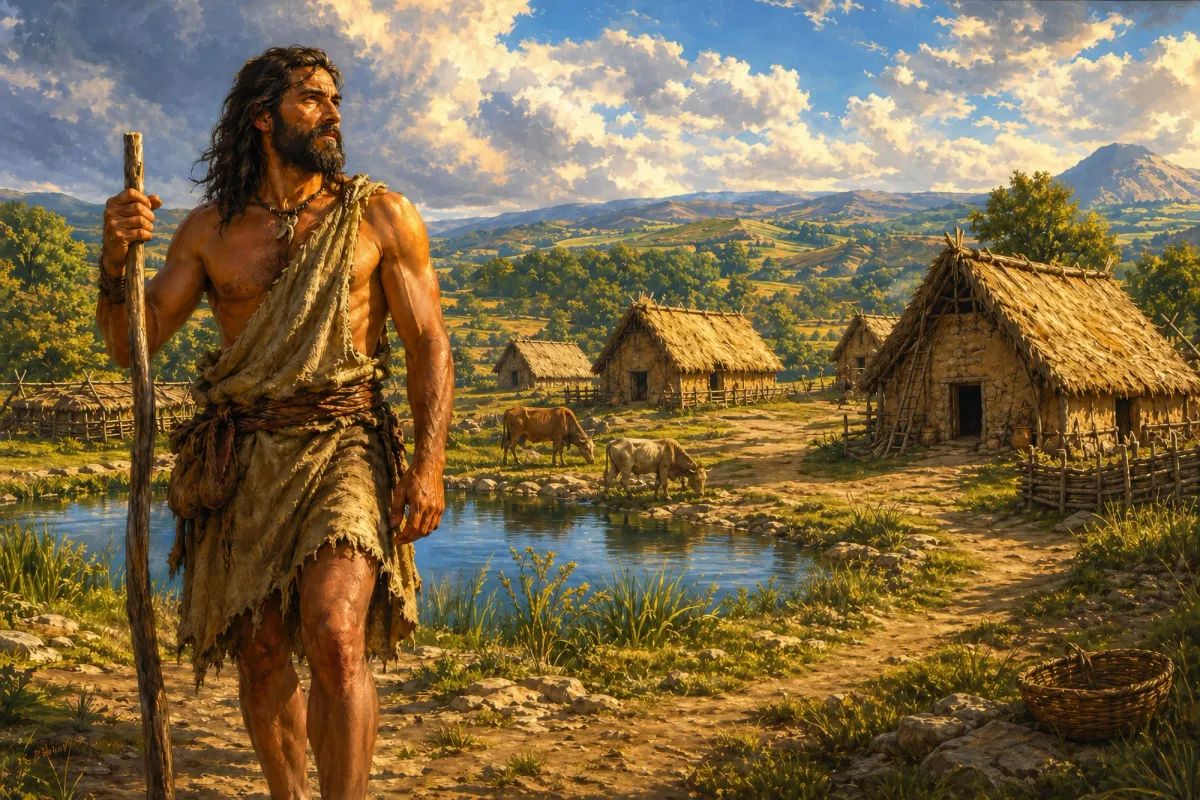
For ages, we've told ourselves a simple story about the Neolithic Revolution: humanity stopped chasing dinner and started growing it. Around 10,000 years ago, hunter-gatherers put down roots, domesticated some plants and animals, and boom — permanent homes and complex societies. Neat, tidy, and apparently, a bit too simple, especially when it comes to North Africa.
Turns out, the origin story of farming in this region is less of a straight line and more of a tangled family tree, complete with migrations, cultural exchanges, and a surprising amount of genetic mingling. New findings, powered by ancient DNA, are blowing up the old narrative and replacing it with something far more interesting.
The Genetic Mixer
For a while, experts debated: did farming pop up independently in North Africa, or was it imported? A recent study in Nature offers a delightfully complex answer: it was a bit of everything. Imagine a bustling cultural crossroads where African hunter-gatherers, early European farmers, and East Saharan herders all met, swapped recipes, tools, and, yes, genes, between 5500 and 4500 BC.
We're a new kind of news feed.
Regular news is designed to drain you. We're a non-profit built to restore you. Every story we publish is scored for impact, progress, and hope.
Start Your News DetoxAn international team, including researchers from several Spanish universities and the Moroccan Institute of Archaeology and Heritage Sciences (INSAP), dug into human remains from three Moroccan sites. What they found reads like an ancient census report.
At Kaf Taht el-Ghar cave, dating back about 7,400 years, the DNA told a clear story: these folks were descendants of European farmers. A few centuries later, at Ifri n’Amr Ou Moussa, the cave dwellers had local ancestry, but they were using pottery and farming methods. This wasn't a case of locals vanishing; it was locals adapting and adopting.
Fast forward another 1,000 years to Skhirat-Rouazi, and the genomes showed a new twist: ancestry linked to pastoralist groups from the Fertile Crescent. This wasn't just a rumor; it was the genetic receipts, confirming earlier archaeological whispers about these groups moving across North Africa.
What this all means is that the Maghreb region was a global hub much earlier than anyone thought. People on both sides of the Strait of Gibraltar were sharing knowledge, tech, culture, and genes long before the Romans showed up or Islam spread. Rafael M. Martínez from the University of Córdoba called the study a "turning point," noting how Moroccan ceramics from different eras tell tales of these diverse influences.
Juan Carlos Vera from the University of Huelva put it plainly: archaeology hinted at it with ancient seeds, but now the genetics show the "physical" arrival of immigrants and "the projection of their genes." Which, if you think about it, is both impressive and slightly terrifying.
A Patchwork Revolution
Cristina Valdiosera from the University of Burgos underscored the lasting impact: later Maghreb populations, including the ancestors of the Berbers, are essentially a genetic blend of these three major groups: African hunter-gatherers, European Neolithic farmers, and those pastoralists from the Fertile Crescent.
And just to prove that history rarely follows a single script, another Nature study (from 2025, because apparently, even scientific discoveries have sequels) showed that the Neolithic transition was a patchwork. While the western Maghreb was a melting pot, communities in the eastern Maghreb largely kept their original genetic makeup, even as they embraced farming practices.
So, there wasn't one neat "Neolithic Revolution" in North Africa. There were many, each a complex dance of migration, cultural exchange, and local innovation. The takeaway? History, like a good stew, often has more ingredients than you initially expect.