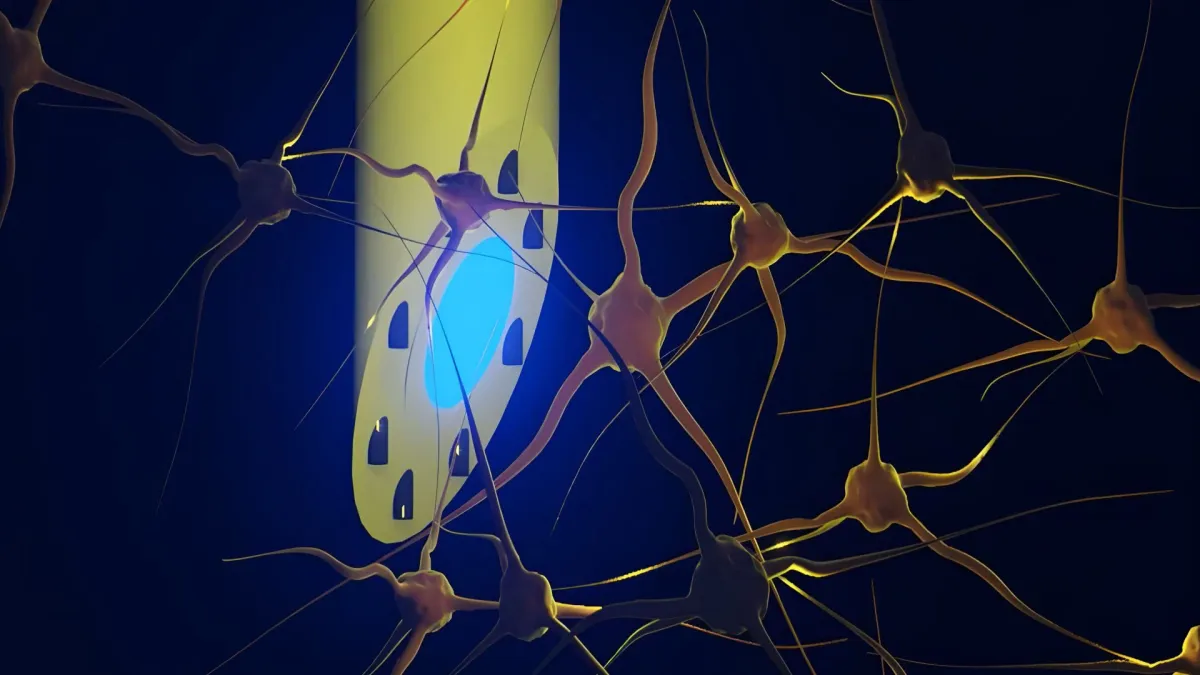
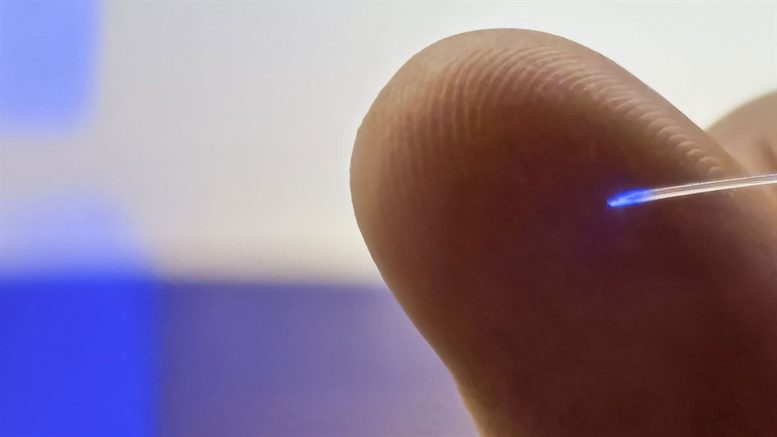
A new brain implant is changing what researchers can actually do inside the brain. Most current electrodes are made of hard silicon and concentrate all their work at a single point—like trying to understand a conversation by listening to only one voice in one room. This new device, called a microfluidic Axialtrode (mAxialtrode), works differently. It's thinner than a human hair, made of soft flexible plastic, and has functional contact points along its entire length instead of just at the tip.
The breakthrough matters because it's less invasive. Hard silicon implants irritate brain tissue and trigger inflammatory reactions. The mAxialtrode, developed by researchers at Denmark's Technical University (DTU) in collaboration with teams at the University of Copenhagen and University College London, moves with the brain instead of cutting through it.
How it works
The fiber itself is less than half a millimeter thick. At its core runs a light-conducting channel. Around it sit eight microscopic fluid channels that can both deliver medication and house thin metal wires for recording electrical signals. Researchers manufacture it by heating a polymer rod and drawing it out into an impossibly thin fiber—a process that sounds simple but requires precision engineering.
We're a new kind of news feed.
Regular news is designed to drain you. We're a non-profit built to restore you. Every story we publish is scored for impact, progress, and hope.
Start Your News DetoxTraditional brain electrodes, usually flat-ended optical fibers, can only stimulate or record from one brain layer at a time. The mAxialtrode changes that. Because it has contact points distributed along its length, scientists can now interact with multiple brain regions simultaneously. In recent mouse experiments, researchers stimulated nerve cells with blue and red light, measured electrical activity from both shallow and deep layers (the cerebral cortex and hippocampus, up to three millimeters apart), and delivered different substances at different depths—all through a single, lightweight fiber that the animals carried without obvious discomfort.
What this opens up
Right now, the mAxialtrode is designed for basic neuroscience research. Many brain processes—epilepsy, memory formation, decision-making—depend on activity spreading across multiple tissue layers. Studying them with single-point tools is like trying to understand a traffic jam by watching one intersection. This implant lets researchers see the whole network.
The longer-term possibility is clinical. Imagine combining targeted drug delivery with electrical stimulation in the same implant, in the same brain region, simultaneously. That could help doctors understand how chemical and electrical interventions influence the same neural circuits—knowledge that might eventually lead to better treatments for neurological conditions.
The research team is now working on patents and exploring clinical trials. The work was published in Advanced Science and represents collaboration across four institutions, each bringing expertise in neural circuit analysis, epilepsy models, and device engineering. What started as a materials science question—how do we make a softer implant?—is becoming a tool that could reshape how we study the brain.