Electrons are the lightest particles in plasma, but when a magnetic field switches on, they become the ones calling the shots. Auburn University researchers just discovered how sensitive this balance is — and what it means for everything from nanotech to understanding distant galaxies.
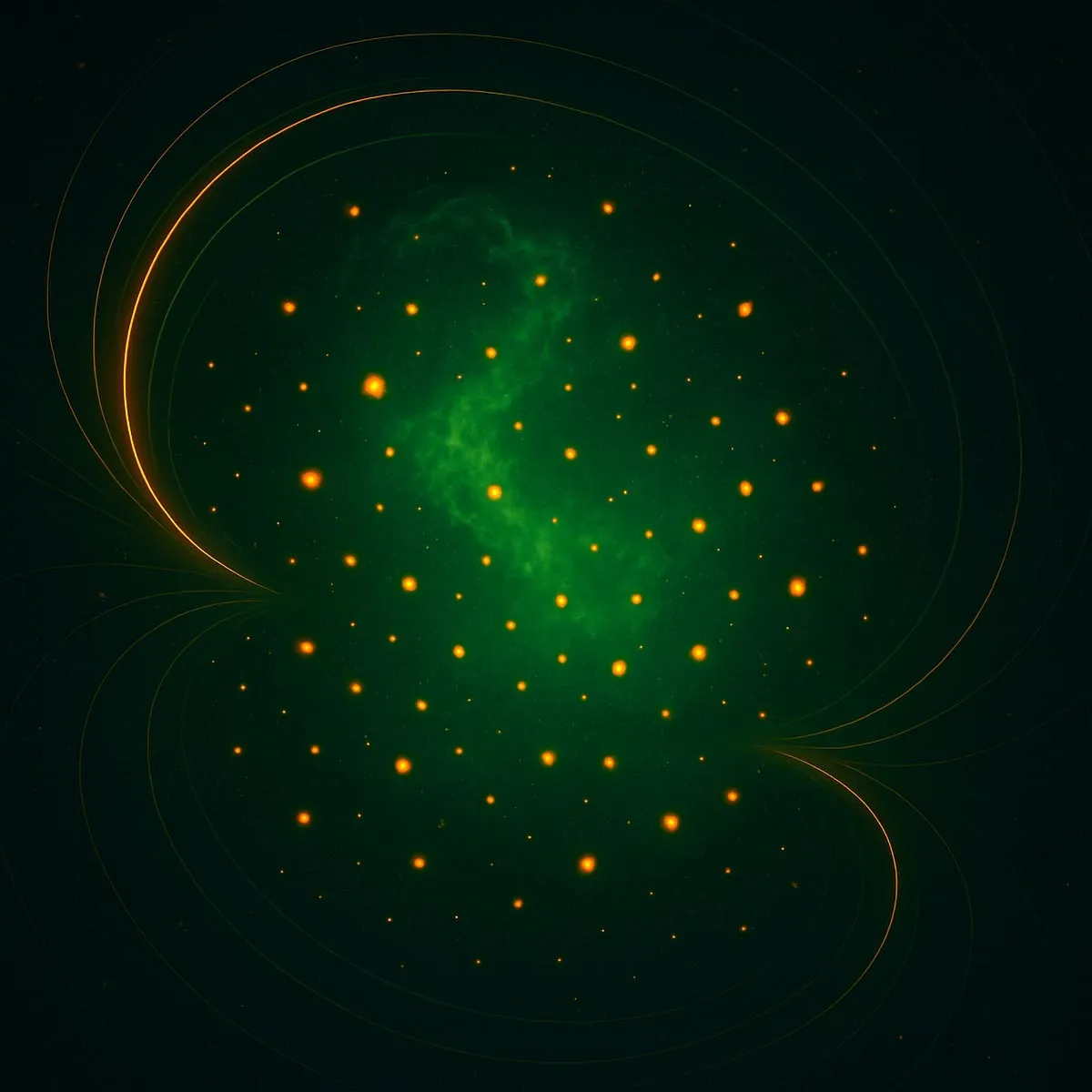
Imagine a glowing cloud suspended in a vacuum, filled with microscopic dust particles floating in a soup of charged gas. That's a dusty plasma, and it exists both in carefully controlled lab boxes and throughout deep space, from Saturn's rings to the solar atmosphere.
The research team, led by Bhavesh Ramkorun, created carbon nanoparticles by igniting a mixture of argon and acetylene gas. Without any magnetic field, the particles grew steadily for about two minutes before drifting away. But the moment they introduced a magnetic field — even a weak one — the rules changed dramatically. Growth periods shrank to under a minute, and the resulting particles stayed smaller.
We're a new kind of news feed.
Regular news is designed to drain you. We're a non-profit built to restore you. Every story we publish is scored for impact, progress, and hope.
Start Your News Detox"It's remarkable how sensitive the system is," said co-author Saikat Thakur. "Electrons are the lightest players in the plasma, but when they become magnetized, they dictate the rules. That simple change can completely alter how nanomaterials form."
What makes this finding useful isn't just the laboratory curiosity. The ability to control particle growth and size through magnetic fields opens new doors for creating nanoparticles with specific properties — materials engineered for electronics, protective coatings, or quantum devices. Right now, these applications rely on trial-and-error tweaking. A better understanding of the underlying physics could make the process more precise and efficient.
But the implications reach beyond the lab bench. Plasma makes up most of the visible universe, and dust is everywhere within it. By mapping how weak magnetic forces reshape these systems at the smallest scales, researchers are building a bridge between what happens in controlled experiments and what's actually happening in planetary rings, stellar atmospheres, and the far corners of space. The same rules that govern a neon-like glow in an Auburn laboratory might explain dust formation around distant stars.
The work appears in Physical Review E and represents the kind of fundamental discovery that rarely makes headlines but quietly shifts how we understand the physical world. Sometimes the smallest forces — and the lightest particles — turn out to be the ones that matter most.