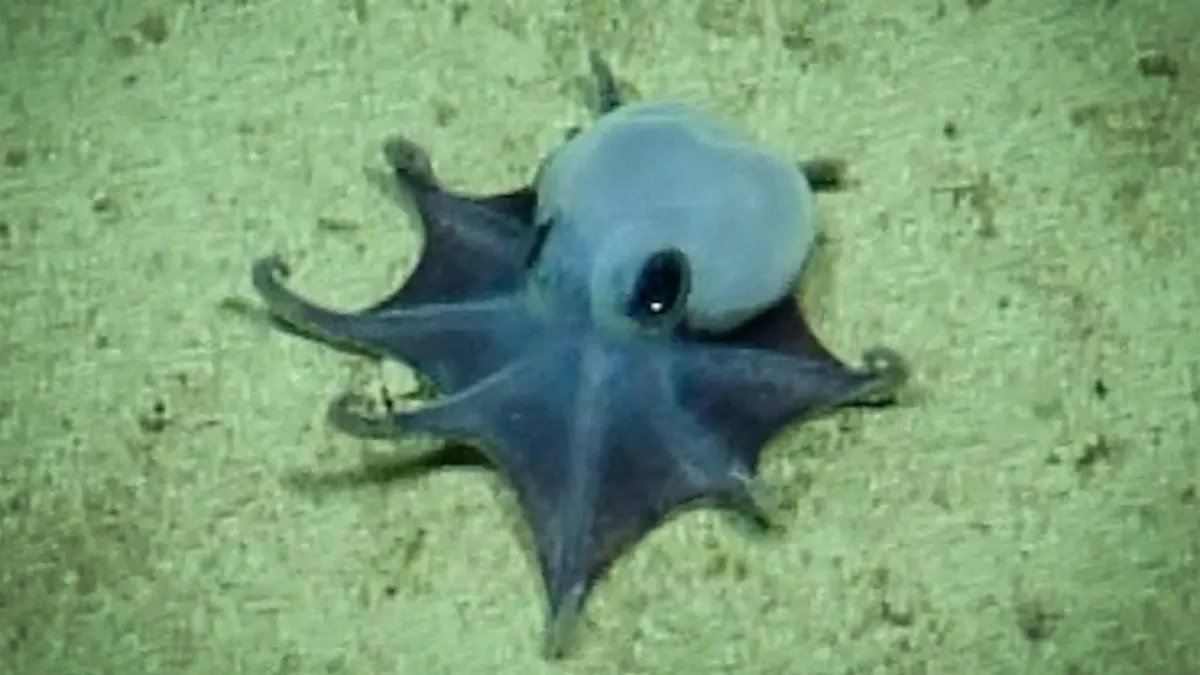
Imagine you're nearly 6,000 feet deep in the Pacific, poking around with a robot, when suddenly, a tiny, golf-ball-sized blue octopus just… appears. That's precisely what happened near the Galápagos Islands, and now, that adorable little cephalopod has officially been declared a brand-new species. Because apparently, the deep sea still has plenty of surprises up its sleeve.
This isn't just any octopus; it's a Microeledone galapagensis, now officially documented in the journal Zootaxa. It's the kind of creature that makes you realize how much of our planet is still playing hide-and-seek.
Not Your Average Deep-Sea Stroll
The whole thing started back in 2015 during a deep-sea expedition. The exploration vessel E/V Nautilus, working with the Charles Darwin Foundation, was using a remotely operated underwater vehicle (ROV) to explore an underwater mountain near Darwin Island. That's when, at a cool 5,800 feet down, the ROV spotted it: a striking blue octopus so unique, the researchers' excited reactions were actually recorded. Because who wouldn't get a little giddy?
We're a new kind of news feed.
Regular news is designed to drain you. We're a non-profit built to restore you. Every story we publish is scored for impact, progress, and hope.
Start Your News DetoxThey managed to collect one specimen and filmed two others. Back on land, this little blue guy stood out from all the other deep-sea critters. Photos were sent to octopus guru Janet Voight, a curator emerita at the Field Museum in Chicago. Her immediate reaction? "Right away, I knew it was something really special. I'd never seen anything like it." Coming from someone who's spent 40 years studying octopus evolution, that's saying something.
The Non-Invasive Octopus Autopsy
Usually, identifying a new octopus means, well, dissecting it. Studying its mouth, beak, and teeth. But with only one precious specimen, Voight wasn't about to start cutting. Enter modern science and a bit of ingenuity.
Instead, the team employed micro CT scans. Stephanie Smith, who manages the Field Museum's X-ray computed tomography lab, created thousands of X-ray images to build a detailed 3D model. "Because CT imaging is non-destructive, it's especially important for type specimens like this one," Smith noted. "There's nothing like spending the day looking at something no other human has ever seen." Let that satisfying thought sink in.
These scans showed every internal organ and even its tiny mouthparts without ever laying a scalpel on it. This allowed scientists to officially classify Microeledone galapagensis as a new species, proving you can still discover new life forms without getting your hands, or tentacles, dirty.
This discovery isn't just a win for the little blue octopus; it's a reminder of the vast, unexplored mysteries of our oceans. As marine scientist Salome Buglass put it, "Every new species helps us better understand these hidden ecosystems and why protecting them matters." Because what you don't know can hurt, especially if it's a fragile ecosystem hiding a golf-ball-sized marvel.