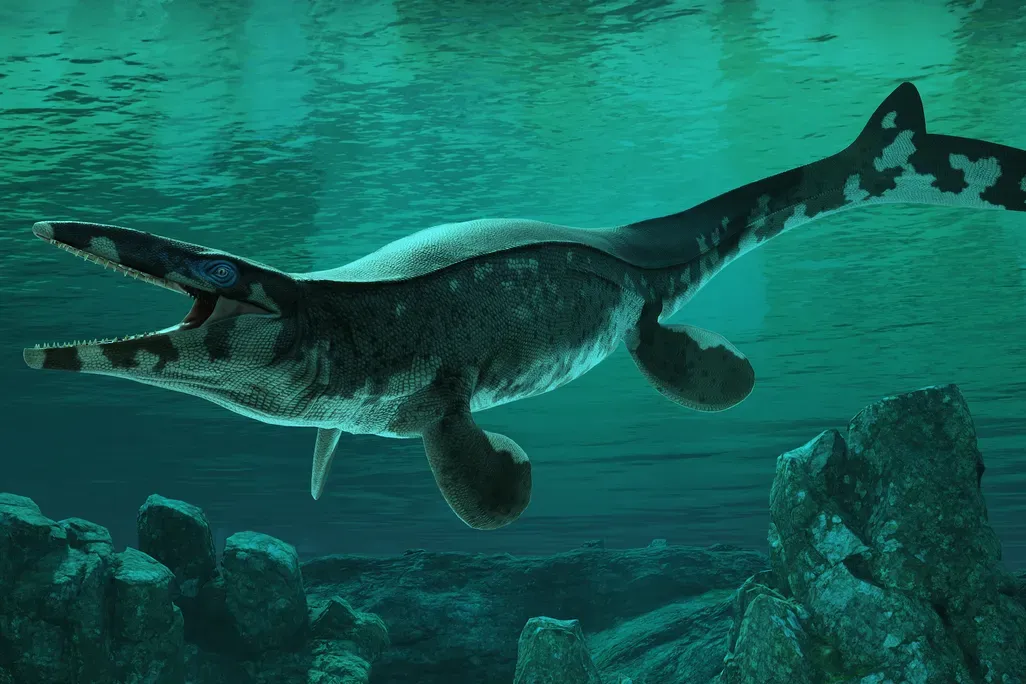
Earth was a scary place between 66 million and 145 million years ago, during the Cretaceous period. Tyrannosaurus rex roamed the land. A new fossil analysis shows that another "T. rex" hunted in the ancient oceans even earlier.
Researchers found a new species of mosasaur, an ancient aquatic lizard. They named it Tylosaurus rex because of its huge size. The name means "king of the knob lizards," similar to the land T. rex's name, "king of the tyrant lizards."
Amelia Zietlow, a paleontologist at the History Museum at the Castle in Wisconsin, co-authored the study. She told National Geographic that this animal truly deserves the name. She noted that half of its features are related to having a bigger jaw and bite.
We're a new kind of news feed.
Regular news is designed to drain you. We're a non-profit built to restore you. Every story we publish is scored for impact, progress, and hope.
Start Your News DetoxUncovering the Sea Tyrant
The extinct animal was identified from 80-million-year-old fossils. These fossils were mostly found in northern Texas over several decades and are now in museums. Before, they were thought to be part of a different mosasaur species, T. proriger.
T. proriger was the first known Tylosaurus species. It was named about 150 years ago for its jaw tips, which might have been used like a battering ram.
About 15 years ago, Michael Polcyn, a paleontologist at Southern Methodist University and study co-author, noticed something odd. He saw strange features in an unusually large T. proriger.
More recently, Zietlow saw a T. proriger specimen at the American Museum of Natural History that seemed surprisingly big. By comparing this specimen to the T. proriger holotype fossil, the one that defines the species, the researchers realized it had been misidentified.
The team then searched museum collections across North America. They found over a dozen similar large mosasaur fossils. Their analysis showed these animals would have been taller than T. proriger. They also had mouths full of finely serrated teeth, which is unusual for mosasaurs.
Most T. proriger specimens are about 84 million years old and come from modern-day Kansas. However, the newly identified fossils are about four million years younger and mostly from Texas.
A New King of the Cretaceous
This evidence pointed to a new, enormous species. It could grow to 43 feet long, roughly the length of a school bus. In comparison, T. proriger reached up to 31 feet long.
Tiago Simões, an evolutionary biologist at Princeton University not involved in the study, told National Geographic that tylosaurs are already known for being among the largest mosasaurs. He believes this study further supports them as the largest group of mosasaurs ever.
Polcyn and Zietlow were not the first to notice something unusual about T. proriger specimens. In the late 1960s, paleontologist John Thurmond realized that tylosaurs from northeast Texas were unusually large. He thought they might be an unrecognized species. He unofficially called them "Tylosaurus thalassotyrannus," meaning "sea tyrant."
Polcyn found a note Thurmond had written about this. The team's new species name honors that nickname. Polcyn told the Dallas Morning News it was "serendipity."
The Tylosaurus rex of the sea had bone features that showed incredibly strong jaw and neck muscles. This suggests it was a terrifying predator, likely "meaner" than other mosasaurs. Ron Tykoski, curator of vertebrate paleontology at the Perot Museum of Nature and Science and study co-author, said the team found evidence of violence within this new species that was greater than in other Tylosaurus specimens.
For example, a T. rex fossil at the Perot Museum, called "The Black Knight," is missing part of its snout and has a broken lower jaw. Researchers believe these injuries were likely caused by other members of its own species.
This study reveals another king of the Cretaceous period. Zietlow noted that "everything is bigger in Texas, and that includes the mosasaurs, apparently."
Deep Dive & References
A new species of Tylosaurus (Mosasauridae) from the Niobrara Formation of North America and the evolution of the Tylosaurus proriger complex - Bulletin of the American Museum of Natural History, 2024