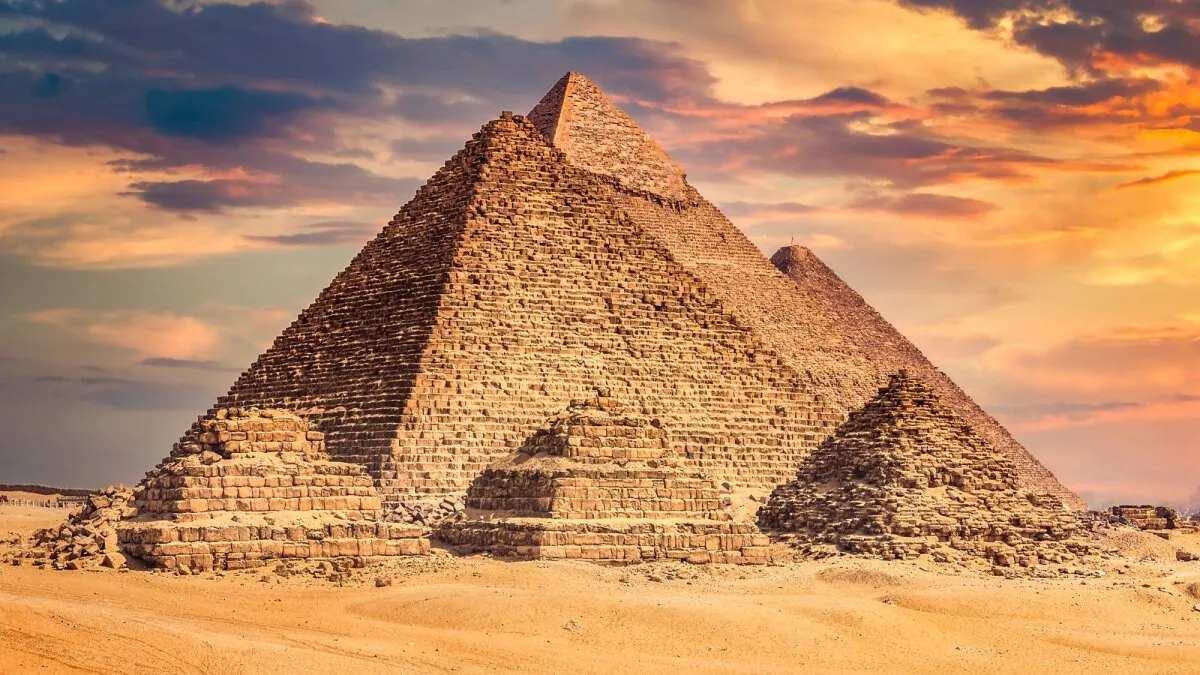
The Great Pyramid of Giza has been standing for over 4,500 years, shrugging off countless earthquakes like they were mere inconveniences. Cairo, for example, got rattled by a 5.8 magnitude quake in 1992, which nudged a few outer stones of the pyramid. The main structure? Barely flinched.
So, what's its secret? A new study suggests the pyramid might be a natural-born earthquake dodger, thanks to how it vibrates. But before we crown the ancient Egyptians as seismic engineering geniuses, there's a catch – or rather, a few shrewd observations.
Shaking Things Up
Researchers measured the pyramid's subtle wobbles under normal conditions and found its natural frequencies hum between 2.0 and 2.6 hertz. The surrounding soil, however, vibrates at a much lazier 0.6 Hz. Think of it like this: every structure has a natural rhythm, much like a child on a swing. If you push the swing at just the right time, it soars. Push at the wrong time, and it just… sits there.
We're a new kind of news feed.
Regular news is designed to drain you. We're a non-profit built to restore you. Every story we publish is scored for impact, progress, and hope.
Start Your News DetoxBuildings behave similarly during an earthquake. If the ground's shaking frequency perfectly matches a building's natural frequency, you get resonance. This is when movements amplify, turning a wobble into a full-blown structural tantrum. The Tacoma Narrows Bridge, famously dubbed "Galloping Gertie," took this concept to its logical, destructive conclusion back in 1940. Curiously, the study also noticed fewer vibrations near the "relieving chambers" above the King's Chamber. These are thought to distribute the immense weight above, but they might also be cleverly redirecting vibrational energy. Which, if you think about it, is both impressive and slightly terrifying.
This frequency mismatch between the pyramid and the ground is key. If they're not vibrating in sync, the ground has a harder time transferring its destructive energy into the pyramid. It's like trying to dance with someone who's listening to a completely different song – a lot of awkwardness, not a lot of successful energy transfer.
The Survivorship Bias
Now, for the dry wit: The pyramid's resilience doesn't necessarily mean the builders were thinking, "Hmm, how do we make this thing earthquake-proof?" It could be a happy accident of excellent practical engineering.
This brings us to survivorship bias, a concept famously illustrated during WWII. Statisticians were asked where to add armor to planes. The obvious answer? Reinforce the spots with the most bullet holes. But Abraham Wald, a brilliant statistician, argued the opposite: the planes with bullet holes in those spots made it back. The planes that didn't return were missing from the data. The real weak spots were where the planes didn't have holes, because getting hit there meant total failure. Ancient structures are similar. We marvel at the ones still standing – the aqueducts, the temples, the pyramids. But what about all the ones that crumbled, had shoddy foundations, or were simply abandoned? They're gone, making the survivors look like super-geniuses by default.
Built to Last (Regardless of Earthquakes)
So, the Great Pyramid's survival isn't magic, nor is it definitive proof of ancient seismic design. It's got a wide base, a low center of gravity, a tapering shape, symmetrical design, a solid limestone foundation, and it's built from a truly massive amount of stone. It's short, stiff, and well-founded – not exactly a recipe for dramatic collapse.
These were simply excellent, pragmatic engineering choices, perhaps born from centuries of building experience, observation, or even cultural reasons. The earthquake benefits might be real, even if they weren't the original design goal. It just goes to show that sometimes, simply building something incredibly well is enough to make it a legend. And a surprisingly good dancer, apparently.