Seismic waves move through Earth's interior at different speeds depending on their direction. This is called seismic anisotropy. Scientists often see this effect under subduction zones, especially near "stagnant slabs" deep inside the Earth. However, they haven't been sure why this happens.
Water-Bearing Minerals and Seismic Anisotropy
Researchers from Ehime University studied how special water-bearing minerals deform. These minerals can survive in cold, wet slabs deep within the Earth. The team focused on two minerals, δ-AlOOH and its solid solution with phase H (δ-H). These minerals are stable in the relatively cool conditions found in deep slabs.
The scientists used high-pressure and high-temperature experiments to mimic the conditions deep inside Earth. They wanted to understand how these hydrous minerals deform within subducting slabs in the mantle transition zone and the uppermost lower mantle.
We're a new kind of news feed.
Regular news is designed to drain you. We're a non-profit built to restore you. Every story we publish is scored for impact, progress, and hope.
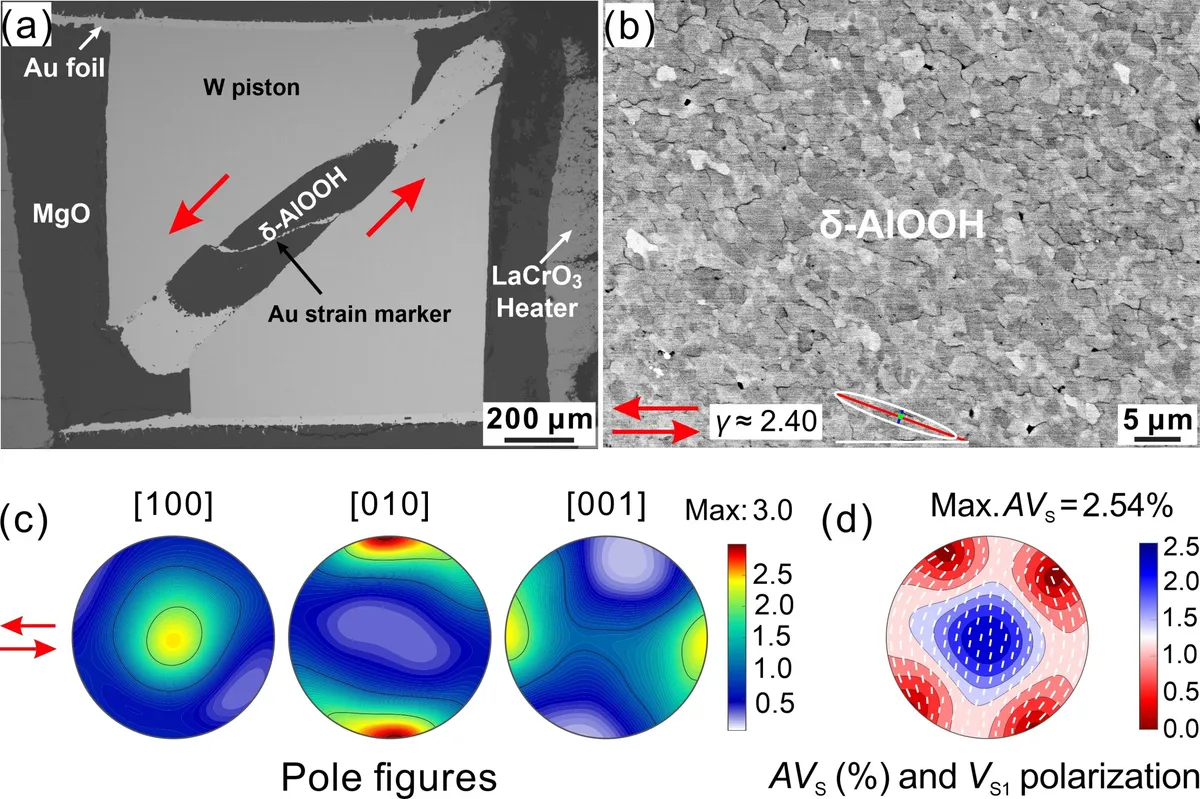
Start Your News Detoxshear deformation cell assembly and (b) microstructure of a shear-deformed δ-AlOOH aggregate deformed at 20 GPa and 950°C, corresponding to lower mantle transition zone conditions. (c) CPO pole figures show that the (010) lattice plane preferentially aligns parallel to the shear plane after deformation, whereas [001] aligns subparallel to the shear direction. (d) Shear-wave anisotropy and polarization directions (white dashes) of the faster shear-wave velocity in the shear-deformed δ-AlOOH aggregate. Credit: Geophysical Research Letters (2026). DOI: 10.1029/2026gl122235") Images show the (a) shear deformation cell assembly and (b) microstructure of a shear-deformed δ-AlOOH aggregate deformed at 20 GPa and 950°C, corresponding to lower mantle transition zone conditions. (c) CPO pole figures show that the (010) lattice plane preferentially aligns parallel to the shear plane after deformation, whereas [001] aligns subparallel to the shear direction. (d) Shear-wave anisotropy and polarization directions (white dashes) of the faster shear-wave velocity in the shear-deformed δ-AlOOH aggregate. Credit: Geophysical Research Letters (2026). DOI: 10.1029/2026gl122235
The study, published in Geophysical Research Letters, showed that when these minerals deform, they develop strong crystallographic preferred orientations (CPOs). This creates a specific type of seismic anisotropy. In this type, vertically polarized shear waves travel faster than horizontally polarized ones when the flow is horizontal.
 Schematic cross-sections of stagnant slabs with stability fields of selected hydrous phases in cold slabs. Blue dots indicate regions where ~15 vol.% δ-AlOOH/δ-H within isotropic mantle rocks is sufficient to explain the seismic anisotropy observed near stagnant slab tops in the lower mantle transition zone (ξ = 0.995). Credit: Geophysical Research Letters (2026). DOI: 10.1029/2026gl122235
These findings, combined with seismic observations, suggest that hydrous minerals play a big role in the seismic anisotropy seen near flattened slab tops deep inside Earth.
Deep Dive & References
Deformation of δ‐AlOOH and Its Solid Solution With Phase H as a Potential Source of Intra‐Slab Seismic Anisotropy in the Mid‐Mantle - Geophysical Research Letters, 2026