Turns out, you don't need to visit a distant planet to get a pretty good idea of what its surface looks like. You just need the James Webb Space Telescope and a seriously clever technique. Scientists have now pulled off their best peek yet at a faraway world, getting a surprisingly clear picture of its rocky, desolate surface.
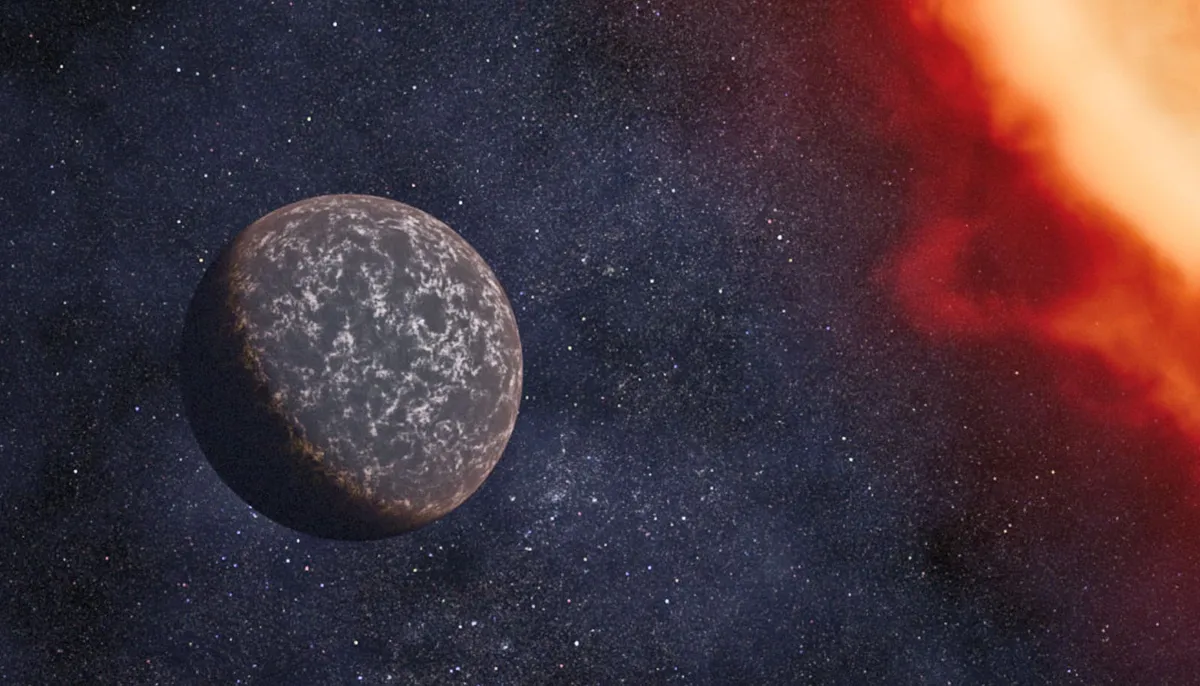
Meet Kua'kua, also known as LHS 3844 b. It's 48 light-years away, which, for context, is about 282 trillion miles. Kua'kua is roughly twice Earth's mass but zips around its star so fast that a year there lasts just half an Earth day. And it's not winning any "most habitable" awards.
Researchers from the University of Chicago peered at Kua'kua and found a dark, solid surface, likely basalt rock – the kind you see forming from volcanic activity on Earth, like in Iceland or Hawaii. It probably doesn't have Earth-style plate tectonics, and definitely not much of an atmosphere. Basically, it's a dry, dark, rocky, and very still place, with one side perpetually baking at 1,300ºF and the other perpetually in cold darkness. Not exactly prime real estate.
We're a new kind of news feed.
Regular news is designed to drain you. We're a non-profit built to restore you. Every story we publish is scored for impact, progress, and hope.
Start Your News DetoxHow You Stalk a Distant Planet
Most exoplanets are too tiny and too far away to just point a telescope at and snap a selfie. So, scientists get creative. They use something called the "secondary eclipse technique." It's less dramatic than it sounds, but super effective.
Here’s the gist: you measure the light from a star system. Then, you wait for the planet to pass behind its star. The slight dip in light tells you what's coming only from the planet. This data is the goldmine for figuring out what its atmosphere and surface are made of. It's like seeing a shadow and knowing the shape of the thing making it.
This technique works wonders for big gas giants, but smaller, rocky worlds – the ones most relevant to finding life as we know it – are much tougher. Enter the James Webb Space Telescope, which, according to graduate student and co-author Brandon Coy, has "opened up a new era" for studying these challenging planets.
Why a Dark Rock Matters So Much
By analyzing data from three secondary eclipses, the team confirmed Kua'kua's surface is dark, likely covered in a weathered powder, a bit like our moon or Mercury. Crucially, they found no signs of an atmosphere with carbon dioxide or sulfur from volcanoes. Which is a relief, because volcanic sulfur tends to ruin your day.
The dark color is a big deal. A lighter surface might have hinted at a granite crust, which on Earth, forms with water and often suggests plate tectonics. And plate tectonics are thought to be key for maintaining a stable, life-friendly climate here on Earth. So, knowing if other planets have them is a pretty big deal for the "is anyone out there?" question.
While Kua'kua won't be in any tourism brochures soon, every new planet we manage to scrutinize this closely teaches us about how planets form and evolve. Our own solar system has just four rocky planets, and they're wildly different. The more data points we get from across the galaxy, the better we understand the ingredients that actually make a world stable and, perhaps, habitable. And that's a knowledge worth digging for, even if the digging is done with light years of data.