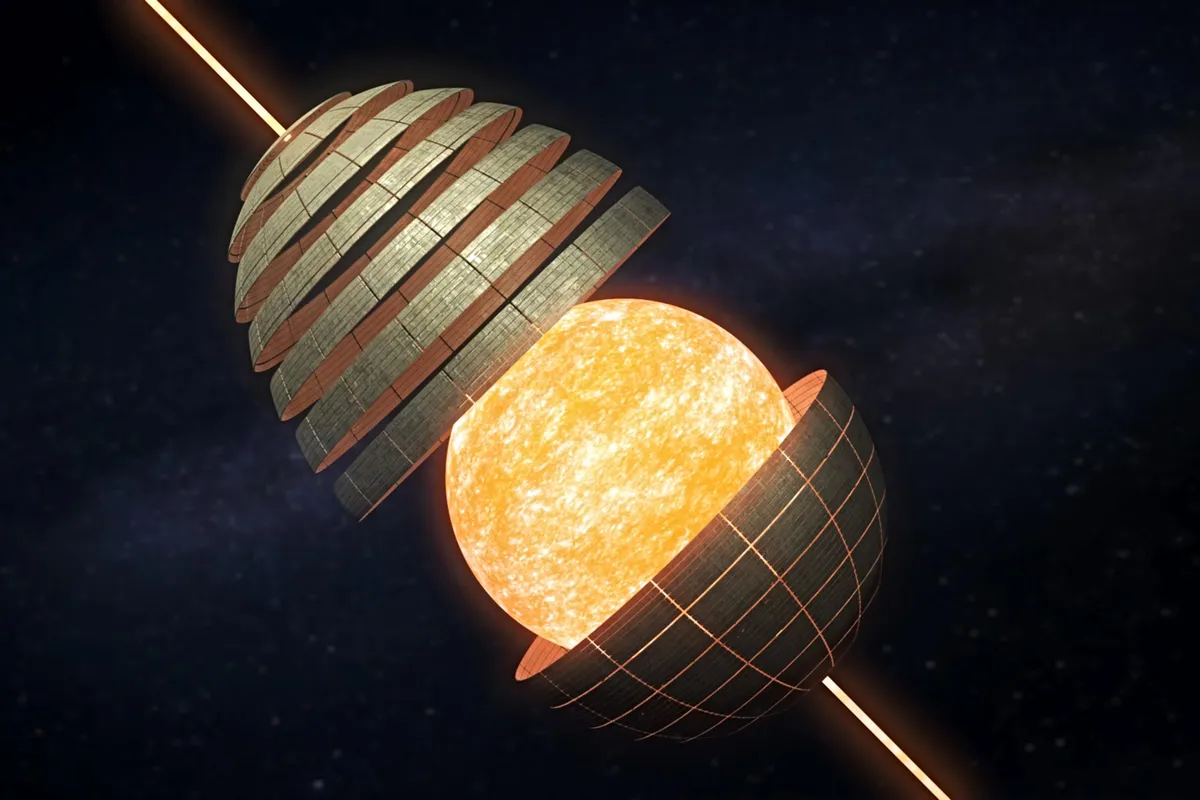
Astronomers are looking for "Dyson spheres," which are huge structures that advanced alien civilizations might build around stars. These structures would capture a star's energy. Scientists believe these aren't solid shells but rather swarms of satellites.
The key is to find stars that give off unusually cold, clean infrared signals. This could be a sign of a Dyson swarm.
Finding Alien Megastructures
Physicist Freeman Dyson first suggested the idea of a Dyson sphere in 1960. Since then, it has become a major focus in the search for alien life. The idea is that a super-advanced civilization could build a structure around its star to harness almost all of its energy.
We're a new kind of news feed.
Regular news is designed to drain you. We're a non-profit built to restore you. Every story we publish is scored for impact, progress, and hope.
Start Your News DetoxA new study by Amirnezam Amiri from the University of Arkansas explores what these structures might look like from Earth. It also points out which types of stars are best for searching for Dyson swarms.
Why Small Stars Are Better Targets
Red dwarfs are a good place to look. These are the most common stars in our galaxy. They burn their fuel very slowly and can last for trillions of years, much longer than the universe has existed.
Red dwarfs are also smaller than our Sun. This means a Dyson swarm could orbit closer, about 0.05 to 0.3 AU from the star. This would require less material to build the structure.
White dwarfs might be even better for engineering. These are the dense, cooled remains of stars like our Sun. They are tiny, with a radius about one percent of their original star. Around a white dwarf, a Dyson swarm could orbit just a few million kilometers from the surface. This would make building a huge energy collector much easier.
White dwarfs can also give off steady energy for billions of years, making them reliable power sources for a long time.
How Starlight Becomes Heat
If a star were surrounded by such a megastructure, it would look very different. Astronomers use the Hertzsprung-Russell (H-R) diagram to classify stars by temperature and brightness. However, a Dyson sphere would block all of a star's natural light. This would completely change its position on the diagram.
Energy cannot be created or destroyed. So, the Dyson sphere would have to emit the same amount of radiation it absorbs from the star. It would release this energy as heat, or infrared light. Essentially, a Dyson sphere absorbs starlight, uses the energy, and then emits it as heat.
This process would shift the star's position far to the right on the H-R diagram, where lower temperatures are mapped. The overall brightness wouldn't change, but it would be shifted into the infrared spectrum. Since H-R diagrams use total brightness (across all light types), the star would appear at the same vertical level as its host star, whether a red or white dwarf.

The key is how far to the right the star would move. A typical red dwarf has a surface temperature of about 3000 Kelvin. A Dyson sphere around a star could have a temperature as low as 50 Kelvin. This is two hundred times colder. There are no natural stars in this temperature range, making such an object a strong candidate for a Dyson swarm.
Unique Signals Could Stand Out
Another clue for a Dyson swarm is a lack of dust. Stars without a Dyson sphere usually show a spectral line for silicate emission, which comes from dusty disks. However, radiator panels wouldn't have any dust around them. This means they would appear "clean" to a spectrograph.
In a "swarm" design, there would likely be small gaps between the solar collectors, or parts of the swarm might be thicker than others. This makes the structure physically possible to build. Modern calculations show that a complete, solid Dyson sphere is not feasible, even with small radii.
If there were small gaps, the star's light curve would be erratic and unnatural as the structure rotates.
Existing Candidates for Telescopes
The James Webb Space Telescope is perfect for looking for these structures because it specializes in infrared light. Even older telescopes like WISE are being used for this search.
In May 2024, Project Hephaistos identified seven strong Dyson sphere candidates, all red dwarfs, from a catalog of 5 million stars. One candidate was ruled out because a supermassive black hole perfectly aligned in the background explained the unusual readings.
This leaves five other potential candidates that need closer observation. This new research will help astronomers better understand what to look for to find these elusive alien megastructures.
Deep Dive & References
Dyson spheres on H-R diagram - arXiv, 2026