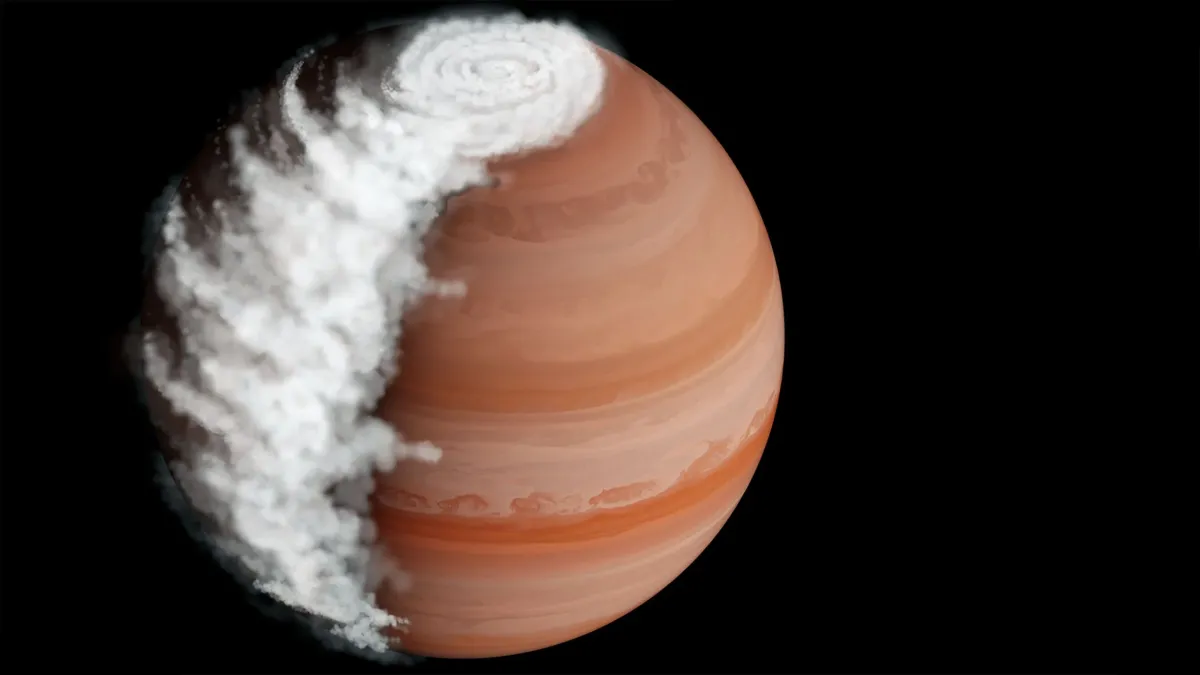
On the distant exoplanet WASP-94A b, the weather changes dramatically each day. Clouds made of rock-forming minerals appear in the morning and then disappear by evening as the planet's atmosphere moves into hotter areas.
This planet is a "hot Jupiter," a large planet that orbits very close to its star. It is about 700 light-years from Earth in the Microscopium constellation. Scientists used the James Webb Space Telescope (JWST) to study how starlight changed as the planet passed in front of its star.
This research offers one of the clearest views yet of a daily cloud cycle on an exoplanet. By separating cloudy and clear parts of the atmosphere, scientists could better understand the planet's chemistry. This also helped solve an earlier mystery about its makeup.
We're a new kind of news feed.
Regular news is designed to drain you. We're a non-profit built to restore you. Every story we publish is scored for impact, progress, and hope.
Start Your News DetoxDavid Sing, a professor at Johns Hopkins and co-author, noted that clouds have long made it hard to study hot Jupiter planets. He said it was like trying to see through a foggy window. Now, they can see clearly, identify what the clouds are made of, and understand how they form and vanish as they move around the planet.
The findings were published in the journal Science.
JWST Shows a Planet's Daily Weather
To study WASP-94A b, Sing and his team observed the planet as it crossed in front of its star. The JWST allowed them to measure the planet's leading edge (morning) and its trailing edge (evening).
The difference was striking. WASP-94A b's mornings are full of clouds made of magnesium silicate, a mineral found in rocks. However, its evenings are clear of clouds.
The team has two ideas for why this happens. Strong winds might push clouds high up on the planet's cooler side. Then, these winds could drive them down on the hotter dayside, hiding them deep inside the planet before evening.
Another idea is similar to morning fog clearing on Earth, but under much more extreme conditions. Clouds might form in the dark nightside and then vaporize as they reach the dayside, where temperatures are over 1,000 degrees Celsius (1,832 degrees Fahrenheit).
Sing called this a "huge surprise." He explained that while some temperature differences between morning and evening are expected, the extreme difference in cloud cover changes their entire understanding of the planet.
A Clearer View of the Atmosphere
Because the evening side of WASP-94A b is clear, researchers could study that part of the atmosphere in detail. This was something the Hubble Space Telescope could not do.
Sagnick Mukherjee, the lead author from Arizona State University, explained that previous observations with Hubble gave an average view, mixing cloud and atmosphere data. The JWST allows for more focused observations, which helped them see the cloud cycle.
The clearer evening view showed that WASP-94A b is more like Jupiter than earlier data suggested. Previous measurements, which combined cloudy and clear areas, indicated the planet had hundreds of times more oxygen and carbon than Jupiter. This was hard to explain with current planet formation models.
The new analysis shows that WASP-94A b has only about five times as much oxygen and carbon as Jupiter.
Similar Cloud Cycles May Exist Elsewhere
Hot Jupiters orbit very close to their stars, even closer than Mercury orbits our sun. This intense heat and radiation make them good places to study atmospheric chemistry and cloud behavior.
Using WASP-94A b as a guide, the team looked at eight other hot gas giants. They found the same type of cloud cycle on two more planets: WASP-39 b and WASP-17 b.
Sing and his team plan to use new JWST data to study cloud cycles on many different types of exoplanets, including a gas giant in the habitable zone.
Deep Dive & References
Cloudy mornings and clear evenings on a gas giant exoplanet - Science, 2026