Researchers have developed a new way to measure the complexity of nanomaterials. This breakthrough could change how engineers design materials. Instead of just discovering new materials, they can now design them with specific properties.
This new method goes beyond simple materials like random nanoparticle coatings or tightly packed crystals. It uses a mix of ordered crystals and randomness, which is key to complexity. This combination allows for new material properties.
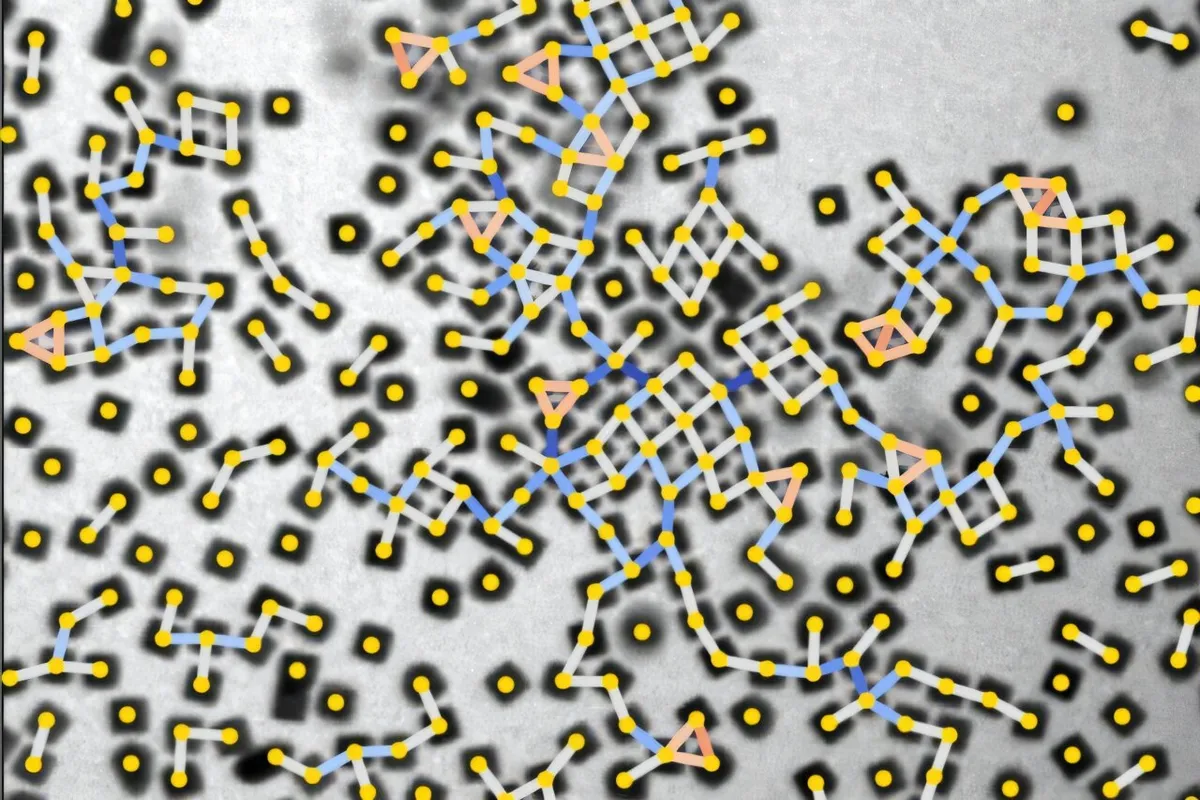
Nick Kotov, a co-author of the study, explained that these structures have clusters connected by bridges. These interconnected groups of particles create something new. The research was published in Science.
We're a new kind of news feed.
Regular news is designed to drain you. We're a non-profit built to restore you. Every story we publish is scored for impact, progress, and hope.
Start Your News DetoxShowing Complexity in Action
The team tested their network structures with several nanoparticle systems. For example, they created loose networks of gold nanoparticle clusters. These networks strongly reflected infrared light. Regular gold nanoparticle suspensions or crystals do not do this well.
The researchers also provided a guide for others to use this complexity framework. It helps quantify order and disorder and predict material properties.
Xiaoming Mao, another co-author, noted that graph-based measurements link strongly with material properties. This offers a new way to design materials for future technologies. It allows engineers to use complexity as a design tool.
How Complexity is Measured
The idea that complexity relates to a material's abilities came from Nobel laureate Murray Gell-Mann. He said complex structures combine order and randomness. Simple structures have only one or the other.
Gell-Mann also noted that complexity at small scales affects larger scales. Bones are a good example. They have curved nanocrystals that form twisted plates. These plates then combine into larger groups that weave with collagen protein. This layered complexity makes bones strong but not brittle.
To apply this to synthetic materials, researchers needed a way to calculate complexity. Gell-Mann had a general idea, but no specific numbers. Nick Kotov said that without numbers, engineers cannot design complexity in real materials. Now, they can.
The researchers used graph theory to put a number on complexity. This method is used to understand interactions in large systems like ecosystems. In their graphs, each particle is a node. A line connects nodes when particles are close enough to interact.
Paul Bogdan, a co-corresponding author, explained that graph theory helps measure how particles organize. This ranges from tiny local clusters to larger, global networks.
For the bone example, nanocrystals could be interconnected nodes. Clusters of nodes would represent plates. This graph could then be part of a larger graph showing how plates combine.
The team created such graphs for several nanoparticle systems. They used a transmission electron microscope to image hundreds of nanoparticles forming crystals. These images guided the graph creation. Computer simulations helped scale up to systems with over 10,000 nanoparticles.
These graphs allowed researchers to turn the network of nodes into metrics. These metrics measured how interactions spread through the group. They also showed how easily the structures could change.
Connecting Structure to Light Behavior
The complexity metric closely matched how gold nanoparticles reflected light. When gold particles were randomly spread in liquid, they weakly reflected green light. But as loosely packed crystal networks formed, they began to reflect infrared light.
As the crystals became more ordered and less complex, they reflected less infrared light. The same complexity metric also linked to how tin-doped indium oxide nanoparticles absorbed and reflected light. This material is often used in touchscreens.
Thomas Truskett, a co-corresponding author, said the next steps involve designing functional materials with specific complexity levels. They also want to understand how these structures create new property combinations.
Deep Dive & References
Decoding collective dynamics and complexity in nanoparticle assemblies using graph theory - Science, 2026