A new genetic study is changing how we understand Europe's ancient populations. It reveals complex interactions between early hunter-gatherers, farmers, and later Bronze Age migrants. This research challenges the simpler idea that Europe was settled by just three major migrations.
For a long time, many geneticists thought Europe's population history was straightforward. They believed there were three main waves of migration from the east. First, hunter-gatherers arrived over 40,000 years ago. Then, about 9,000 years ago, farmers from Anatolia spread across the continent during the Neolithic age. Finally, around 5,000 years ago, the Corded Ware people from the Russian steppe brought in the European Bronze Age. Most Europeans today have ancestry from all three groups.
However, this picture was too simple. New research highlights more complex interactions, especially in northwest Europe.
We're a new kind of news feed.
Regular news is designed to drain you. We're a non-profit built to restore you. Every story we publish is scored for impact, progress, and hope.
Start Your News DetoxThis study looked at prehistoric populations in Belgium and the Netherlands. It also identified where a migration into Britain came from during the late Neolithic. This migration seems to have replaced about 90% of Britain's Neolithic farmers.
Earlier ancient DNA research already hinted at a more complex story. For example, when the first Neolithic farmers moved into Europe, they didn't mix much with local hunter-gatherers. Their DNA still looked like their Anatolian ancestors. But 1,000 to 2,000 years later, they had absorbed a lot of local ancestry. Their hunter-gatherer ancestry grew from 10% to 30-40% in some areas. This showed that hunter-gatherers didn't just disappear as farmers expanded.
Surprising Mix in Northern Wetlands
The new research goes even further. About ten years ago, a research team at the University of Huddersfield started working with Professor John Stewart and archaeologists in Belgium. They analyzed DNA from Neolithic human remains found along the River Meuse in Belgium, dating back about 5,000 years.
This work became part of a larger project led by Professor David Reich and Dr. Iñigo Olalde at Harvard University. It included geneticists and archaeologists from across western Europe. The focus expanded to sites around the Lower Rhine–Meuse area, including wetlands and coastal regions. These sites covered cultures from late hunter-gatherers to the Bronze Age.
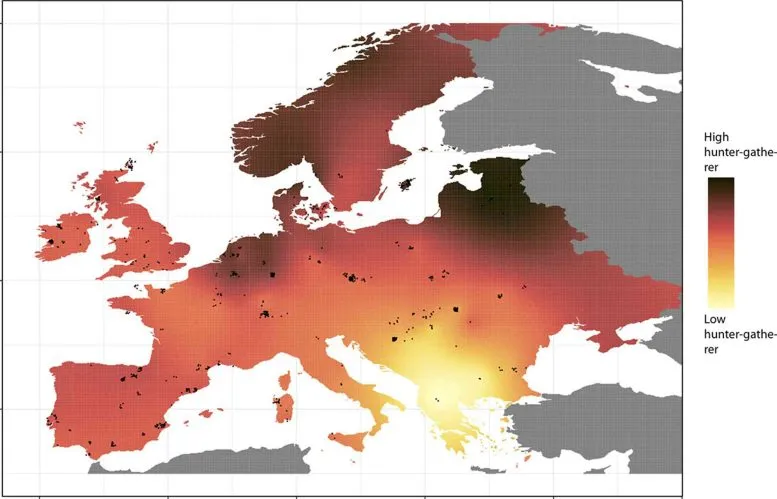
The fertile lands south of the Rhine-Meuse wetlands attracted early Neolithic farmers as far back as 5,500 BC. However, the rich resources of the northern wetlands were better suited for hunter-gatherers. Despite this, the results were surprising.
The DNA of people from later Neolithic times in Belgium showed at least 50% local hunter-gatherer ancestry. This was alongside the expected Anatolian farmer ancestry. This pattern also appeared in other water-rich areas in the region. Many earlier Neolithic Dutch samples from further north, like the Swifterbant culture, had almost 100% hunter-gatherer ancestry. These people were known for keeping their hunter-gatherer way of life while also adopting some farming.
Women's Role in Spreading Farming
The researchers then compared Y chromosome and mitochondrial DNA. These track male and female family lines. The Y chromosomes in the Belgian remains were all typical of hunter-gatherers. But three-quarters of the mitochondrial DNA came from Neolithic farmers from further south. This suggests that farming knowledge was brought into the "waterworld" hunter-gatherer communities by women.
These findings support a model called "frontier mobility" or "availability." This model, proposed by archaeologists in the 1980s, describes a contact zone between pioneer farming groups and hunter-gatherer areas. It suggests that contact and small movements across this frontier happened gradually, with trade and marriage alliances forming. Eventually, farming would develop alongside foraging, and then farming would become dominant.
The results suggest that women crossed this frontier more easily than men. It might have been the marriage of Neolithic women into hunter-gatherer communities that helped hunter-gatherers adopt farming full-time. Farming was becoming widespread across Europe, so the alternative for hunter-gatherers was likely extinction.
This model might also explain how hunter-gatherer ancestry increased in other parts of Europe during the later Neolithic. It challenges the idea that hunter-gatherer women would "marry up" into more "advanced" farming groups. Instead, it shows that farming women married into hunter-gatherer groups.
Bell Beakers and the Bronze Age
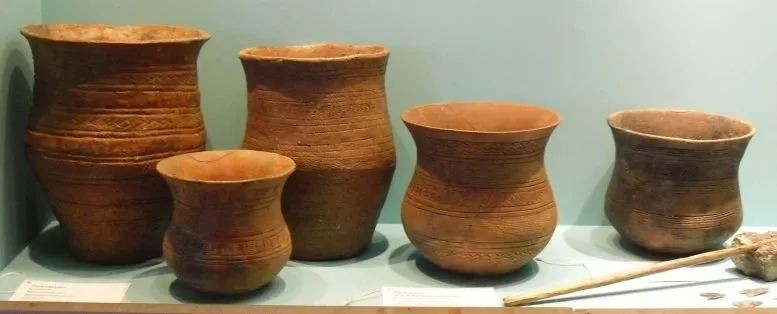
Around 4,600 years ago, people started moving again. A new group of settlers, pastoralist-farmers from the Russian steppe, began to enter the Rhine area. They were part of the Corded Ware culture. As more people moved in from the east, they transformed into what is known as the Bell Beaker culture.
Within a few centuries, the genetic makeup of the Rhine-Meuse region changed completely. Less than 20% of the ancestry of people living there 4,400 years ago came from the earlier farmers and hunter-gatherers. At least 80% of their ancestry was now from the steppe.
The Bell Beaker people quickly expanded in all directions, bringing the Bronze Age to central Europe. They also spread across the English Channel into Britain, reaching as far north as Orkney. It seems that the British farmers who built Stonehenge largely disappeared. The reasons for this are still unclear. However, future archaeological and ancient DNA research may provide more detailed insights into these changes.