For over a century, scientists have been scratching their heads over high-temperature superconductors. These materials, discovered in 1911, have some truly wild electrical properties — like zero resistance and the ability to levitate magnets. Very cool party tricks, but the how of it all has remained stubbornly out of reach.
Now, a team led by Junfeng He from the University of Science and Technology of China (USTC), working with Qikun Xue and Zhuoyu Chen from Southern University of Science and Technology (SUSTech), has finally pulled back the curtain on a crucial piece of the puzzle. They've been digging into nickelate superconductors, which are basically the new kids on the high-temp block, offering a fresh angle on an old problem.
No Nodes is Good News
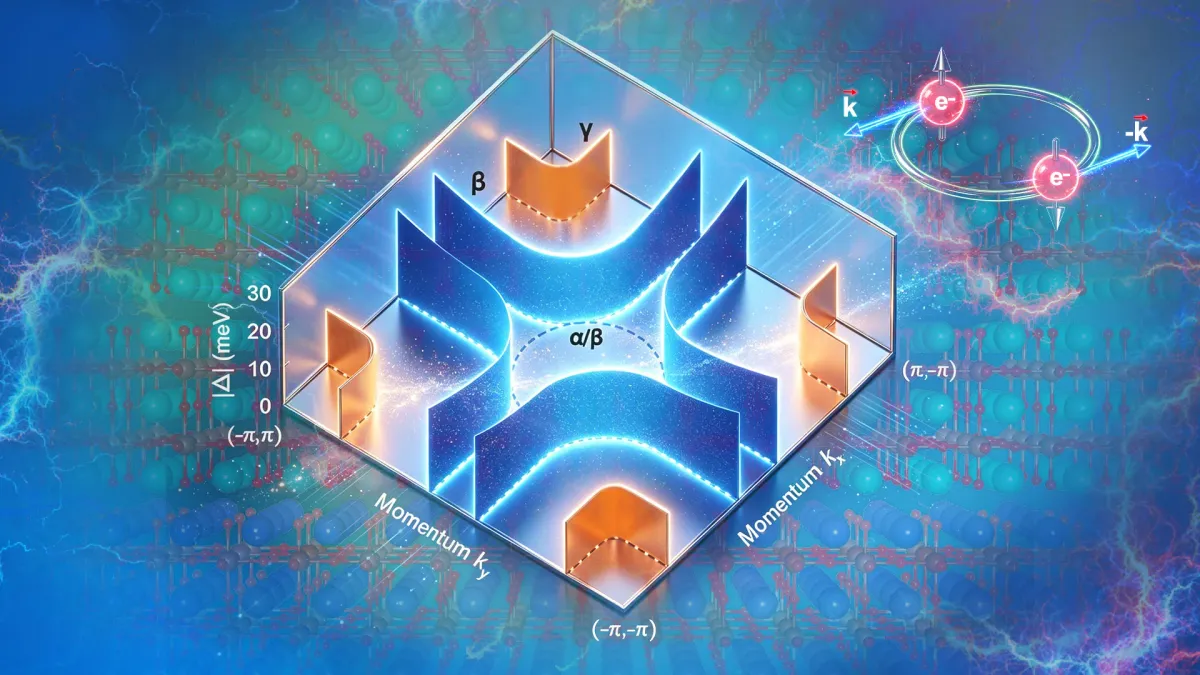
One of the biggest questions in high-temp superconductivity revolves around something called the "superconducting gap symmetry." Imagine the energy required to break apart the electron pairs that allow for superconductivity. This 'gap' can have 'nodes' – points where the energy required is zero. Finding out if a superconductor has these nodes or not is like getting a critical clue in a cosmic detective novel.
We're a new kind of news feed.
Regular news is designed to drain you. We're a non-profit built to restore you. Every story we publish is scored for impact, progress, and hope.
Start Your News DetoxUsing a technique called angle-resolved photoemission spectroscopy (ARPES) — which sounds like something from a sci-fi movie, but is actually just very precise electron sniffing — the team looked at thin films of a specific type of nickelate. Their big discovery? No nodes. Anywhere. This is a huge deal because it points to an "s-wave" symmetry, narrowing down the potential mechanisms for how these materials work.
The Electron Dance
But wait, there's more! Another head-scratcher has been how electrons actually pair up in these materials. Conventional wisdom suggests "electron-boson coupling" is involved – essentially, electrons team up by interacting with other particles (bosons) in the material.
And guess what the researchers found? A "dispersion kink" about 70 meV below the Fermi level. Which, for the rest of us, translates to a fingerprint of electron-boson coupling. It's the smoking gun, confirming that yes, these tiny particles are indeed doing a very specific dance to enable superconductivity.
Getting these delicate nickelate samples from Shenzhen to Hefei for testing was no small feat. The scientists had to invent a special liquid nitrogen-cooled, ultra-high vacuum transfer method just to keep the oxygen from escaping the samples. Because apparently, even superconductors are divas sometimes.
Published in Science, these findings don't just solve two major questions; they open up new pathways for designing future superconducting materials. Which, if you think about it, is a pretty electrifying prospect for everything from energy grids to quantum computing. Let that sink in.