For over a century, scientists have been scratching their heads about cosmic rays. These aren't your everyday sunbeams; we're talking about the most energetic particles in the universe, zipping around at speeds that make your head spin. Where do they come from? How do they get so much juice? It's been one of the universe's longest-running mysteries, a cosmic "whodunit" without a single clear suspect.
Now, thanks to the aptly named DAMPE (Dark Matter Particle Explorer) space telescope and an international team including the University of Geneva, we finally have a solid clue. Published in Nature, the findings reveal a shared, consistent pattern in how these high-energy particles behave. Think of it as finding a secret handshake among a bunch of intergalactic speed demons.
The Universe's Most Extreme Particles
Cosmic rays are wild. They make anything we can cook up in Earth-bound particle accelerators look like a toddler's toy car. While their precise origins are still a bit murky, the smart money's on places like supernova explosions, those spectacular stellar death throes, or the powerful jets screaming out of black holes and pulsars.
We're a new kind of news feed.
Regular news is designed to drain you. We're a non-profit built to restore you. Every story we publish is scored for impact, progress, and hope.
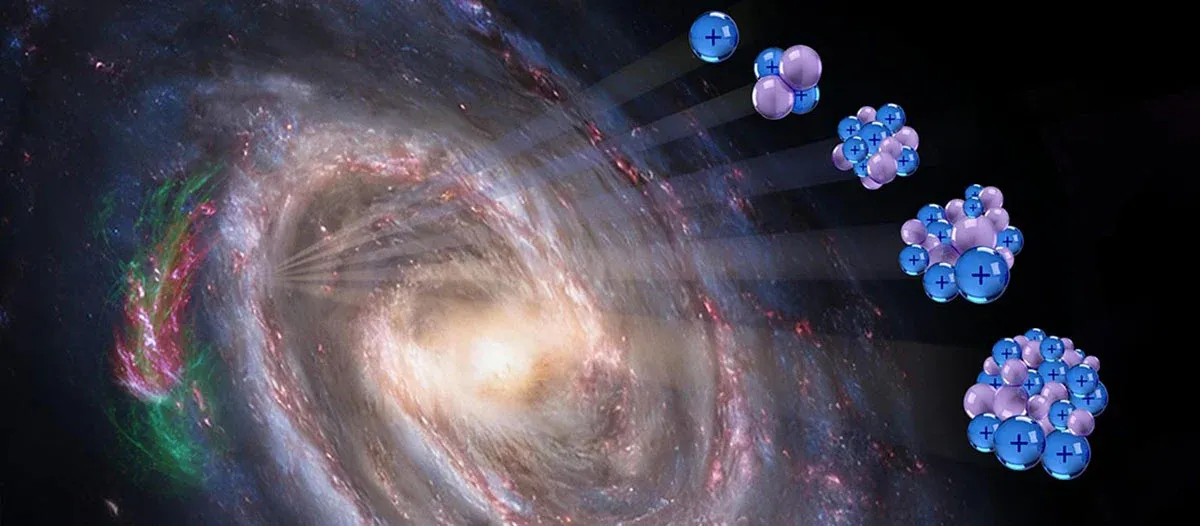
Start Your News DetoxThe DAMPE telescope, launched in 2015, has been diligently collecting data, and the astrophysics group at UNIGE's Department of Nuclear and Particle Physics (DPNC) has been instrumental in making sense of it. They've been peering at incredibly precise measurements of primary cosmic ray nuclei – everything from humble protons to chunky iron atoms.
What they found was a "spectral softening" — basically, after a certain energy level, the number of particles drops off much, much faster than expected. It's like a cosmic bouncer suddenly deciding, "Alright, party's over, folks," and clearing out the dance floor at a specific energy threshold.
This dramatic drop happens at about 15 teravolts (TV) of "rigidity" – which is basically a fancy way of measuring how much a particle's path is bent by magnetic fields. The crucial bit? This same pattern, at the same rigidity, shows up across different types of nuclei. Let that satisfying number sink in: the confidence level for this finding is 99.999%.
This discovery throws a serious wrench into older theories that focused on energy per nucleon (the energy divided by the number of particles in the nucleus). Instead, it strongly supports models where both the acceleration and the movement of cosmic rays are tied to this rigidity. Which, if you think about it, is both impressive and slightly terrifying. The universe, it seems, has its own set of rules, and we're just now starting to write them down. And if that's not enough to make you want to tell someone, consider that UNIGE researchers even developed advanced AI to help untangle this cosmic knot. Because apparently that's where we are now.