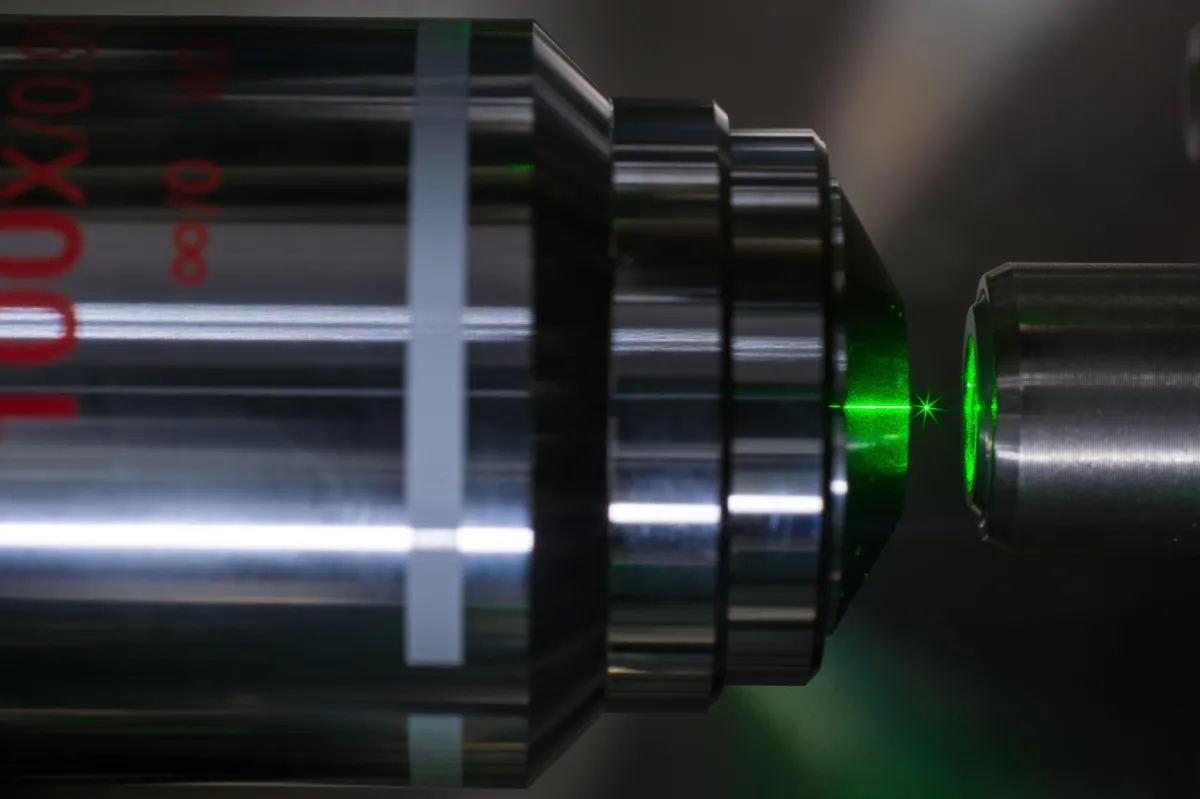
Lasers have transformed science and technology since the 1960s. They work by controlling photons, which are light particles. In recent years, scientists have applied this idea to other particles, including phonons, which are tiny units of vibration or sound.
Controlling phonons could lead to new discoveries, like understanding unusual quantum effects such as entanglement.
A New Way to Measure Gravity
A team from the University of Rochester and Rochester Institute of Technology created a new "squeezed phonon laser." This device can precisely control vibrations at a very small scale. This control might help scientists better understand gravity, how particles accelerate, and the rules of quantum physics.
We're a new kind of news feed.
Regular news is designed to drain you. We're a non-profit built to restore you. Every story we publish is scored for impact, progress, and hope.
Start Your News DetoxThe researchers published their findings in Nature Communications. They showed how they made these tiny units of mechanical motion act together like a laser.
Overcoming Noise for Better Accuracy
Nick Vamivakas, a professor of optical physics at the University of Rochester, first demonstrated a phonon laser in 2019. In that earlier work, phonons were trapped and floated using a special optical tool in a vacuum.
To make this tool practical for precise measurements, a big problem needed solving: noise. Noise is unwanted fluctuations that can interfere with signals and make measurements less accurate in both photon and phonon lasers.
Vamivakas explained that even though a laser looks steady, it has many fluctuations that cause noise. By carefully pushing and pulling on a phonon laser with light, they can greatly reduce these fluctuations.
Reducing Thermal Noise
The team used a method called "squeezing" to lower the thermal noise in the phonon laser. This reduction in background disturbance allows for much more precise measurements. Vamivakas noted that this improvement makes it possible to measure acceleration more accurately than with methods using photon lasers or radio waves.
Future Uses in Navigation and Physics
This more sensitive phonon laser could become a valuable tool for measuring gravity and other forces with high precision. This capability might lead to new navigation technologies. For example, scientists have suggested "quantum compasses" as very accurate, unjammable alternatives to GPS, which don't rely on satellites. Vamivakas is exploring if phonon lasers could help develop these systems.
Deep Dive & References
A two-mode thermomechanically squeezed phonon laser - Nature Communications, 2026