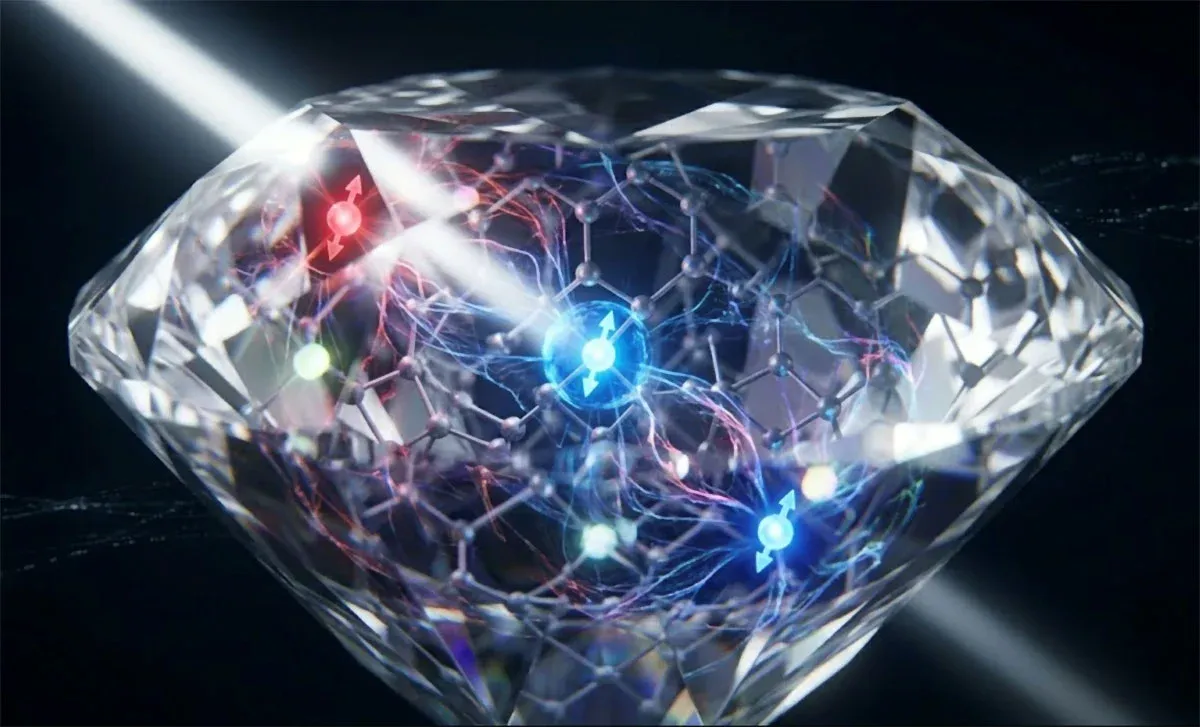
Researchers have found a new way to control tiny flaws in diamonds. They can gently stretch or squeeze the diamond crystal to change how these flaws behave at a quantum level. This discovery could lead to advanced sensors that can precisely measure pressure, temperature, and other physical changes.
These flaws are called "color centers." They are already used in quantum technologies like sensitive sensors and quantum communication. One type, the silicon-vacancy (SiV) center, is very promising because it emits bright, steady light, making it great for quantum devices.
How Stretching Diamonds Changes Quantum Behavior
An international team, including scientists from the Singapore University of Technology and Design (SUTD) and Yangzhou University in China, studied SiV centers. They looked at what happens when the diamond around these centers is squeezed or stretched. Using detailed computer models, they analyzed how the defect's atomic structure and light-emitting properties change under different mechanical conditions.
We're a new kind of news feed.
Regular news is designed to drain you. We're a non-profit built to restore you. Every story we publish is scored for impact, progress, and hope.
Start Your News DetoxThe team saw complex changes. When compressed, the defect stayed stable and kept its original shape. But when stretched by more than about 4%, it changed its structure. This change broke its symmetry and created a new atomic arrangement.
This structural shift also changed how the defect interacts with light. The researchers found that important optical features, like the color and brightness of the light emitted, changed smoothly and predictably as strain was applied.
Professor Yunliang Yue from Yangzhou University explained that these optical changes act like a "built-in ruler." By measuring the light from the defect, scientists can tell how much the material is being compressed or stretched.
New Possibilities for Quantum Sensors
Because of this consistent response, SiV centers could become excellent nanoscale sensors. Their optical signals change continuously with deformation, allowing for very precise measurements of pressure or strain, even at tiny scales.
The study also looked at the defect's magnetic properties, which are useful for techniques like electron spin resonance. These properties also shifted predictably under strain, offering another way to detect changes and expanding the sensor's abilities.
The researchers explained that as the diamond expands or contracts, the defect's electronic structure changes. This directly affects how it interacts with light and magnetic fields, linking basic quantum behavior to real-world uses.
These findings suggest that SiV centers could become reliable and adjustable parts for quantum sensing. This is especially useful in situations where materials are under mechanical stress, such as in high-pressure research, tiny devices, and advanced materials.
Assistant Professor Yee Sin Ang from SUTD noted that showing how mechanical deformation can precisely control the quantum properties of silicon-vacancy centers opens new doors for designing multi-functional quantum sensors. This work helps both understand the basics and guide practical applications for quantum defects.
Dr. Shibo Fang, an SUTD Research Fellow, added that the predictability of the response is exciting. The defect behaves in a very controllable way under strain, which is exactly what reliable sensing technologies need. This study sets the stage for future experiments and device integration.
The team believes that combining mechanical control with quantum defects could lead to new types of quantum devices. These could include adaptive sensors and hybrid systems that react in real time to changes in their environment.
Deep Dive & References
Effects of hydrostatic compression and tension on silicon-vacancy centers in diamond - Applied Physics Letters, 2026