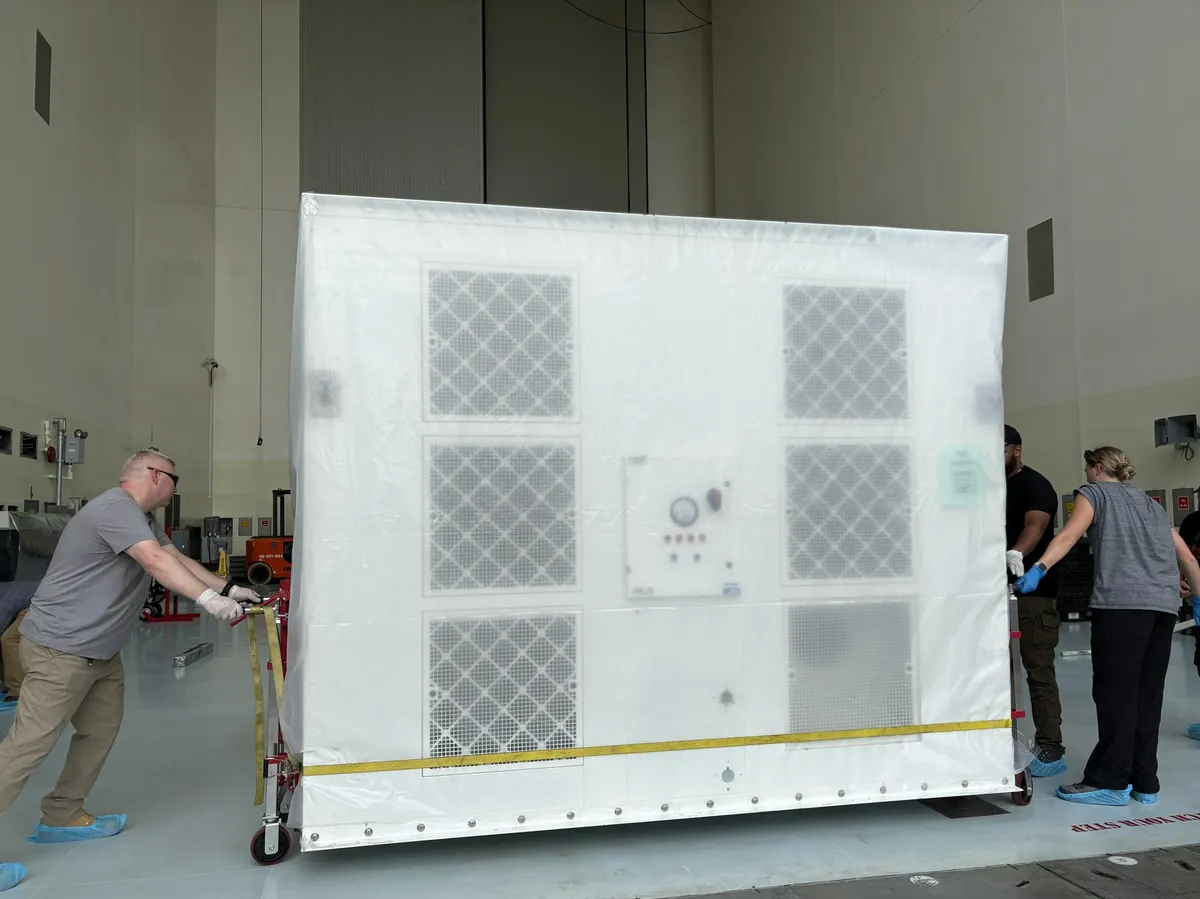
NASA's Nancy Grace Roman Space Telescope, destined to peek at the universe's biggest secrets, just received a critical delivery at Kennedy Space Center: eight enormous, 1,800-pound HEPA filter modules. Because apparently, even space telescopes need to breathe clean air.
These industrial-sized air scrubbers are headed straight for the Payload Hazardous Servicing Facility (PHSF), where Roman will get its final prep — including a full tank of fuel — before blasting off. The goal? To make the PHSF's clean room even cleaner, ensuring not a speck of dust interferes with the telescope's incredibly sensitive instruments.
And why all the fuss? This isn't just any telescope. Roman is basically an infrared super-eye, designed to give us panoramic views of the cosmos. Its mission is to tackle some truly mind-bending questions, like why the universe's expansion is mysteriously speeding up. (Spoiler: it's probably dark energy, but Roman is going to give us a much better look at it.)
We're a new kind of news feed.
Regular news is designed to drain you. We're a non-profit built to restore you. Every story we publish is scored for impact, progress, and hope.
Start Your News DetoxUnlocking Cosmic Mysteries
Using its Wide Field Instrument and a fancy Coronagraph Instrument, Roman will map how the universe has evolved over eons. It'll also be on the hunt for exoplanets, those fascinating worlds beyond our solar system, and help us understand how regular matter and its elusive cousin, dark matter, are distributed across the vast stretches of space and time.
Think of it as NASA's next-gen cosmic cartographer, ready to fill in the blank spaces on our universal map. All this groundbreaking science is set to launch as early as September, hitching a ride on a SpaceX Falcon Heavy rocket from Launch Complex 39A. Let's hope those filters are doing their job.