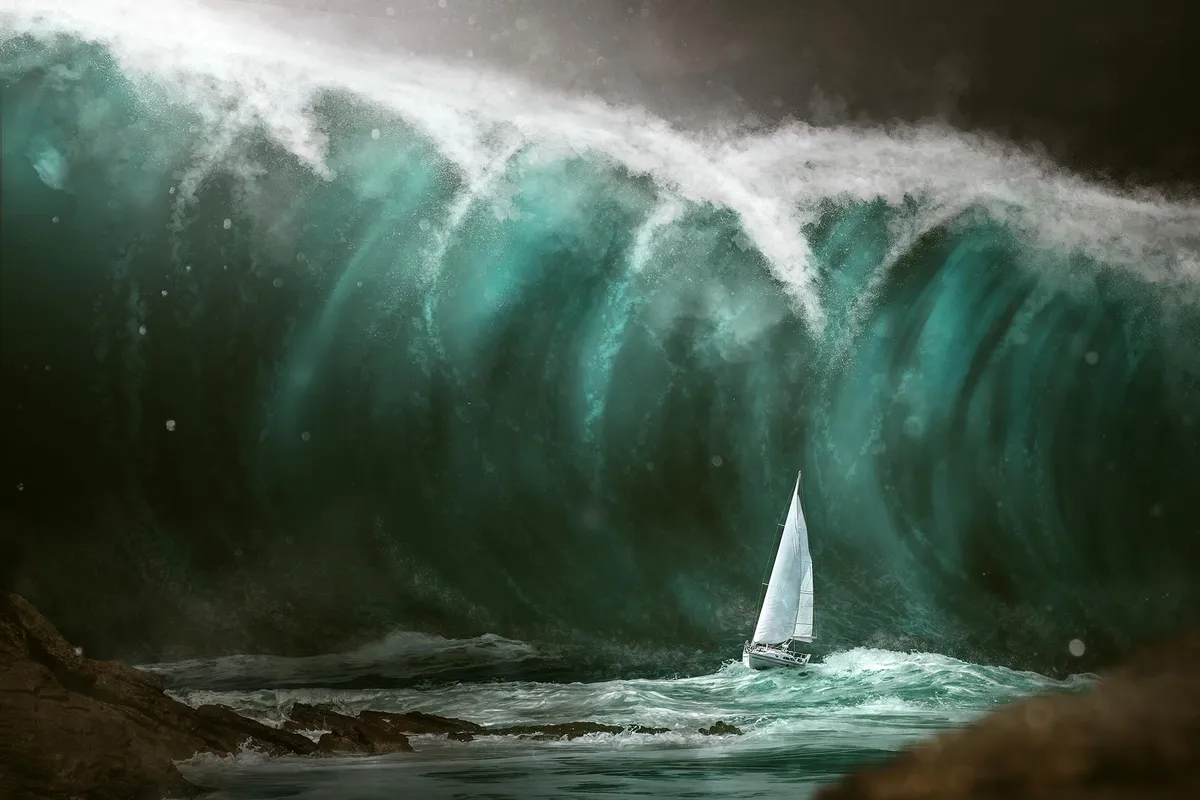
You know how tsunamis work, right? Big earthquake, big wave, everyone runs for higher ground. Simple. Except, apparently, not so much. A NASA satellite recently caught a massive Pacific tsunami in unprecedented detail, and what it saw is making scientists rethink everything they thought they knew about these oceanic monsters.
Turns out, tsunamis are a lot more complicated than a single, wall-of-water event. Who knew the ocean could be so dramatic?
The Satellite That Saw Too Much
It all started with an 8.8 magnitude earthquake off Russia’s Kamchatka Peninsula. That’s the sixth-largest quake since 1900, just to give you some perspective. It sent a tsunami racing across the Pacific, which is exactly when the Surface Water Ocean Topography (SWOT) satellite — a joint project by NASA and the French space agency — decided to show off.
We're a new kind of news feed.
Regular news is designed to drain you. We're a non-profit built to restore you. Every story we publish is scored for impact, progress, and hope.
Start Your News DetoxSWOT, launched in December 2022, is designed to map Earth's surface water, not necessarily play paparazzi for tsunamis. But it did, capturing the first high-resolution, space-based track of a major tsunami, and the data was... messy. Scientists, who published their findings in The Seismic Record, expected a relatively clean, intact wave. Instead, they saw a complex, scattering pattern of energy. It was like watching a perfectly formed wave hit a rock and splash everywhere, but on an ocean-sized scale.
Angel Ruiz-Angulo from the University of Iceland, who co-authored the study, called the SWOT data "a new pair of glasses." Because while traditional DART (Deep-ocean Assessment and Reporting of Tsunamis) buoys give you a single point of data, and other satellites just a thin line, SWOT captures a 120-kilometer-wide swath of incredibly detailed sea surface information. It’s the difference between looking through a peephole and having an IMAX screen.
Challenging the Old Ideas
For years, the thinking was that massive tsunamis were "non-dispersive." Meaning, their wavelengths were so long they’d travel mostly intact, like a single, massive entity. No breaking up into smaller, trailing waves. Just one big, terrifying unit.
“The SWOT data for this event has challenged the idea of big tsunamis being non-dispersive,” Ruiz-Angulo said. The satellite showed clear evidence of dispersion—the wave energy actually spread into multiple parts. This means our current tsunami models, while good, might be missing some crucial information. That "extra" variability could significantly change how a tsunami behaves as it nears a coastline, which, if you think about it, is pretty important for anyone living near one.
This new data also helped scientists get a better handle on the earthquake itself. Earlier forecasts, based on seismic and land deformation measurements, didn't quite match what the DART buoys recorded. By using the buoy data, researchers now believe the earthquake's rupture stretched about 400 kilometers — a full 100 kilometers longer than initial estimates. It's like finding out the monster under your bed isn't just in the corner, but also under the dresser and maybe even the closet.
Given that the Kuril-Kamchatka region has a history of spawning some of the largest tsunamis ever (a 1952 quake there led to an international warning system), these new observations from SWOT could be a game-changer for real-time forecasting. Because when it comes to a giant wall of water, knowing exactly what kind of wall it is, and where it's going, makes all the difference.