For centuries, we thought light mostly just... went straight. Boring, right? Well, it turns out light has been keeping a secret. Scientists just discovered it can develop a hidden "handedness" as it zips through empty space, no fancy mirrors or lenses needed. Because apparently, light is more self-sufficient than we gave it credit for.
Researchers at the University of East Anglia and the University of the Witwatersrand basically figured out how to program light using its own natural geometry. This means light can act like a left hand or a right hand, all on its own, completely challenging the old textbooks.
Why Light's Spin Matters More Than You Think
This "handedness" is called chirality, and it’s a big deal in science. Think about medicines: many molecules come in left- and right-handed versions. They look almost identical, but one might heal you, and the other… not so much. Until now, telling these molecular twins apart usually required special light that rotated either clockwise or counter-clockwise. And making that light? That needed custom surfaces, advanced materials, or bulky lenses.
We're a new kind of news feed.
Regular news is designed to drain you. We're a non-profit built to restore you. Every story we publish is scored for impact, progress, and hope.
Start Your News DetoxDr. Kayn Forbes from UEA says that light can just naturally develop this handed behavior. You just have to prepare it correctly. While most of us picture light traveling like a laser pointer, scientists can create "structured light" – where its brightness, shape, and direction are all meticulously arranged.
Light can twist into a corkscrew shape, carrying information, which is handy for high-speed internet and secure comms. It can also spin, which is another type of handedness. Previously, the interaction between light's twist and spin was thought to be super weak, only showing up under very specific conditions. But the UEA team found that if light is prepared in a "balanced state," its spin just… appears. Out of nowhere. In empty space.
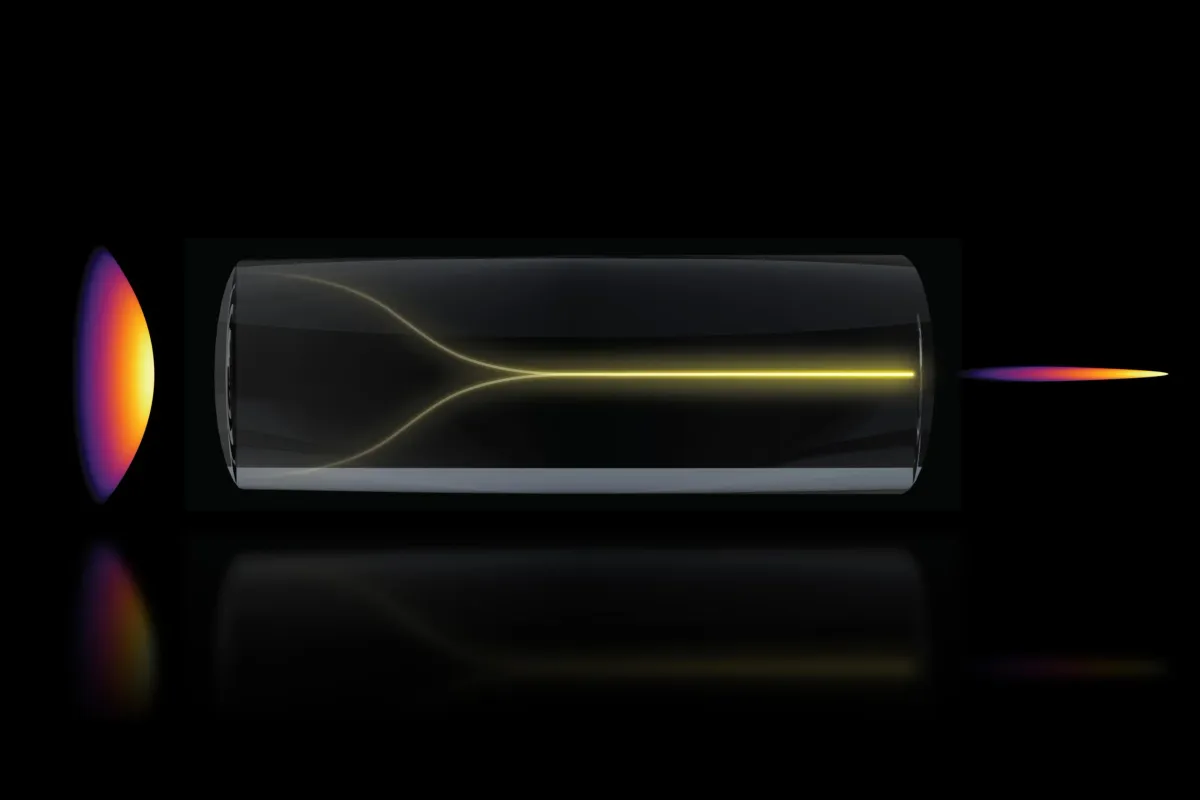
MSc student Light Mkhumbuza (yes, that's his name, and it’s fantastic) noted that the light starts with no spin. But as the beam travels, spinning regions pop up and separate. "It's almost as if the spin was hidden and then showed itself," he explained. No mirrors, no special materials – just light being light.
Dr. Isaac Nape from the University of the Witwatersrand explains this phenomenon through topology, a field of math that studies properties that stay the same even when you stretch things. Imagine a coffee mug and a doughnut. You can morph one into the other without tearing it because both have one hole. That's a topological feature.
Light, it seems, has its own version of this "hole count" – a hidden topological signature in how its polarization is arranged. This feature stays constant as light travels and guides how the beam changes. As the beam moves, this internal structure causes spinning behavior to appear, giving researchers a new "tuning knob" for light. By changing its topology, they can decide exactly how and where this handedness appears.
Dr. Forbes thinks this could lead to simpler, more sensitive medical tests (especially for drug development), and help us cram even more information into laser beams for communications and quantum networks. And since it doesn't need fragile materials, it could be cheaper and easier to use in the real world. Think compact sensors, more powerful communication, and even new ways to move tiny particles with light alone.
This research, published in Light: Science & Applications, basically tells us that light is richer, stranger, and more powerful than we ever imagined. And this new behavior? "It has been there all along, just waiting to be seen," Forbes added. Let that sink in.