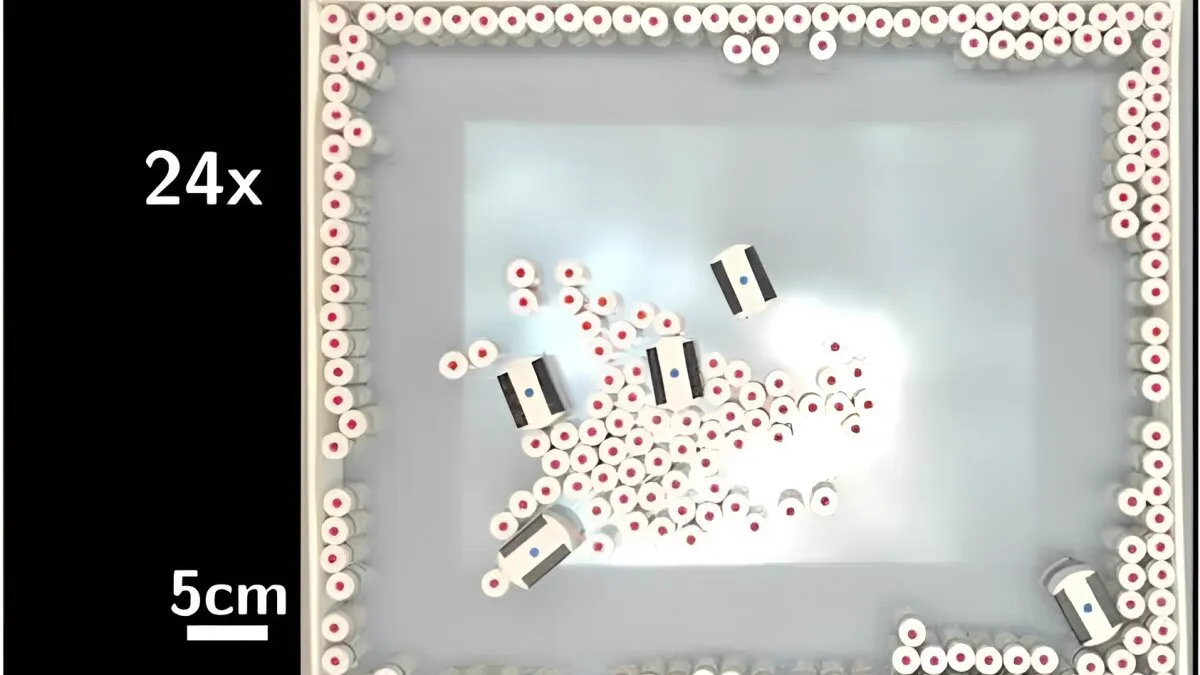
Harvard and Indian Institute of Technology Madras have unleashed a new breed of miniature robots. They're called RAnts, and they're less about individual brilliance and more about the power of the collective. Think tiny, autonomous construction workers that don't need a foreman yelling instructions.
These little guys, developed by Fabio Giardina and L. Mahadevan at Harvard, along with S. Ganga Prasath, can build and demolish simple structures by, well, just existing near each other. Unlike their Harvard predecessors, who were apparently only good at breaking out of robot jail, these RAnts are all about teamwork.
The Secret Life of RAnts
Their coordination comes down to two surprisingly simple settings: how much they cooperate and how fast they add or remove building blocks. These aren't pre-programmed marching orders; the RAnts adjust their behavior based on how many of their buddies are gathered around specific markers. More RAnts, more building. Fewer RAnts, more demolition. It's like a tiny, self-organizing construction party.
We're a new kind of news feed.
Regular news is designed to drain you. We're a non-profit built to restore you. Every story we publish is scored for impact, progress, and hope.
Start Your News DetoxReal ants, termites, and bees are masters of this decentralized construction. They leave signals in their environment that tell their pals what to do next – a concept charmingly called stigmergy. It's a fancy word for saying: the work itself guides the workers. Our RAnts mimic this “exbodied intelligence,” where the collective brainpower isn't in one central computer, but in the ongoing interaction between the robots and their environment.
Why does this matter? Because eventually, humans are going to want to build things where breathing isn't an option. The Moon, Mars, your ex's house – you name it. Sending a crew to assemble prefab habitats in a radiation-soaked, airless vacuum is, shall we say, costly. And dangerous. But sending a swarm of tiny robots to do the grunt work before anyone even packs their bags? Now that's thinking ahead.
So while some future space construction might involve massive 3D printers or giant mechs, it's equally likely that the heavy lifting (or light lifting, in this case) will be done by something the size of a bug. Which, if you think about it, is both impressive and slightly terrifying.