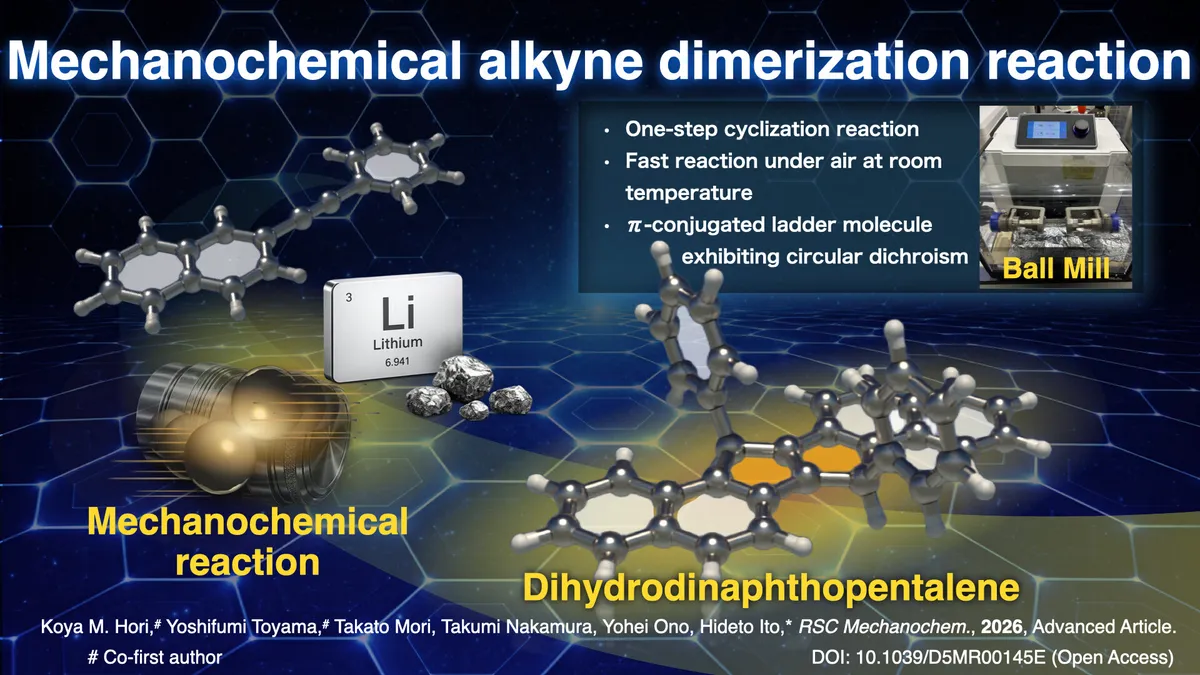
Mechanochemistry is changing how chemicals are made. This method uses solid materials and very little or no solvent. For a long time, solvents were seen as essential for modern chemistry. However, researchers are now showing that mechanochemistry can create complex molecules more effectively.
This approach could help reduce the environmental and financial costs linked to solvents in chemical industries.
A New Way to Make Conductive Molecules
Researchers at Nagoya University, including Koya M. Hori, Yoshifumi Toyama, and Hideto Ito, have used mechanochemistry to create a two-step method for making dihydrodinaphthopentalenes (DHDPs). These are conductive organic molecules that are usually very hard to synthesize.
We're a new kind of news feed.
Regular news is designed to drain you. We're a non-profit built to restore you. Every story we publish is scored for impact, progress, and hope.
Start Your News DetoxTheir findings were published in RSC Mechanochemistry on February 5, 2026. This work is expected to improve how compounds used in organic materials are made.
Conductive organic molecules are important for technologies like OLED screens in smartphones, solar cells, and anti-static coatings. DHDPs have not been widely used in products, likely because they are complex and expensive to make.
Previous methods for making DHDPs involved many steps, took a long time (12–48 hours), required specific starting materials, and were sensitive to air. The new mechanochemical method can create several DHDPs in just 15 minutes. It works in open air and uses about 99% less solvent than older methods.
How the Mechanochemical Method Works
The mechanochemical process is straightforward. Solid ingredients, such as lithium wire and 2-arylethynylnaphthalene (an organic starting material), are placed in a small stainless-steel container. A tiny amount of THF (less than 1 mL) is added as an extra ingredient. Stainless-steel balls are also put into the container.
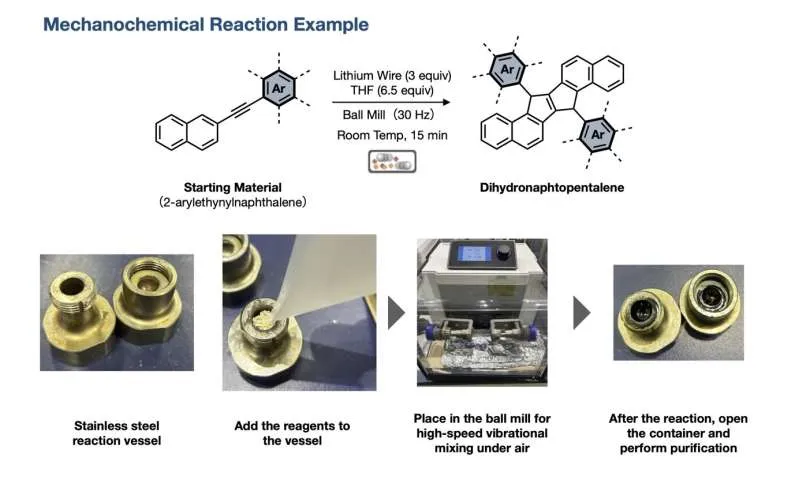
The container is then placed in a ball mill, which mixes and shakes the ingredients with high-speed vibrations. After 15 minutes, the container is opened. An aqueous ammonium chloride solution is added to stop the reaction and collect the new DHDP. This easy method allows for the creation of both simple and complex DHDPs using affordable starting materials.
Deep Dive & References
Lithium-mediated mechanochemical annulative dimerization of diarylacetylenes for synthesis of 1,4-dihydrodinaphthopentalenes - RSC Mechanochemistry, 2026