Spider dragline silk is stronger than steel by weight and tougher than Kevlar. For years, scientists knew this was true. What they didn't know was why—until now.
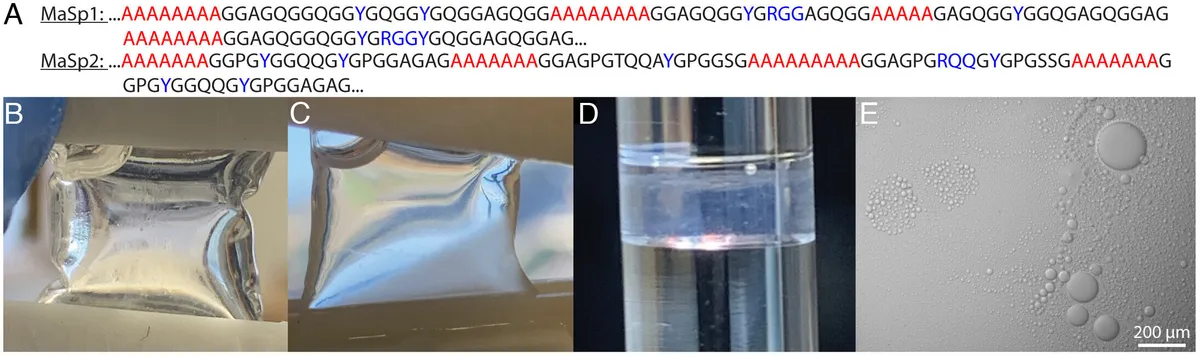
Researchers at King's College London and San Diego State University have identified the molecular mechanism that makes spider silk so exceptional: two amino acids, arginine and tyrosine, act like molecular "stickers" that hold silk proteins together in just the right way. The discovery, published in the Proceedings of the National Academy of Sciences, reveals design principles that could reshape how we build high-performance materials.
How the stickers work
The researchers used advanced computational modeling, including AlphaFold3 structural prediction and nuclear magnetic resonance spectroscopy, to trace how these amino acids interact. What they found was elegant: arginine and tyrosine don't just trigger the initial clustering of silk proteins—they stay active throughout the fiber formation process, organizing the protein structure into the complex nanoarchitecture that gives silk its dual superpowers of strength and flexibility.
We're a new kind of news feed.
Regular news is designed to drain you. We're a non-profit built to restore you. Every story we publish is scored for impact, progress, and hope.
Start Your News Detox"What surprised us was that silk—something we usually think of as a beautifully simple natural fiber—actually relies on a very sophisticated molecular trick," says Gregory Holland, a professor of physical and analytical chemistry at SDSU. "The same kinds of interactions we discovered are used in neurotransmitter receptors and hormone signaling."
This isn't just academic curiosity. The implications ripple outward quickly. Lightweight protective clothing that doesn't sacrifice durability. Airplane components that weigh less and perform better. Biodegradable medical implants. Soft robotics that need both strength and flexibility. Each of these applications has been held back by the lack of materials that combine what spider silk naturally achieves.
"The potential applications are vast," says Chris Lorenz, a professor of computational materials science at King's College London. "We now have general design principles that could guide the development of a new class of high-performance, sustainable fibers."
There's another angle worth noting: the way silk proteins organize—through a process called phase separation, forming structures rich in β-sheets—mirrors mechanisms seen in neurodegenerative diseases like Alzheimer's. Understanding how spider silk pulls off this trick without toxicity could provide a clean, evolutionarily-optimized system for studying disease mechanisms that have proven difficult to untangle in other contexts.
The research moves us closer to a world where we can engineer materials that match nature's efficiency without relying on mass silk farming. That shift—from harvesting to designing—could reshape manufacturing across industries.