Japanese astronomers have spotted something that shouldn't exist: a supermassive black hole in the young universe that's feeding on material at a rate that violates the rulebook.
The discovery, made by researchers at Waseda and Tohoku Universities using the Subaru Telescope, caught a distant quasar—an actively feeding black hole—when the universe was less than 1.5 billion years old. What makes it extraordinary isn't just that it's growing fast. It's that it's growing fast and doing something else at the same time that theory says shouldn't happen together.
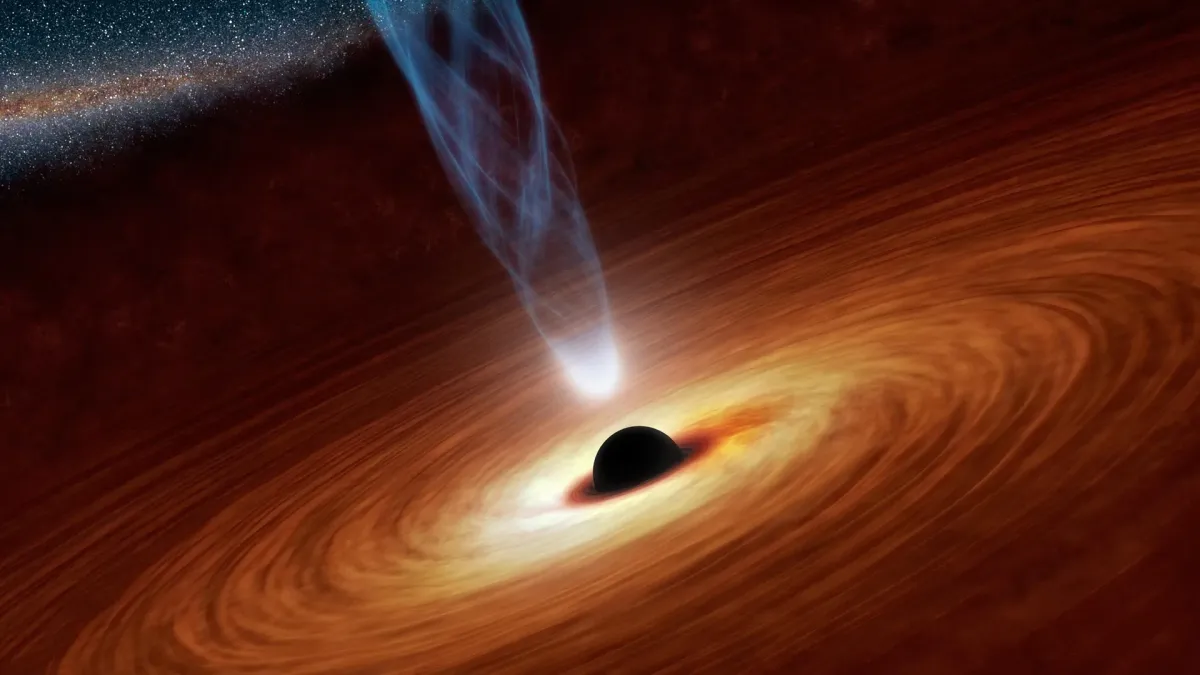
Most supermassive black holes sit at the centers of galaxies, pulling in surrounding gas like cosmic drains. As material spirals inward, it heats up and can emit X-rays from a hot region called a corona. Some black holes also launch jets of material outward that shine brightly in radio wavelengths. These are two separate features, and they usually don't coexist during periods of extreme growth.
We're a new kind of news feed.
Regular news is designed to drain you. We're a non-profit built to restore you. Every story we publish is scored for impact, progress, and hope.
Start Your News DetoxThere's a speed limit built into the physics: the Eddington limit. Think of it as a self-regulating valve. When gas falls toward a black hole too quickly, radiation from that gas pushes back on the material flowing behind it, eventually slowing the inflow. Black holes can temporarily exceed this limit through what's called super-Eddington accretion, allowing rapid growth over cosmic timescales. But when they do, current models predict they should dim in X-rays and weaken their jets.
This black hole is accreting at roughly 13 times the Eddington limit—among the fastest-growing black holes known at its mass scale. Yet it's still shining brightly in X-rays and producing strong radio emission. The observations simply don't match what the equations predict.
"This discovery may bring us closer to understanding how supermassive black holes formed so quickly in the early Universe," said Sakiko Obuchi, lead author of the study published in The Astrophysical Journal. The team believes they've caught the quasar in a fleeting transition state: a moment when a rapid surge of gas pushed it beyond the speed limit, while its X-ray corona and radio jet persisted briefly before fading.
If confirmed, this snapshot could help explain one of astronomy's lingering puzzles: how supermassive black holes grew so large so quickly in the early universe. It might also illuminate how powerful jets from extreme black hole growth shape star formation in galaxies. The observation is rare enough to suggest we're missing something fundamental about how these objects work—which, in science, is usually where the most interesting questions live.