Astronomers have spotted what may be the oldest barred spiral galaxy ever observed—and it's forcing a rethink of how quickly the universe organized itself.
The galaxy, called COSMOS-74706, existed roughly 11.5 billion years ago, just 2 billion years after the Big Bang. That's surprisingly early for a structure this complex. Daniel Ivanov, a graduate student at the University of Pittsburgh, led the research using data from the James Webb Space Telescope to confirm the finding.
What Makes This Galaxy Remarkable
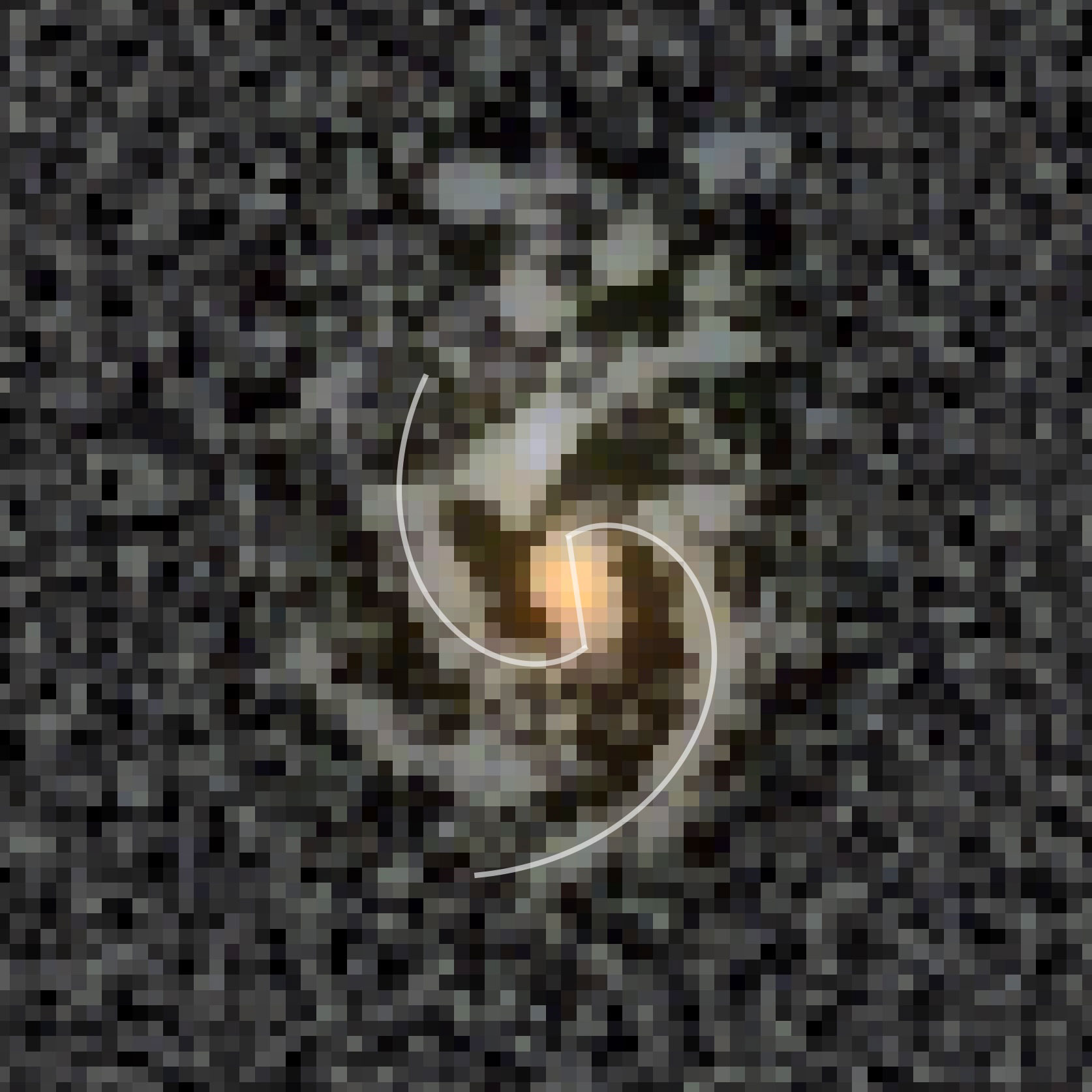
An unsharp mask overlaid onto filter compositions showing the bar structure (white lines). Credit: Daniel Ivanov, et al.
We're a new kind of news feed.
Regular news is designed to drain you. We're a non-profit built to restore you. Every story we publish is scored for impact, progress, and hope.
Start Your News DetoxA stellar bar is a dense alignment of stars and gas running through a galaxy's center, visible as a bright line when viewed edge-on. The Milky Way has one too. These aren't just aesthetic features—they actively reshape galaxies by funneling gas inward, feeding the supermassive black hole at the core while simultaneously slowing new star formation across the galaxy's disk.
What makes COSMOS-74706 stand out isn't just its age. Other researchers have claimed to find older barred galaxies, but those findings relied on less rigorous methods. Some used redshift measurements that aren't as definitive; others involved gravitational lensing, where light bends around massive objects on its way to us, making the image harder to interpret. Ivanov's team used spectroscopy—essentially splitting the galaxy's light like a prism—to confirm their discovery with much higher certainty. "It's the highest redshift, spectroscopically confirmed, unlensed barred spiral galaxy," Ivanov said.
Why This Matters
The discovery tightens the window on when stellar bars first formed. Some simulations predict bars could emerge as early as 12.5 billion years ago, but finding one at 11.5 billion years ago is the first solid observational evidence that the universe was organizing itself this quickly. Ivanov wasn't shocked—"In principle, I think that this is not an epoch in which you expect to find many of these objects"—but the finding does something important: it constrains the timescales, turning speculation into measurable fact.
This matters because stellar bars are thought to be key drivers of galactic evolution. If they formed this early and this frequently, it means the universe's large structures took shape faster than some models predicted. It's one more piece of evidence that the cosmos was busier in its youth than we once thought.