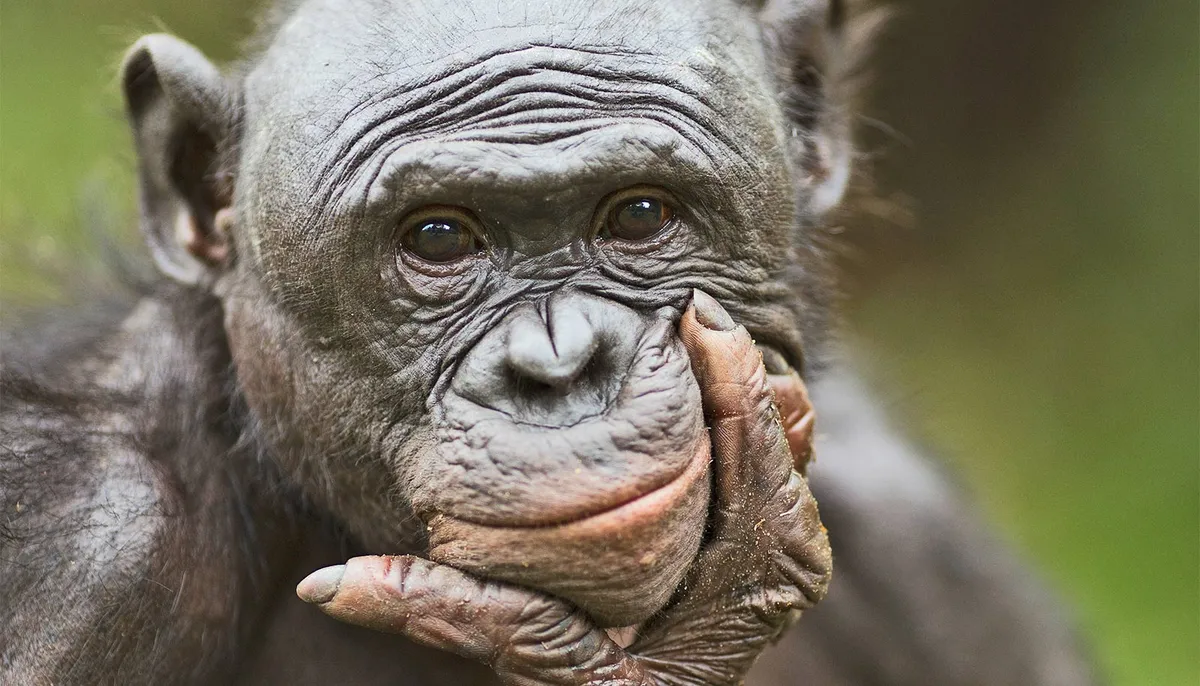
A bonobo can imagine things that don't exist. Kanzi, a single ape at a research center, watched a scientist pretend to pour juice into an empty cup, then pointed to the correct container when asked where the juice was—even after it was moved. He did this consistently across multiple tests, tracking imaginary grapes and juice in his mind while knowing they weren't real.
This matters because imagination has always been the thing we pointed to as uniquely human. The ability to hold a false idea in your head, to play pretend, to think about things that aren't there—it separated us from the rest of the animal kingdom. Except it apparently doesn't.
What the experiments showed
Christopher Krupenye, an assistant professor at Johns Hopkins who studies animal cognition, ran the tests with Kanzi. The setup was simple: a table, some empty cups and bowls, and an experimenter who pretended to fill them. When asked "Where's the juice?" or "Where's the grape?", Kanzi pointed to the right container. He did it repeatedly. He tracked the imaginary items even when their locations changed. He understood that the objects existed in the pretend space but not in reality.
We're a new kind of news feed.
Regular news is designed to drain you. We're a non-profit built to restore you. Every story we publish is scored for impact, progress, and hope.
Start Your News Detox"Kanzi is able to generate an idea of this pretend object and at the same time know it's not real," says Amalia Bastos, who worked on the research at Johns Hopkins and is now at the University of St. Andrews. That's the crucial bit—it's not just that Kanzi could follow instructions. He was actually imagining.
The finding pushes back against a boundary we've drawn around ourselves for centuries. If Kanzi can do this, the capacity probably goes back 6 to 9 million years to our common evolutionary ancestors. Imagination isn't a recent human invention. It's old, shared, woven into our primate family tree.
The researchers want to know what else apes can do with their minds. Can other apes imagine? Can they think about the future, or imagine what's going on in someone else's head? Those questions are still open. But the fact that we're asking them at all—that we've found reason to ask them—changes how we have to think about the creatures we share the planet with.
"We should be compelled by these findings to care for these creatures with rich and beautiful minds and ensure they continue to exist," Krupenye says. It's not a dramatic conclusion, but it follows logically from what Kanzi showed us: that the boundary between their minds and ours is smaller than we thought.