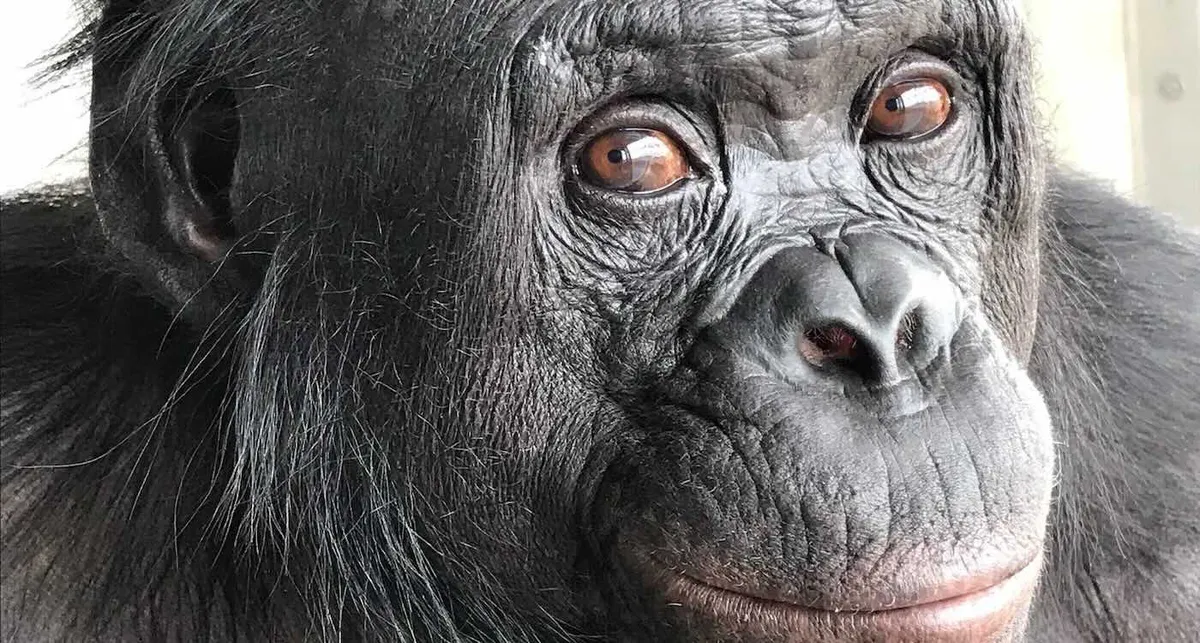
Kanzi, a 43-year-old bonobo, sat across from a researcher who pretended to pour imaginary juice into cups, then moved them around the table. When asked "Where's the juice?", Kanzi pointed to the right cup—the one that still held the pretend liquid. He'd tracked an object that existed only in someone else's mind.
This wasn't a trick. It was evidence of something scientists thought only humans could do: imagine things that aren't there.
Researchers at Johns Hopkins University ran a series of "tea party" experiments to test whether apes could hold imaginary objects in mind the way we do when we play pretend. The setup was simple but rigorous. In the first task, Kanzi watched a researcher mime pouring juice, then correctly identified which cup still contained the imaginary drink even after the cups were shuffled. In a second test, the team placed a real cup of juice alongside an imaginary one. Kanzi overwhelmingly chose the real juice, proving he could distinguish between what was pretend and what was actual.
We're a new kind of news feed.
Regular news is designed to drain you. We're a non-profit built to restore you. Every story we publish is scored for impact, progress, and hope.
Start Your News DetoxA third experiment involved an empty container. The researcher pretended to pick grapes from it, then pretended to empty one of two containers. Kanzi again identified the location of the imaginary grapes with accuracy that went far beyond chance.
"It's extremely striking that the data suggest apes can conceive of things that are not there," said Amalia Bastos, one of the study's authors. "Kanzi is able to generate an idea of this pretend object and, at the same time, know it's not real." That last part matters. Imagination isn't just daydreaming—it's holding two truths at once: this thing is pretend, and I understand it as pretend.
The findings, published in Science, reshape what we thought we knew about animal minds. For decades, imagination was treated as a uniquely human trait, a line drawn between us and everything else. Christopher Krupenye, another co-author, frames the shift plainly: "Imagination has long been seen as critical to being human, but the idea that it may not be exclusive to our species is transformative."
That transformation has immediate weight. If apes can imagine, they have richer inner lives than we've acknowledged. They can think about things that aren't present, hold hypotheticals, play. They're not just responding to their immediate environment—they're modeling possibilities. The researchers are already planning the next phase: testing whether apes can imagine the future or understand what's happening in another mind. What comes next will likely surprise us again.