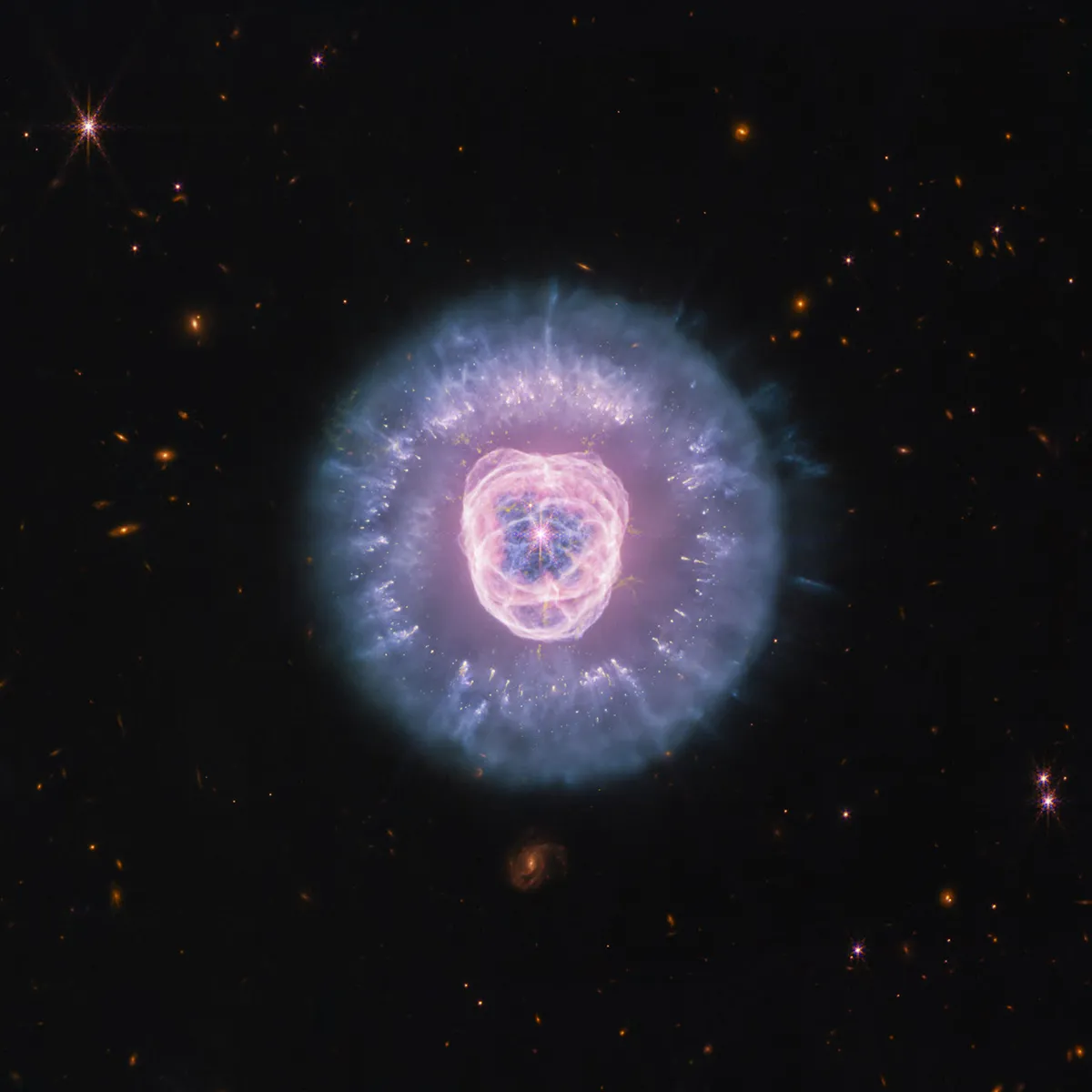
Even in death, some stars just can't help but put on a show. Case in point: the Lion's Head Nebula, also known as NGC 2392, which just got its close-up courtesy of the James Webb Space Telescope (JWST). And yes, it absolutely looks like a lion's head.
This isn't just any cosmic cat, though. This nebula is the celestial ghost of a star much like our own Sun, having shed its outer layers in a dramatic, fiery finale. Talk about going out with a bang.
The Mane Event
So, what exactly are we looking at? The star at the nebula's heart simply ran out of fuel for its nuclear fusion furnace. When that happens, things get a little... explosive. It puffed off vast clouds of gas and dust into the cosmos, creating the stunning, irregular bubble we see today.
We're a new kind of news feed.
Regular news is designed to drain you. We're a non-profit built to restore you. Every story we publish is scored for impact, progress, and hope.
Start Your News DetoxRight in the middle, nestled where the lion's nose would be, is a searing hot stellar core — a white dwarf star. This little powerhouse is blasting out radiation, which in turn ionizes the expanding gas, forming the 'face' of the lion. The 'mane' itself is a glorious tangle of dust clumps that somehow survived this stellar onslaught, mixed with more ionized gas.
The JWST, flexing its impressive NIRCam and MIRI instruments, pieced together this incredibly detailed composite image. Scientists are now poring over it, hoping to unravel the intricate dance between gas, dust, and the radiation from that central white dwarf. Essentially, they're trying to figure out how stars like our Sun eventually kick the bucket.
Which, if you think about it, is a pretty important bit of information to have for our own future. Just saying.