A research team has found key molecular details about how tendons and ligaments form. These tissues are vital for connecting muscles and bones. Understanding this process could help create new ways to repair tendons, ligaments, and their attachment points, called entheses. These areas usually heal poorly after injury because they don't have many blood vessels.
The findings were published in the journal Development.
A Key Genetic Switch for Tendons
The international team discovered a new enhancer. This enhancer controls when and where the Scleraxis (Scx) gene is active. Scx is a crucial factor for making and maturing tendons, ligaments, and entheses. Enhancers are DNA segments that act like genetic switches, turning genes on or off at specific times and places. The new Scx enhancer specifically directs Scx gene activity in these tissues during development.
Scleraxis is also reactivated in adults when tissues repair themselves or adapt to physical stress. Scientists have known that tendons, ligaments, and entheses don't develop correctly if the Scx gene doesn't work. Entheses are also prone to injury and stress, which can cause pain and problems like enthesopathy.
We're a new kind of news feed.
Regular news is designed to drain you. We're a non-profit built to restore you. Every story we publish is scored for impact, progress, and hope.
Start Your News DetoxHow the Discovery Was Made
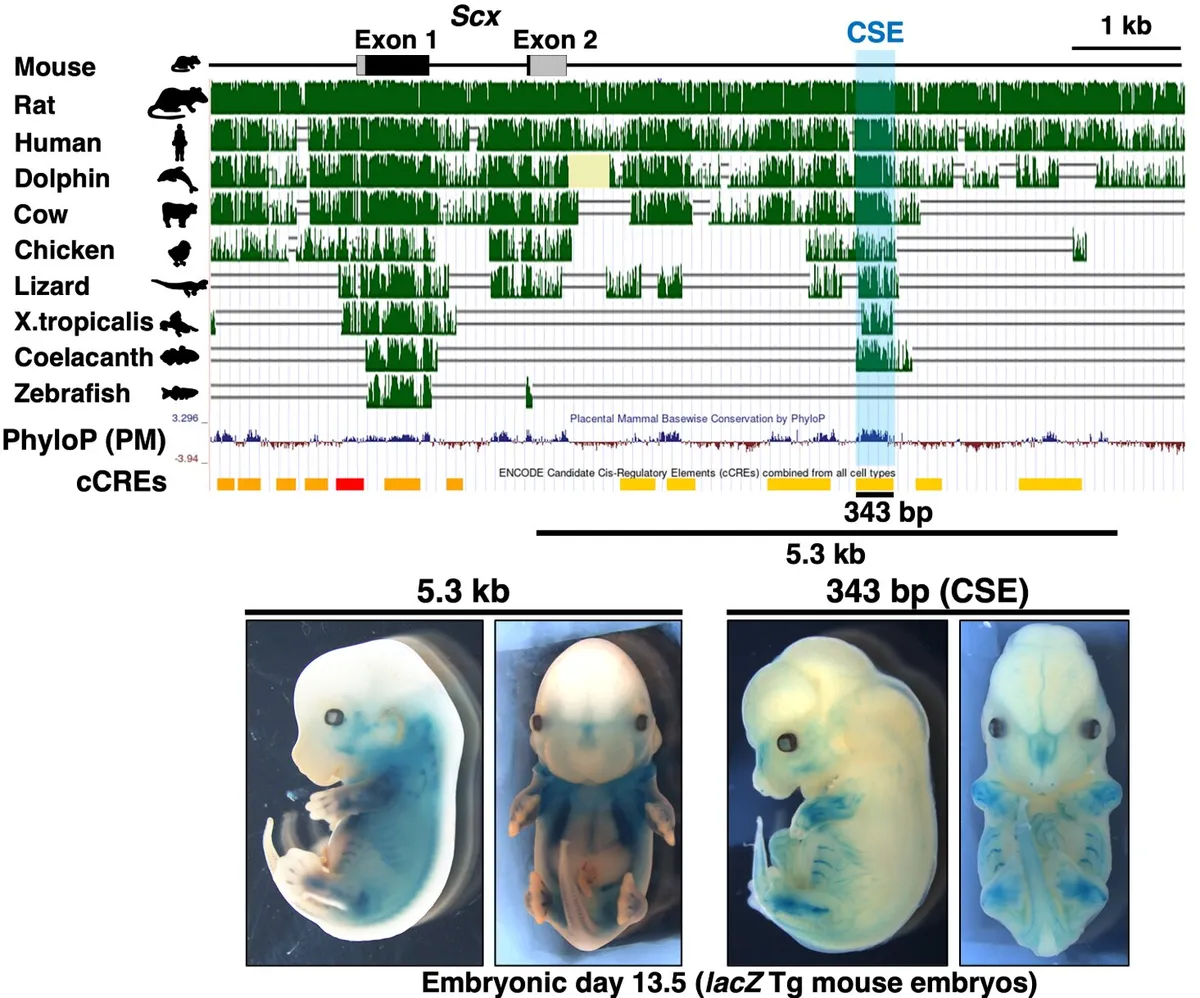
For their study, the team used special mice called transgenic reporter mice. These mice allow researchers to see when and where DNA sequences activate genes in living tissues. Using this method, the team found a 5.3 kb downstream Scleraxis enhancer (dSE). This dSE showed strong and accurate gene activity.
Within the dSE, they found a smaller 343 bp conserved Scleraxis enhancer (CSE). This CSE is remarkably similar across many species, from lobe-finned fish to humans. It can restart Scx gene activity in developing limbs.
Mice without the CSE had much less Scx gene activity during limb development. They also failed to form the deltoid tuberosity (DT). The DT is a bone ridge where the deltoid muscle attaches to the upper arm bone, helping with shoulder movement. This shows that the CSE must be active at the right time during development for the DT to form properly.
Even with an early drop in Scx gene activity, it slowly recovered later on. The team believes other parts of the dSE caused this recovery. These results show that the CSE is a key enhancer needed for Scx to turn on early in limb development, which is essential for proper DT formation.
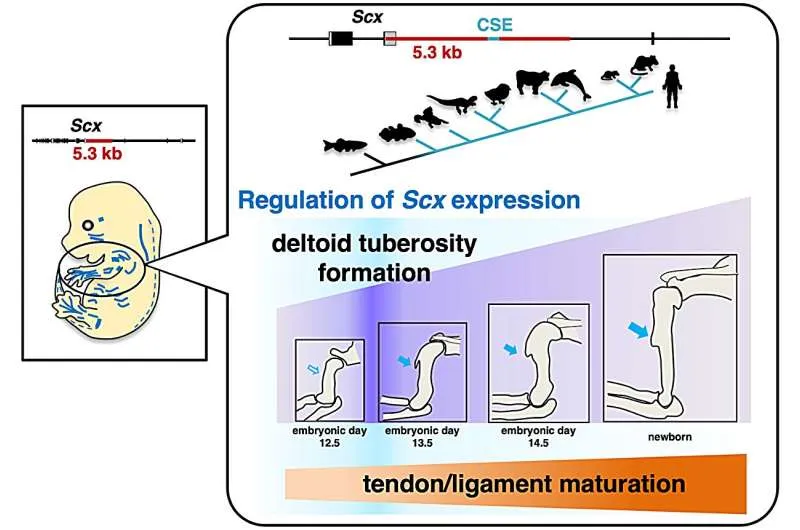
Professor Chisa Shukunami from Hiroshima University explained that their in-vivo analysis with transgenic mice helped them find a regulatory region with a tendon- and ligament-specific enhancer. Within this, they found an important evolutionary sequence conserved from coelacanths to humans. Genome editing confirmed this region is critical for DT formation.
Paving the Way for Regenerative Medicine
The team's goal was to understand how Scx, a transcription factor vital for musculoskeletal integration, is regulated in specific tissues. Shukunami noted that because tendons, ligaments, and entheses have limited ability to regenerate, knowing how the Scx gene is controlled is crucial. This knowledge forms the basis for regenerative medicine, which aims to repair or replace damaged body parts.
The team has made significant progress in understanding how the Scx gene works. Shukunami believes this study is an important step toward uncovering the basic molecular mechanisms of tendon and ligament formation.
Looking ahead, the team plans to expand their research. Shukunami hopes to fully map the regulatory network that controls Scx gene activity. Their ultimate goal is to identify the central factors that coordinate musculoskeletal integration.
Deep Dive & References
Divergent temporal control of deltoid tuberosity and limb tendon development by an evolutionarily conserved scleraxis enhancer - Development, 2026