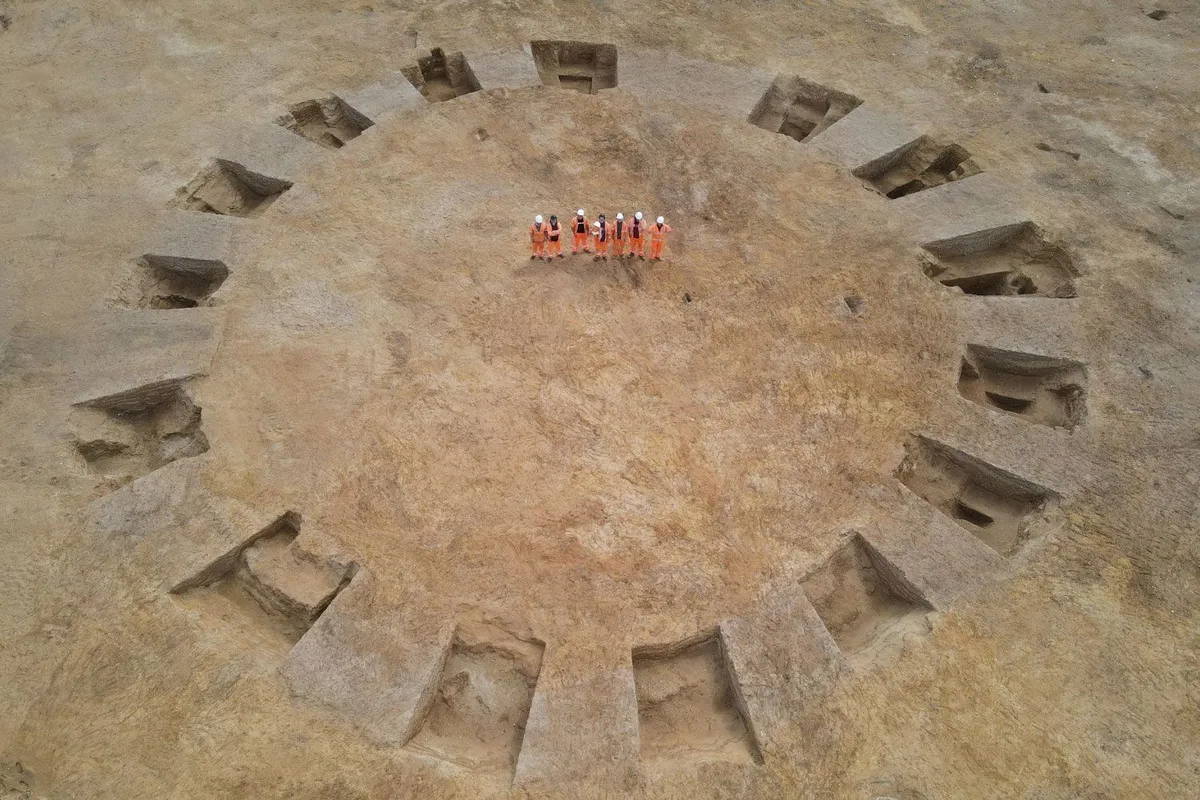
Construction work for wind farms in England has led to many surprising archaeological discoveries. Recently, excavations for an offshore wind farm on the eastern coast uncovered a Roman villa with a bathhouse. Researchers also found a bronze artifact they nicknamed "Norfolk Nessie." This is because it looks like the mythical Loch Ness monster.
Unearthing a Roman Farming Estate
Archaeologists found these sites near Dereham, Norfolk. They were working along an underground cable route that spans almost 40 miles. Initially, based on maps and surveys, experts didn't expect to find anything important in this specific area.
However, in 2021, trial trenching revealed something hidden. Jessica Lowther from Headland Archaeology, which led the dig, noted they kept finding many roof tiles. This suggested something significant was beneath the surface.
We're a new kind of news feed.
Regular news is designed to drain you. We're a non-profit built to restore you. Every story we publish is scored for impact, progress, and hope.
Start Your News DetoxA digital rendering of what the Roman villa might have looked like RWE
The archaeologists uncovered a large villa with many other buildings, including a bathhouse and a Roman road. Lowther believes it was a big farming estate, as there was much evidence of food growing and processing.
RWE, the energy company behind the wind farm, stated that the site was wealthy and used for a long time. It was occupied from the Iron Age into the Roman period, around 250 C.E.
Ancient Artifacts and "Norfolk Nessie"
Other items found include a silver ring and a bronze lion's head, likely a chair foot. The "Norfolk Nessie" is a bronze vessel handle. Its snake-like shape and green color reminded researchers of the Loch Ness monster. They don't claim a direct link to the legend, just a visual similarity.
Elsewhere on the cable route, excavations revealed a Neolithic pit with pottery and stone tools. They also found Bronze Age burial sites and abandoned medieval villages mentioned in the Domesday Book. These findings, along with environmental clues like grains and animal bones, help archaeologists understand how people lived and traded in the region over time.
RWE shared these discoveries at community events in March. People could see historical objects and try an augmented reality experience of the Roman villa. The villa has since been reburied to protect it.
Project director Jon Darling noted that the archaeological work tells a remarkable story about how the landscape changed. He emphasized that careful archaeology goes hand-in-hand with responsible infrastructure development. This helps protect Norfolk's heritage while supporting renewable energy.
The Roman era in Norfolk began in 43 C.E. with Emperor Claudius's invasion of Britain. The region was home to the Iceni tribe, led by Queen Boudica, who rebelled against Roman rule in 60 C.E. The Romans stayed until 410 C.E., then left to deal with conflicts in mainland Europe. Britain then became an island of small, isolated settlements.