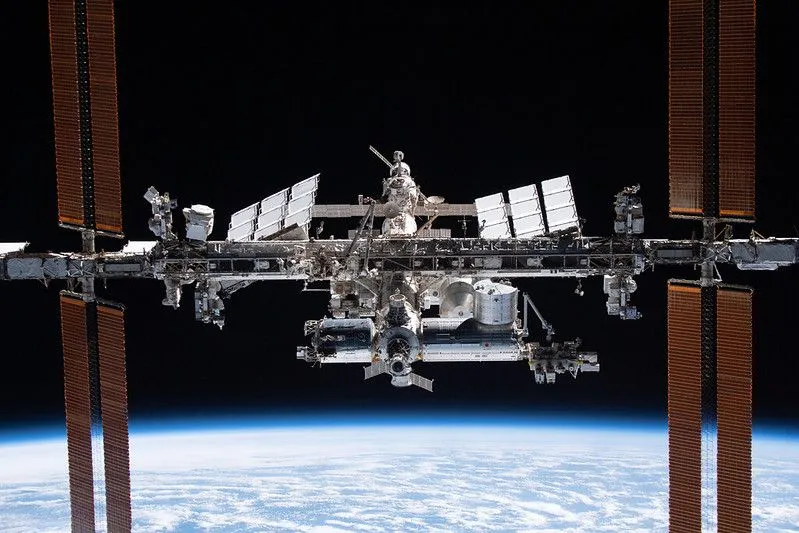
Turns out, you can take the human out of Earth, but you can't quite take the Earth's gravity out of the human. Even after months floating around the International Space Station, astronauts' brains cling to the memory of terrestrial weight, influencing how they move and, more importantly, how they grip things. Because apparently, even in space, old habits die hard.
This isn't just about fumbling for your space-sandwich. As humanity eyes longer missions to the Moon and Mars, understanding how our brains handle gravity's vanishing act is crucial. Safety, after all, is a pretty big deal when you're hurtling through the vacuum of space at 17,000 miles per hour.
The Brain's Stubborn Recall
We already knew spaceflight can temporarily squish and reshape your brain, and that long-term trips can actually rewire it. But a new study in the Journal of Neuroscience dug into the nitty-gritty: fine motor skills. Specifically, how astronauts grip objects, which sounds mundane until you consider the potential consequences of a misplaced wrench on the ISS.
We're a new kind of news feed.
Regular news is designed to drain you. We're a non-profit built to restore you. Every story we publish is scored for impact, progress, and hope.
Start Your News DetoxPhilippe Lefèvre, a biomedical engineer and co-author, led a team that meticulously analyzed the grip and arm movements of 11 astronauts. These space veterans had spent at least five months on the ISS, performing repetitive tasks with objects both in orbit and back on solid ground. What they found was, in Lefèvre's own words, "totally unexpected."
Even after half a year in microgravity, astronauts were still gripping objects far more tightly than necessary. It was as if their brains expected the items to have the same weight they would on Earth, even though intellectually, they knew better. They'd overcompensate, moving their arms slower and clenching harder when an object started moving quickly. It's the kind of muscle memory that sticks with you from childhood—a lifetime of gravity isn't easily forgotten, even by a brain that's seen the Earth from above.
And when they returned to Earth? They initially still misjudged weights, gripping too hard for a bit. But here's the kicker: while adapting to microgravity is a struggle, readapting to Earth's familiar pull happens remarkably fast. Apparently, gravity is like that comfy old armchair you always return to.
When a Dropped Spatula Becomes a Catastrophe
Why does this matter beyond a few clumsy moments? Because in space, a dropped object isn't just an inconvenience; it's a hazard. If an astronaut is trying to perform a delicate experiment or operate critical equipment, a misjudged grip could send something vital — or even dangerous — floating off. As Lefèvre ominously put it, "Even if the risk of slippage is low, the consequence of slippage would be really dramatic."
Imagine a large object, perhaps a piece of equipment with significant kinetic energy, getting loose and colliding with something essential on the ISS. Suddenly, a minor motor skill glitch becomes a major safety incident. Future lunar or Martian missions, with their partial gravity environments, will demand specialized training to help astronauts truly shed their Earth-bound reflexes. Because when you're millions of miles from home, you really don't want to be dropping the cosmic equivalent of the car keys.