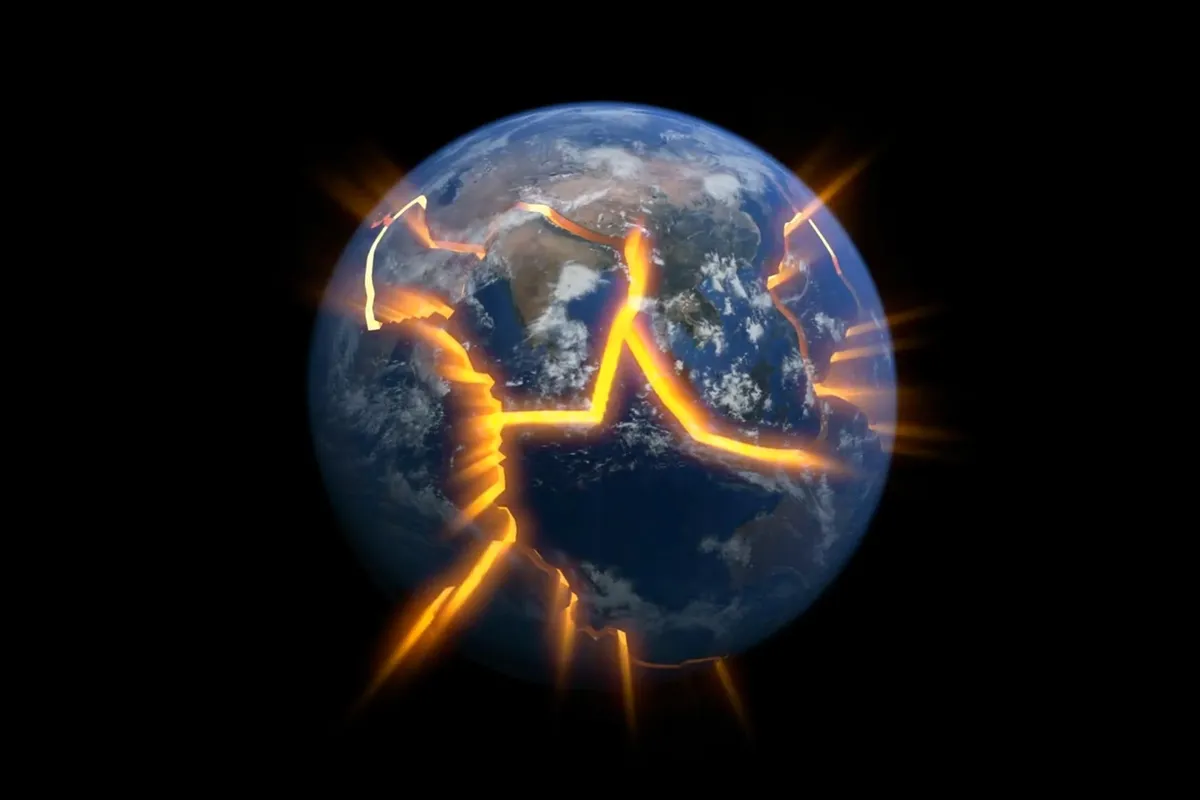
Deep beneath Africa, a colossal blob of hot rock is doing something unexpected: it's not just pulling the continent apart, it's also dragging it sideways. Scientists have been scratching their heads over this for a while, but new computer simulations just confirmed that the continent's largest continental rift is getting a very strange makeover.
Turns out, the African Superplume — a massive column of scorching rock rising from the Earth's mantle — is to blame. This isn't just a slow continental drift; it's a dynamic, slightly chaotic tear, and it’s shaping the East African Rift System in ways we didn't fully grasp until now.
Continental rifting, for the uninitiated, is when a landmass decides it's had enough and slowly starts to rip itself in two. Give it a few million years, and you get a brand-new ocean. It starts with the Earth's rigid outer shell, the lithosphere, stretching thin. Think of it like pulling taffy. Eventually, the top crust cracks, causing earthquakes, while the deeper parts flow more like very, very slow-motion lava.
We're a new kind of news feed.
Regular news is designed to drain you. We're a non-profit built to restore you. Every story we publish is scored for impact, progress, and hope.
Start Your News DetoxThe Case of the Sideways Shift
For ages, the scientific consensus was that rift zones pulled apart in a pretty straightforward, perpendicular fashion. Makes sense, right? You pull something, it stretches that way. The East African Rift, the grandaddy of all active continental rifts, largely follows this script. But then GPS measurements started showing something odd: parts of the region were also shifting parallel to the rift. Like trying to tear a piece of paper, but it’s also sliding across the table.
Enter Tahiry Rajaonarison, whose detailed 3D computer models finally offered an explanation. His simulations show that this peculiar, rift-parallel shimmy is caused by the mantle flow from the African Superplume, which is moving northward and taking a chunk of the continent with it.
This is a big deal because it settles a long-running scientific debate. Some geophysicists thought shallow forces, like the buoyancy of the elevated African Superswell, were behind the weird movement. Others pointed to deeper mantle traction forces — the horizontal movement of hot rock. Earlier models suggested both were important, but couldn't quite nail the parallel motion. This new study fills that gap, identifying the superplume's northward flow as the missing driver.
It also explains seismic anisotropy in the region, which is a fancy way of saying seismic waves travel faster in certain directions because the rocks underground are aligned. And guess what? That alignment perfectly matches the superplume's northward flow, adding another juicy piece of evidence.
A Continent in Flux
Rajaonarison notes that while the superplume isn't driving the main east-west rift, it's definitely responsible for that unusual northward, parallel movement. So, the rift is still tearing as expected, but it's also getting a subtle, yet significant, shove from the side.
These findings, published in Geophysical Research Letters, are a stark reminder of how processes hundreds or even thousands of kilometers beneath our feet directly dictate how continents above decide to dismember themselves. Because apparently, even landmasses aren't immune to complex, multi-directional stresses.
And just to make things even more interesting, another study in Geophysical Research Letters (set for 2025, because science is always ahead of schedule) looked at smaller crustal blocks, called microplates, within the rift. It found that the Victoria microplate is slowly rotating counterclockwise, at a leisurely 0.0583 degrees per million years. That's about 6.48 millimeters a year, roughly the speed of a snail on a leisurely stroll.
Most of the deformation happens along the edges of this microplate, with faults slipping at a couple of millimeters per year, while the inside remains remarkably stable. This rotation helps explain why the deformation isn't perfectly aligned with the rift. It's a slightly angled, multi-layered dance of deep mantle flow, surface forces, and these smaller, shifting crustal blocks.
It seems Africa's breakup isn't just a simple tear; it's a complex, multi-act drama orchestrated by forces both seen and unseen. And if that's not enough to make you look at the ground differently, what is?