Astronomers have seen a magnetar being born for the first time. This confirms that these highly magnetic, spinning neutron stars power some of the universe's brightest exploding stars.
This discovery supports a theory a UC Berkeley physicist proposed 16 years ago. It also reveals a new feature in exploding stars: supernovae with a "chirp" in their light curve, caused by general relativity. This finding was published in Nature on March 11.
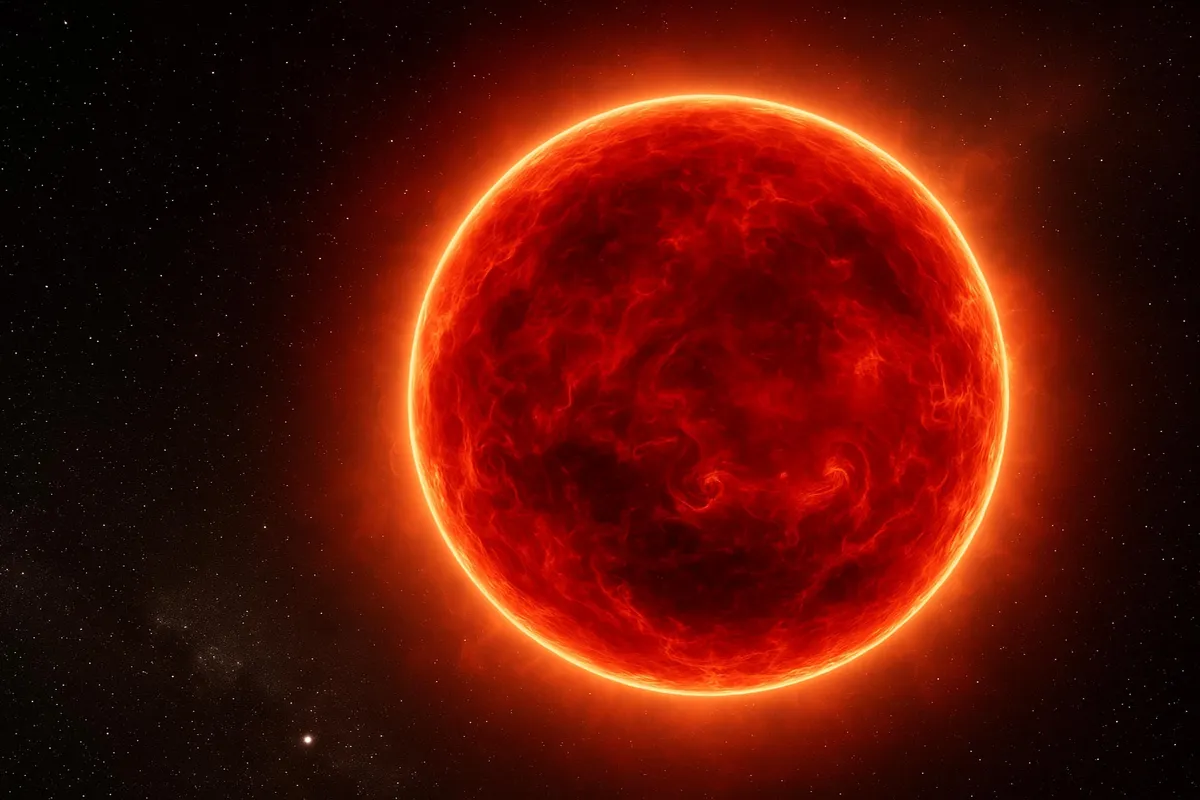
Superluminous supernovae are 10 or more times brighter than regular supernovae. They have puzzled astronomers since they were first found in the early 2000s. Scientists thought they came from very massive stars, perhaps 25 times the size of our sun. However, these supernovae stayed bright much longer than expected after a star's core collapsed.
We're a new kind of news feed.
Regular news is designed to drain you. We're a non-profit built to restore you. Every story we publish is scored for impact, progress, and hope.
Start Your News DetoxIn 2010, Dan Kasen, a UC Berkeley theoretical astrophysicist, suggested that a magnetar powered this long-lasting glow. He co-authored this theory with Lars Bildsten. Stanford Woosley of UC Santa Cruz also suggested it independently.
The theory states that when a massive star collapses, it forms a dense neutron star. If the star had a very strong magnetic field, it would become even stronger during magnetar formation. This creates a field 100 to 1,000 times stronger than normal spinning neutron stars, called pulsars. Magnetars and pulsars are only about 10 miles wide but can spin over 1,000 times per second when young.
As a magnetar spins, its magnetic field can speed up charged particles. These particles then hit the debris from the expanding supernova, making it brighter. Magnetars are also thought to cause fast radio bursts.
Joseph Farah, a graduate student at UC Santa Barbara and Las Cumbres Observatory (LCO), confirmed the link between magnetars and Type I superluminous supernovae (SLSNe-I). He analyzed data from a 2024 supernova called SN 2024afav. Farah will join Kasen's group at UC Berkeley this fall as a Miller Postdoctoral Fellow.

In the Nature paper, Farah and his team explained unusual bumps in the supernova's light curve. They called this a "chirp" and linked it to a magnetar using general relativity.
Alex Filippenko, a UC Berkeley distinguished professor of astronomy and co-author, called this "definitive evidence" for a magnetar forming from a superluminous supernova core collapse. He noted that Kasen and Stan Woosley's model suggested the magnetar's energy powered the brightness. Farah's paper now shows that a magnetar did form inside the supernova.
Kasen added that the magnetar idea felt like a "theorist's magic trick" because the engine was hidden. He said the chirp in the supernova signal is like the engine "pulling back the curtain" to show it's real.
Distant Discovery
SN 2024afav was found in December 2024. The Las Cumbres Observatory, a network of 27 telescopes, tracked its brightness for over 200 days. This exploding star was about one billion light-years from Earth.
Farah, working with UCSB astronomer Andy Howell, noticed something unusual. After the brightness peaked around 50 days, it didn't just fade. Instead, it slowly oscillated downward, with the oscillations getting shorter. This created a series of four bumps, which Farah compared to a bird chirp.
Earlier superluminous supernovae showed a couple of bumps in their fading light. Some thought this was the supernova shock hitting gas around the star, making it briefly brighter. But no one had seen four bumps before.
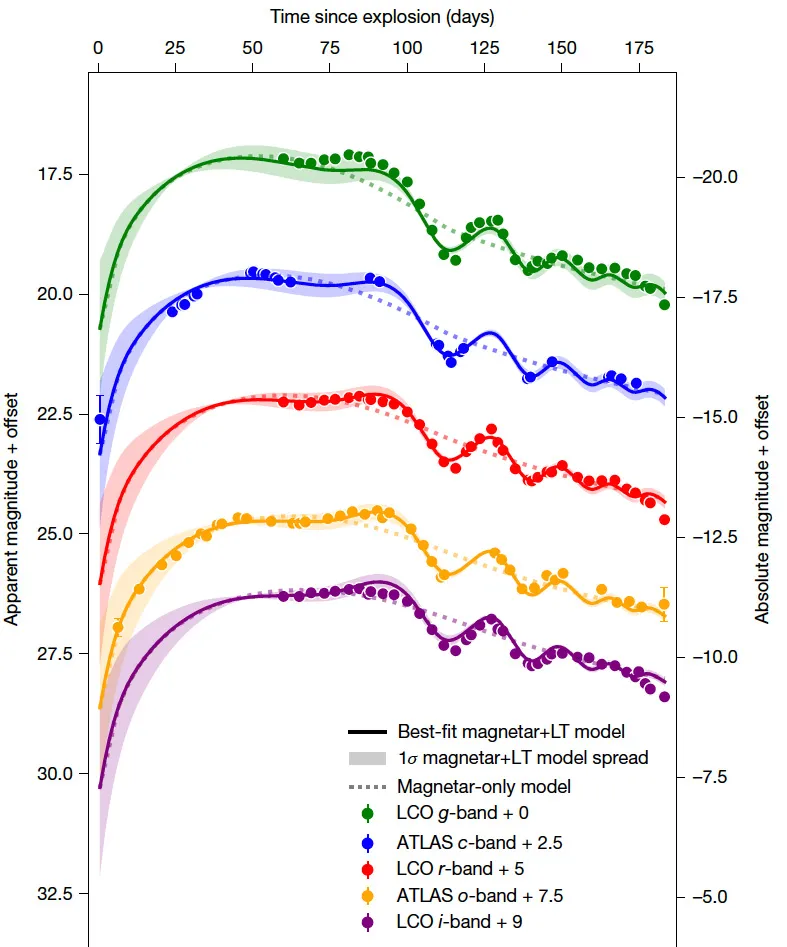
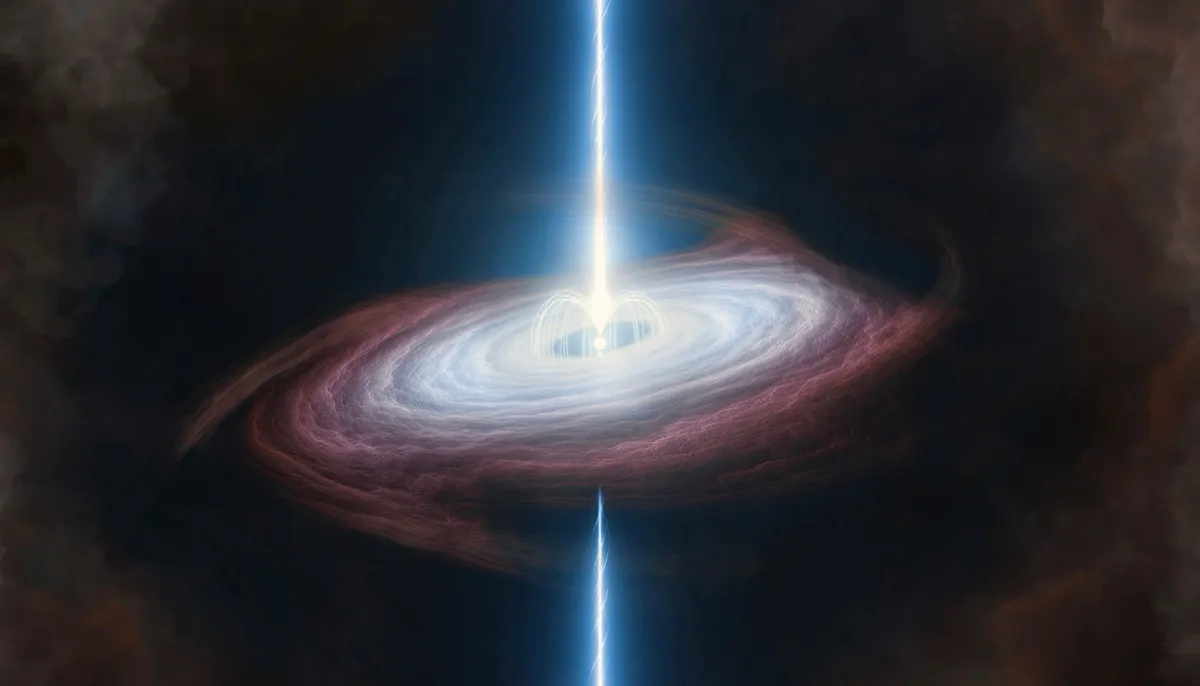
Farah's model suggests that some material from the SN 2024afav explosion fell back towards the magnetar. This formed an accretion disk. Since the material around the magnetar isn't perfectly symmetrical, the accretion disk wouldn't be symmetrical either. This would cause the magnetar's spin axis and the disk's spin axis to be misaligned.
General relativity states that a spinning mass drags space-time with it. This means the spinning magnetar would cause the misaligned disk to wobble, an effect called Lense-Thirring precession. A wobbling disk could periodically block and reflect light from the magnetar, making the system strobe like a cosmic lighthouse. As the disk moves closer to the magnetar, it wobbles faster, causing the light to oscillate more rapidly as it fades. This creates the "chirp" seen by telescopes.
Farah said they tested several ideas, but only Lense-Thirring precession matched the timing perfectly. He noted it's the first time general relativity has been needed to describe supernova mechanics.
The astronomers also estimated the neutron star's spin period at 4.2 milliseconds. Its magnetic field was about 300 trillion times that of Earth. Both are signs of a magnetar.
Howell, a senior scientist at LCO, called Farah's finding the "smoking gun." He said it connects the bumps to the magnetar model and explains everything with general relativity, calling it "incredibly elegant."
Filippenko added that seeing a clear effect of Einstein's general theory of relativity is always exciting, especially for the first time in a supernova.
Filippenko cautioned that Farah's conclusion doesn't mean all superluminous supernovae are powered by magnetars. Another theory suggests that a shock wave from the exploding star hitting surrounding material can also increase brightness. Kasen also proposed that if a star's core collapses into a black hole, it could power a brighter supernova and create bumps in the light curve if it has a misaligned accretion disk.
Filippenko believes that the fraction of Type I superluminous supernovae powered by surrounding material is smaller than previously thought, as this discovery explains some of them.
Farah expects to find dozens more of these "chirping" supernovae. This will happen when the Vera C. Rubin Observatory comes online and begins its comprehensive sky survey.
Farah described this as the "most exciting thing" he's been part of, saying it's the universe challenging us to understand it better.
Andy Howell, Logan Prust, and Yuan Qi Ni also contributed to this work.
Deep Dive & References
Lense–Thirring precessing magnetar engine drives a superluminous supernova - Nature, 2026