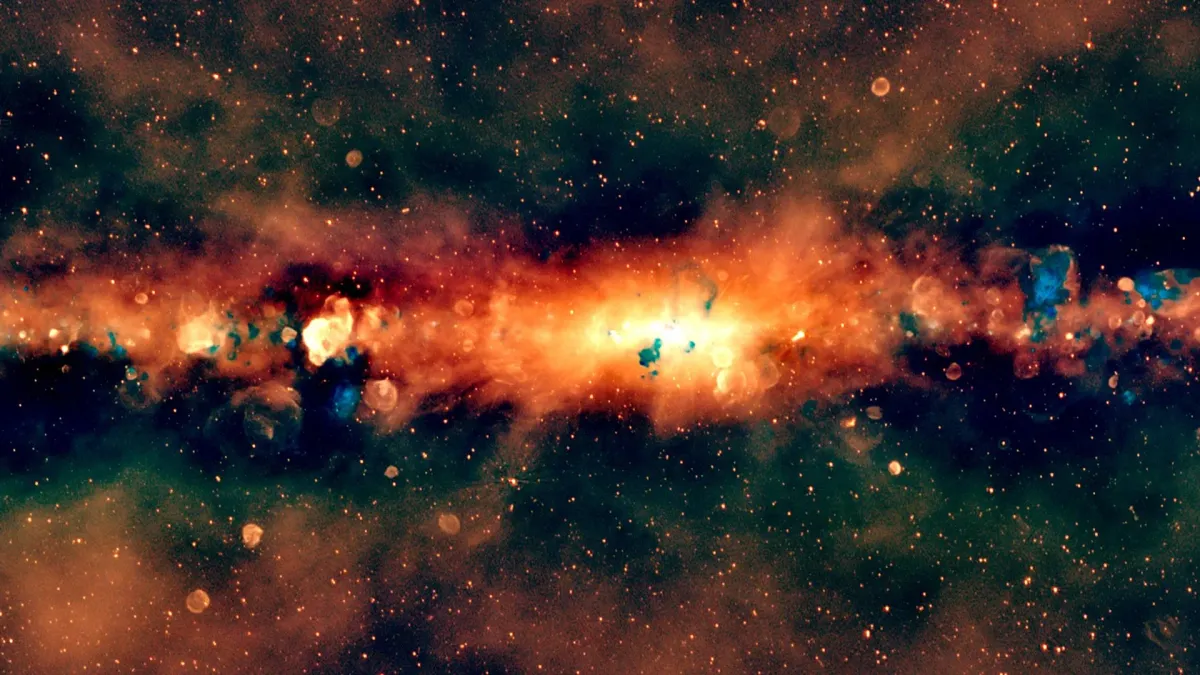
For the first time, astronomers have captured the entire southern Milky Way in low-frequency radio light—a view that exposes the galaxy's most violent moments and most generative ones, all at once.
The image, assembled by Silvia Mantovanini at Curtin University's node of the International Centre of Radio Astronomy Research, represents something genuinely new. It has twice the resolution and ten times the sensitivity of the previous radio portrait from 2019, and it covers twice as much sky. To build it, Mantovanini spent 18 months processing data from the Murchison Widefield Array telescope in Western Australia, burning through roughly 1 million CPU hours on supercomputers just to align and combine all the observations.
What emerges is a portrait of the galaxy in motion. The radio wavelengths reveal what visible light cannot: the expanding shells of gas where stars have violently exploded at the end of their lives, and the dense stellar nurseries where new stars are actively forming. In the image, exploded stars appear as large red circles, while the blue regions mark where star birth is happening right now.
We're a new kind of news feed.
Regular news is designed to drain you. We're a non-profit built to restore you. Every story we publish is scored for impact, progress, and hope.
Start Your News DetoxReading the Galaxy's Story
Mantovanini's focus is supernova remnants—those expanding clouds of gas and energy left behind when a massive star reaches the end of its life and detonates. The new image makes it far easier to separate the material surrounding newborn stars from the debris of dead ones, revealing structures throughout the galaxy that were previously blurred together.
"You can clearly identify remnants of exploded stars," Mantovanini explained. "The smaller blue regions indicate stellar nurseries where new stars are actively forming." This clarity matters because it lets astronomers trace the full lifecycle of stars—how they form, how they evolve, and ultimately how they end—all within the same galactic frame.
The image may also help scientists understand pulsars, the rapidly spinning remnants of dead massive stars that emit beams of radio waves. By analyzing how bright pulsars appear across different radio frequencies, researchers hope to learn more about how these objects work and where they're scattered throughout the galaxy.
Associate Professor Natasha Hurley-Walker, the principal investigator of the GLEAM-X survey, called the achievement a milestone. "This low-frequency image allows us to unveil large astrophysical structures in our Galaxy that are difficult to image at higher frequencies," she said. No one has published a low-frequency radio image of the entire Southern Galactic Plane before—which means what Mantovanini and her team have created is genuinely unprecedented.
The real work now is interpreting what this new view reveals. Astronomers can see the structures, trace the explosions, identify the nurseries. What comes next is understanding what all of it tells us about how galaxies like ours actually work.